
TL;DR:
- Celebration software enhances workplace recognition by increasing visibility, consistency, and authenticity beyond traditional methods. It enables structured, peer-inclusive acknowledgment through features like automated milestones, social feeds, and analytics, fostering a stronger, more inclusive culture. The true ROI lies in shaping employee conversations and strengthening organizational values rather than just tracking nominations or points.
Most HR managers assume that moving celebrations into software makes them feel cold, transactional, or robotic. The opposite is true. When done well, celebration software creates more visibility, more consistency, and more genuine moments of recognition than any spreadsheet or group email chain ever could. This article breaks down exactly how these platforms work, what features matter most, and how HR teams in mid-to-large organizations can use them to build a culture where every milestone actually gets noticed.
Table of Contents
- What is celebration software and why do companies use it?
- Core features: How celebration software works behind the scenes
- Peer visibility and inclusivity: Modern celebration software for all teams
- AI, analytics, and integrations: Taking recognition to the next level
- Practical tips for HR: Maximizing ROI with celebration software
- What most guides miss: The real cultural ROI of celebration software
- Explore next-level celebration solutions for your organization
- Frequently asked questions
Key Takeaways
| Point | Details |
|---|---|
| Configurable recognition | Admins set up tailored recognition programs that employees and managers use to celebrate achievements efficiently. |
| Peer-to-peer visibility | Platforms promote open recognition, making contributions visible and meaningful across all teams. |
| AI-driven insights | Advanced software uses AI to highlight contributions, boost inclusivity, and guide HR strategy. |
| Seamless integration | Modern systems easily connect with HR suites, streamlining celebration processes and tracking. |
| Practical ROI tips | HR can maximize platform impact by aligning programs with culture and automating milestone events. |
What is celebration software and why do companies use it?
Celebration software is a digital platform that lets organizations plan, track, and execute employee recognition and team celebrations in a structured, repeatable way. Think of it as the operational backbone for your culture programs. Instead of relying on a manager's memory or a shared Google doc, the software handles scheduling, communication, gift coordination, and public acknowledgment automatically.
Enterprise celebration software typically works by having HR or admins configure global recognition programs, which employees and managers then use to send recognitions, often paired with reward points, to colleagues. That structure matters because it removes the burden from any single person and distributes the act of celebrating across the whole organization.
"Recognition isn't a perk. It's the signal that tells employees their work is seen. Without a system, that signal gets lost in the noise of daily operations."
Companies invest in these platforms for several interconnected reasons:
- Culture building: Consistent recognition reinforces the behaviors and values a company wants to see more of.
- Employee retention: People who feel regularly recognized are far less likely to look for work elsewhere.
- Efficiency: HR teams spend less time chasing down birthday reminders or organizing group gift collections manually.
- Compliance and fairness: Configurable eligibility rules ensure recognition programs stay within policy and reach all employee groups equitably.
- Visibility for leadership: Analytics dashboards give managers and HR a real-time view of who is being recognized and who might be getting overlooked.
Understanding the celebration planning basics is the first step toward choosing a platform that actually fits your organization's size, culture, and goals. The best platforms scale from small teams to enterprise environments without losing the personal touch.
Core features: How celebration software works behind the scenes
Understanding the "what" sets us up to explore exactly how these platforms work, step by step.
At the admin level, HR configures the recognition programs: what types of recognition exist, who is eligible, what the approval chain looks like, and how reward points are allocated. This setup phase is where most of the strategic thinking happens, and it directly shapes how authentic and fair the program feels to employees.
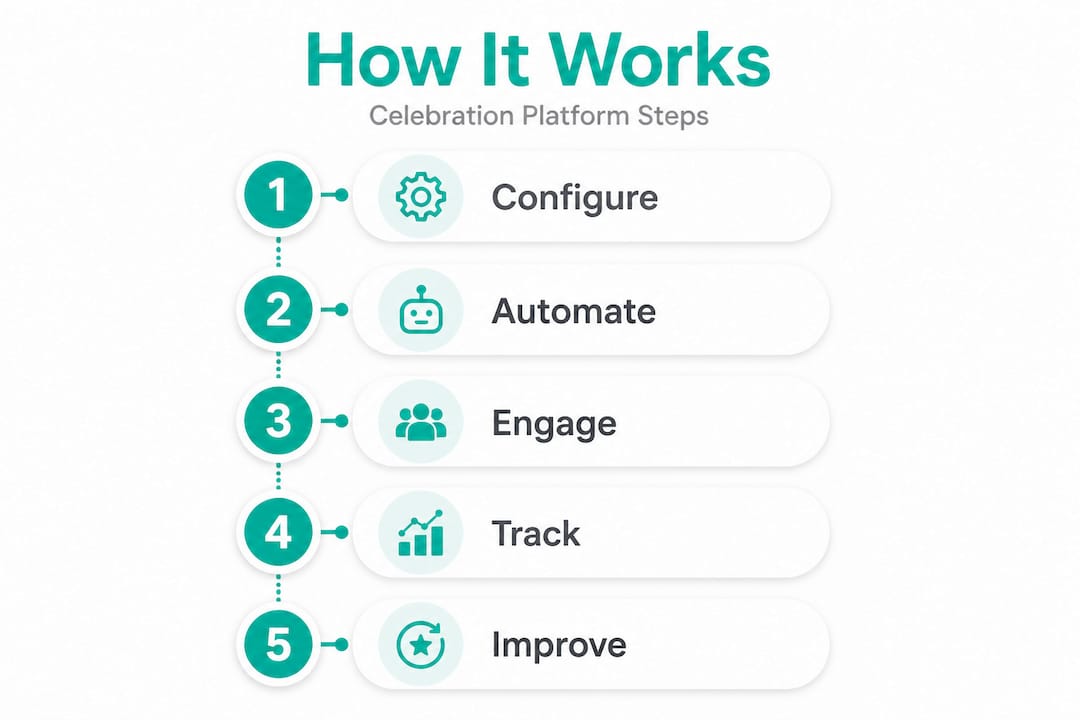
Administrators create recognition programs and employees can then select a program and send recognitions. Employees can send reward points, post congratulatory messages that others can see, and react on their dashboards. That social layer is what transforms a private "nice job" email into a public moment of celebration.
Here is a typical workflow inside a celebration platform:
- Admin setup: HR configures programs, sets eligibility rules, and defines award types and point budgets.
- Employee nomination: A colleague selects a recognition program and submits a nomination with a personalized message.
- Approval routing: Depending on the program, the nomination may route to a manager or HR for review.
- Public timeline record: Once approved, the recognition appears on the employee's timeline where peers can view, react, and add comments.
- Reward fulfillment: Points or awards are credited to the recipient's account for redemption.
| Stage | Who acts | What happens |
|---|---|---|
| Program configuration | HR admin | Sets rules, budgets, eligibility |
| Nomination | Any employee | Writes message, selects program |
| Approval | Manager or HR | Reviews and approves or returns |
| Timeline posting | System | Auto-publishes to employee record |
| Reward credit | System | Points or award delivered |
For step-by-step planning of specific events like birthdays or work anniversaries, platforms also support automated milestone triggers that fire reminders or even pre-written messages without any manual input. That automation is where HR teams save the most time.
Pro Tip: Automate recurring milestones like work anniversaries and birthdays from day one. Manual tracking of these events across a 500-person company is a full-time job. Automation frees your team to focus on the quality of recognition, not the logistics. You can also use automation to handle managing birthday wishlists and group gift coordination without a single email thread.
Peer visibility and inclusivity: Modern celebration software for all teams
With the technical process laid out, let's look at the human side: the features that drive real engagement and inclusion.
One of the most underappreciated aspects of celebration software is what it does for peer recognition. Manager-driven recognition is valuable, but it has a ceiling. A manager can only see so much. Peer-to-peer recognition, on the other hand, captures the everyday moments of collaboration, support, and creativity that managers often miss entirely.

Peer visibility and peer-to-peer recognition are repeatedly positioned as critical for distributed and manager-limited environments. Recognition programs that deliberately emphasize tools allowing anyone to celebrate anyone, within policy and eligibility rules, consistently outperform those that restrict recognition to the management layer.
Key features that support inclusivity and peer recognition include:
- Open nomination: Any employee can nominate any colleague, not just their direct reports.
- Social feed: A visible, scrollable feed of recent recognitions that keeps celebration front and center in the daily work experience.
- Reactions and comments: Peers can amplify a recognition by adding their own reactions, creating a ripple effect of visibility.
- Cross-team visibility: Recognitions are visible across departments, breaking down silos and helping employees discover colleagues they've never worked with directly.
- Milestone alerts: Automated notifications remind the whole team when someone hits a major anniversary or personal milestone.
"The most powerful recognition programs are the ones where a junior employee can publicly celebrate a senior colleague's contribution, and vice versa. That bidirectional visibility changes the culture."
For remote-first or hybrid teams, these features are not optional extras. They are the primary mechanism for maintaining a sense of community. When people work in different time zones and rarely share physical space, a public social feed of celebrations is one of the few touchpoints that reminds everyone they belong to the same organization.
Explore the full range of types of celebration events that work well across in-person, hybrid, and fully remote environments. And if you're managing a large team, coordinating group recognition at scale becomes far more manageable with the right platform structure in place.
Pro Tip: Actively encourage cross-departmental nominations during quarterly culture pushes. When engineering celebrates a win from the marketing team, it signals to the whole organization that collaboration across boundaries is valued, not just performance within a silo.
AI, analytics, and integrations: Taking recognition to the next level
Beyond the essentials, some solutions are reshaping how organizations understand and elevate employee engagement.
AI-powered recognition platforms can do something human managers simply cannot: analyze recognition patterns across thousands of employees simultaneously and flag who is being consistently overlooked. That is not a minor feature. It is a structural fix for one of the most persistent fairness problems in large organizations.
Workday and Achievers launched AI-powered recognition and rewards to provide a continuous record of contributions, helping more employees' work be visible and recognized. That continuous record is the key phrase. It means no contribution disappears into the void, and no employee goes six months without acknowledgment because their manager was too busy.
Analytics dashboards in modern platforms typically surface:
- Recognition frequency by team or department: Which groups are celebrating each other regularly, and which are silent?
- Demographic equity reports: Are recognition rates consistent across gender, tenure, and location?
- Top contributors: Who is sending the most nominations, and are they being recognized in return?
- Engagement hotspots: Which recognition programs drive the most participation and reaction?
| Feature | Traditional software | AI-powered software |
|---|---|---|
| Recognition tracking | Manual logs | Automated, continuous record |
| Equity monitoring | Not available | Flags underrecognized groups |
| Contributor insights | Basic counts | Pattern analysis and recommendations |
| Integration depth | Limited | Full HRIS sync and workflow automation |
| Personalization | Generic templates | AI-suggested messages and timing |
For HR teams thinking about modern team recognition strategy, the analytics layer is where the real strategic value lives. It turns celebration from a feel-good activity into a measurable input for retention and engagement planning. Combined with corporate celebration tools that integrate with your broader HRIS, you get a complete picture of how recognition connects to performance, tenure, and turnover risk.
Practical tips for HR: Maximizing ROI with celebration software
Having seen the most advanced features, let's focus on what you can do right now to maximize impact with any celebration platform.
The biggest mistake HR teams make is launching a recognition platform without a clear strategy behind it. The software is only as good as the program design. Here is a practical framework for getting it right:
- Define your objectives first. Are you trying to reduce turnover, strengthen cross-team collaboration, or make remote employees feel more included? Your goal shapes which features you prioritize and how you measure success.
- Communicate eligibility clearly. Employees who don't understand the rules either don't participate or feel frustrated when nominations are declined. A simple one-page guide distributed at launch prevents most confusion.
- Monitor analytics monthly, not quarterly. Recognition trends shift quickly. Catching a department that has gone silent for three weeks is far easier to address than one that has been disengaged for three months.
- Reward authentic nominations, not volume. Some employees will game any points-based system. Watch for recognition inflation: a flood of low-effort nominations that dilute the meaning of the program. Encourage specificity in nomination messages.
- Celebrate the overlooked milestones. Work anniversaries, project completions, and professional development achievements often get skipped in favor of birthdays. Recognition and awards appear as a visible record on employees' timelines, so every milestone you capture becomes a permanent part of their work history.
For a broader view of how recognition fits into your event calendar, the employee engagement event guide offers a practical framework for connecting individual celebrations to company-wide engagement initiatives. And if you're looking for fresh inspiration, creative celebration ideas for remote and hybrid teams can spark new program concepts that go beyond the standard birthday card.
Pro Tip: Use your platform's automation to schedule recognition for milestones that are easy to forget, like the two-year anniversary of a remote employee who joined during a chaotic onboarding period. Those are often the people who feel least connected, and a well-timed automated message can genuinely change how they feel about the organization.
What most guides miss: The real cultural ROI of celebration software
It is easy to get caught up in feature comparisons and integrations. But the real return on investment from celebration software is not measured in points redeemed or nominations submitted. It is measured in how employees talk about their workplace when no one from HR is listening.
The platforms that consistently deliver the strongest cultural outcomes share one design philosophy: they make peer-driven visibility the center of the experience, not a side feature. When any employee can celebrate any colleague, and that celebration is visible to the whole organization, it creates a fundamentally different social contract. People start paying attention to each other's work in a way that manager-only recognition never produces.
There is also a real risk that most implementation guides ignore: recognition inflation. When programs are poorly designed or incentivize volume over authenticity, the nominations become noise. Employees stop reading them. The social feed becomes a wall of generic "great job" messages that carry no emotional weight. The fix is not more features. It is intentional program design that rewards specificity and meaning over quantity.
Another overlooked dimension is demographic equity. Analytics can reveal uncomfortable truths: that employees in certain departments, at certain tenure levels, or in certain demographic groups receive significantly less recognition than their peers. That data is not just interesting. It is actionable. HR teams that use it to actively correct imbalances are organizing team celebrations in a way that actually strengthens inclusion rather than just performing it.
The bottom line: celebration software works best when HR treats it as a culture infrastructure investment, not a communication tool. The features matter. The design matters more. And the intention behind the program matters most of all.
Explore next-level celebration solutions for your organization
If you're ready to put these insights into practice, the right platform can be a genuine turning point for your team culture.
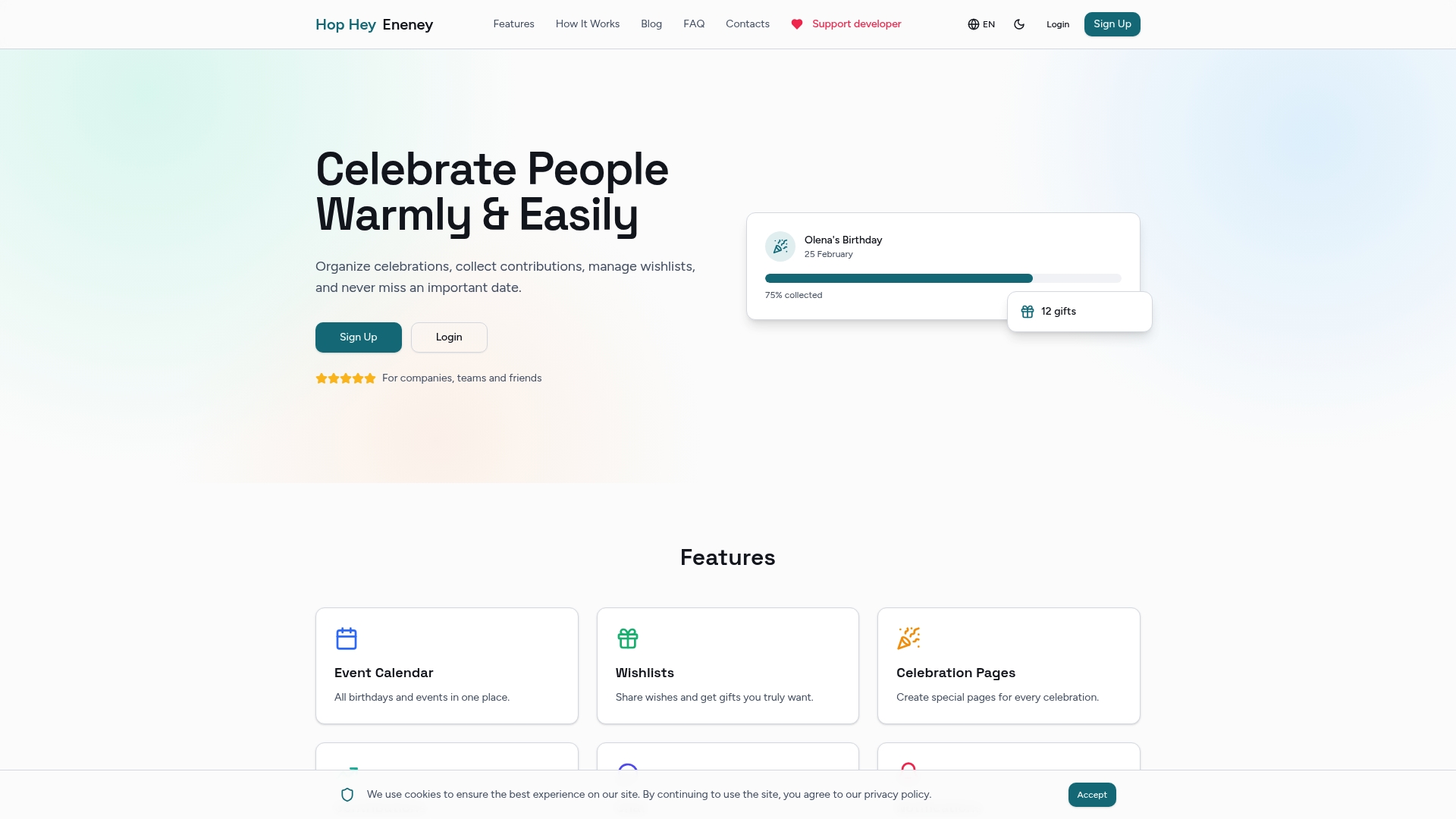
Hop Hey Eneney is built for exactly this challenge. The platform gives HR teams and team leaders a structured, intuitive way to organize celebrations, coordinate group gift contributions, manage wishlists, and communicate privately without spoiling the surprise. With automated reminders, multi-currency support, Telegram notifications, and real-time contribution tracking, every milestone gets the attention it deserves without adding to your team's workload. Whether you're managing a 50-person team or a 5,000-person organization, Hop Hey scales to fit your structure. Contact Hop Hey to learn how the platform can support your recognition programs and celebration planning from day one.
Frequently asked questions
What key features should HR look for in celebration software?
Essential features include configurable recognition programs, visible records on employee timelines, peer-to-peer nomination, approval workflows, and integration with HR systems. Award programs should appear on employee timelines and support an approval process before going public.
How does AI improve celebration and recognition platforms?
AI helps spotlight top contributors, analyzes participation patterns, and enables continuous, unbiased visibility across the workforce. AI-powered recognition creates a continuous record of contributions so no employee's work goes unseen.
Can celebration software help remote teams stay engaged?
Yes, especially with platforms that prioritize peer-to-peer visibility and inclusivity. Peer-to-peer recognition is specifically designed for distributed environments where manager visibility is limited.
Is it difficult to integrate celebration software with existing HR tools?
Most modern platforms offer native integrations with major HRIS systems, making implementation straightforward and enabling recognition to flow seamlessly within existing HR workflows.
Recommended
- Team celebration: boost engagement and recognition in 2026
- Why organize team celebrations: boost engagement 1.5%
- Types of celebration events for engaged teams: a guide
- Group celebration coordination: Streamline team recognition
- How to Boost Member Engagement and Why use Engagement Software|CS
- How to Boost Employee Engagement - Inspire Wellness