
TL;DR:
- Choosing the right celebration format aligns with business goals and enhances employee engagement.
- Frequent, personalized recognition surpasses large events in impact and cost-effectiveness.
- Using the right infrastructure streamlines celebration efforts and fosters an inclusive, authentic culture.
Choosing the wrong celebration format is one of the most common and costly mistakes HR teams make. When events feel generic or misaligned with what employees actually value, they quietly signal that recognition is performative rather than genuine. Recognition reduces turnover by 31%, and engaged teams report 23% higher profitability and 18% higher productivity. Those numbers make event selection a strategic decision, not just a logistics task. This guide walks you through how to choose the right celebration format, the major event types available to you, how they compare on cost and impact, and what separates forgettable events from ones that actually move the needle on culture.
Table of Contents
- How to choose the right celebration format
- Main types of celebration events (with examples))
- Comparison of event types: Impact, cost, and inclusivity
- Expert best practices for successful events
- Rethinking celebration events: What actually moves the needle?
- Make celebrations effortless with the right platform
- Frequently asked questions
Key Takeaways
| Point | Details |
|---|---|
| Match events to goals | Select celebration types that align with team objectives and company values for the highest impact. |
| Diverse formats matter | Use a mix of event types and delivery methods to engage different employee groups, including remote staff. |
| Measure and adapt | Track outcomes with data and feedback to refine future events and maximize engagement ROI. |
| Prioritize inclusion | Ensure celebrations are accessible and meaningful for all team members, not just a select few. |
How to choose the right celebration format
Before you book a venue or send a calendar invite, you need a clear framework. The format you choose should map directly to a business objective, whether that is improving retention, marking a milestone, building cross-functional relationships, or simply boosting day-to-day morale. Without that anchor, you end up with events that feel nice in the moment but leave no lasting impression.
Start with your objectives. Ask yourself: is this event meant to recognize individual achievement, celebrate a team win, or simply create connection? Each goal calls for a different format. A peer-to-peer recognition moment needs a different structure than a company-wide anniversary party.
Next, budget with intention. A practical way to think about this is in tiers:
- Tier 1 (under $50 per person): Digital shout-outs, team lunches, virtual trivia, peer recognition cards
- Tier 2 ($50 to $200 per person): Catered team dinners, escape rooms, curated gift boxes, hybrid happy hours
- Tier 3 ($200+ per person): Off-site retreats, large milestone galas, multi-day team experiences
As outlined in corporate event planning best practices, the most effective programs use SMART goals, clear budget tiers, and hybrid inclusivity to serve modern, distributed teams.
Inclusivity is non-negotiable. Remote employees, deskless workers, and globally distributed teams should never feel like afterthoughts. Design events that work across time zones, languages, and physical locations.
Use the AIR framework to structure recognition: Action (what the person did), Impact (how it affected the team or company), and Reward (how you celebrate it). This keeps recognition specific and meaningful rather than vague.
Finally, measure what you do. Use employee Net Promoter Score surveys, post-event feedback, and engagement benchmarks to understand what worked. For deeper guidance on celebration planning for HR, a structured approach makes all the difference.
Pro Tip: Map every event choice to at least one core company value. When employees can connect a celebration to something the organization genuinely stands for, engagement becomes authentic rather than obligatory.
Main types of celebration events (with examples)
Not all celebration events are created equal. Each type serves a distinct purpose and works best in specific contexts. Here is a breakdown of the most impactful formats, with real examples and usage scenarios.
- Appreciation and recognition events: Spotlights, awards ceremonies, peer-to-peer shout-outs, and handwritten notes. Best for reinforcing positive behavior regularly.
- Milestone events: Work anniversaries, promotions, hitting major KPIs. These call for personalized gifts and public acknowledgment.
- Team-building events: Escape rooms, cooking classes, outdoor outings. Focus on collaboration and breaking down silos.
- Wellness events: Yoga sessions, fitness challenges, lunch-and-learns on mental health. These signal that the company cares about the whole person.
- Volunteer and CSR events: Charity drives, community service days. These attract purpose-driven employees and strengthen brand values.
- Holiday and end-of-year events: Themed parties, cross-team lunches, gift exchanges. High visibility, high energy, but require careful cultural sensitivity.
- Virtual and hybrid events: Online trivia, digital recognition boards, hybrid happy hours. Essential for distributed teams. Explore party planning tips for remote-friendly ideas.
- Innovation and learning events: Hackathons, skill workshops, internal conferences. These celebrate intellectual contribution and growth.
According to top employee appreciation research, the most effective programs rotate across these categories to prevent fatigue and keep participation high. You can also review the benefits of team celebrations to understand why variety matters so much.
| Event type | Sample format | Ideal group size | Cost tier |
|---|---|---|---|
| Recognition | Awards, shout-outs | Any | Tier 1 |
| Milestone | Anniversary gifts | 1 to 20 | Tier 2 |
| Team-building | Escape room | 10 to 50 | Tier 2 |
| Wellness | Yoga, fitness challenge | Any | Tier 1 |
| Volunteer/CSR | Community service day | 20 to 100 | Tier 1 |
| Holiday | End-of-year party | 20 to 200 | Tier 2 to 3 |
| Virtual/hybrid | Online trivia | Any | Tier 1 |
| Innovation | Hackathon | 10 to 80 | Tier 2 |
For teams celebrating individual moments like birthdays, work birthday planning adds a personal layer that generic events simply cannot replicate.

Pro Tip: Rotate event types quarterly. Employees who experience the same format repeatedly disengage faster than those who encounter fresh, varied experiences.
Comparison of event types: Impact, cost, and inclusivity
Knowing your options is one thing. Knowing which option fits your team's specific situation is another. This comparison gives you a practical lens for evaluating each format.
| Event type | Engagement impact | Cost | Remote-friendly | Inclusivity score |
|---|---|---|---|---|
| Recognition | Very high | Low | Yes | High |
| Milestone | High | Medium | Partial | Medium |
| Team-building | High | Medium | Partial | Medium |
| Wellness | Medium | Low to medium | Yes | High |
| Volunteer/CSR | Medium to high | Low | No | Low |
| Holiday | Medium | Medium to high | Partial | Medium |
| Virtual/hybrid | Medium to high | Low | Yes | Very high |
| Innovation | High | Medium | Yes | High |
Virtual and recognition-based events consistently score highest on inclusivity because they work regardless of location or physical ability. Volunteer and in-person team-building events, while powerful for culture, tend to exclude remote or deskless workers unless you build in digital alternatives.
Common pitfalls to avoid:
- Tokenism: A generic gift card with no personal message signals indifference, not appreciation
- Cultural blind spots: Alcohol-centric events or holiday parties tied to specific traditions can alienate diverse teams
- Over-celebration: When every minor task gets a trophy, genuine milestones lose their weight
- Selective recognition: Celebrating only top performers while ignoring support roles breeds resentment
For inclusive event planning at scale, role-based flexibility and cultural awareness are the two factors most often overlooked. You can also improve personalization by using workplace birthday wishlists to make individual recognition feel genuinely thoughtful.
The data is clear: recognition linked to 45% lower turnover and 23% higher profitability according to Gallup. That return makes even modest investment in structured recognition programs financially defensible to any executive team.
Expert best practices for successful events
Having a shortlist of event types is a starting point. Executing them well is where most organizations stumble. Here is a step-by-step process that works for mid to large companies.
- Set clear goals before anything else. Define what success looks like. Is it a 10-point eNPS increase? A 15% improvement in retention among a specific department? Vague goals produce vague results.
- Align events with company values. Every celebration should reinforce something the organization genuinely believes in. If innovation is a core value, a hackathon carries more weight than a generic pizza party.
- Choose the right technology. Scalable recognition platforms enable data-driven event impact tracking and hybrid inclusivity, making them essential for distributed teams in 2026.
- Ensure full inclusivity. Design for your most constrained participant first, whether that is a remote employee in a different time zone or a deskless worker without regular computer access.
- Collect feedback every time. Post-event surveys should be short, three to five questions maximum, and results should be shared with the team. Transparency builds trust.
"70% of the variance in team engagement is attributable to the manager." This means leadership training and manager involvement in recognition are not optional extras. They are the foundation.
Embed recognition into your regular workflow rather than treating it as a standalone event. Weekly shout-outs, monthly peer nominations, and quarterly milestone reviews create a culture where appreciation is constant, not occasional. For practical guidance on office event organization and birthday list tools that support ongoing recognition, the right infrastructure makes consistency effortless.
Measure impact by comparing pre-event and post-event data across eNPS, voluntary turnover, and productivity metrics. Over time, this data builds the business case for continued investment in celebration programs.
Rethinking celebration events: What actually moves the needle?
Here is the uncomfortable truth most event planning guides skip over: a single elaborate annual party does far less for engagement than a consistent rhythm of small, genuine recognition moments throughout the year. Companies spend enormous budgets on end-of-year galas while ignoring the Tuesday afternoon when a team member shipped something remarkable and heard nothing.
Frequent, personalized recognition outperforms big-ticket events every time. It does not need to be expensive. It needs to be timely, specific, and tied to something real.
Hybrid teams have made this even more complex. The employee joining a celebration via video call while everyone else is in the same room is not having the same experience. Designing for that person first, not as an afterthought, is what separates inclusive cultures from performative ones.
There is also a pattern worth naming: selective recognition. When only high-visibility roles get celebrated, the people doing essential but less glamorous work notice. That quiet resentment is a retention risk hiding in plain sight.
"Recognition drives engagement eight times more than salary increases."
For a deeper look at how gift exchange culture shapes team dynamics, the research consistently points to meaning over magnitude. The most memorable recognition moments are rarely the most expensive ones.
Make celebrations effortless with the right platform
Ready to implement the best event strategies for your team? The gap between knowing what works and actually executing it consistently is usually an infrastructure problem, not a motivation problem.
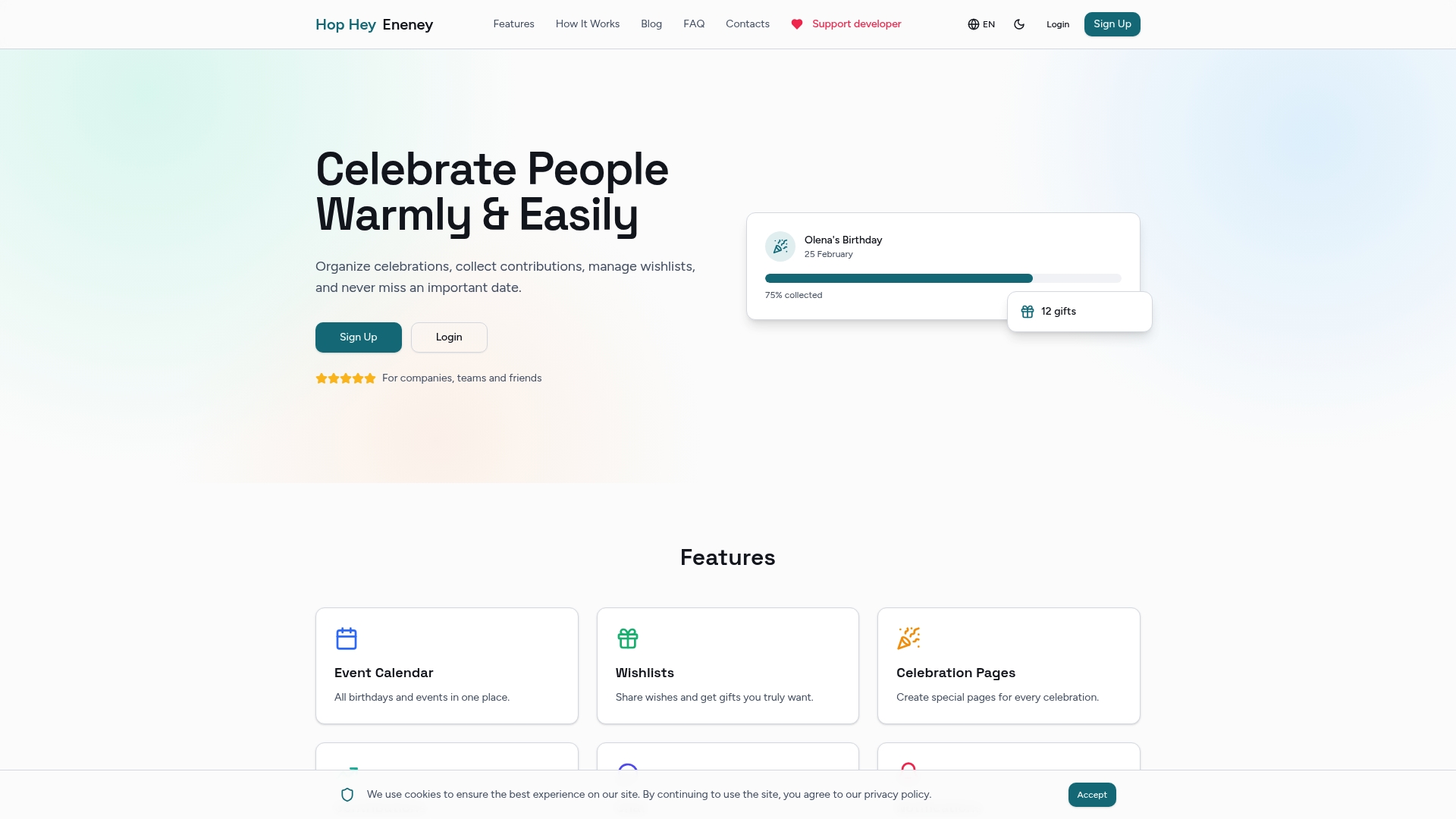
Hop Hey Eneney gives HR teams and team leads a single platform to centralize recognition, automate event reminders, coordinate gift contributions transparently, and support both remote and in-person employees without the usual administrative chaos. You can track participation, manage wishlists, run private celebration pages, and measure engagement all in one place. For mid to large companies that want to build a genuine culture of recognition without drowning in spreadsheets and group chats, it is the structural backbone your celebration program needs.
Frequently asked questions
What are the most effective types of celebration events for remote teams?
Virtual events such as online trivia, digital recognition boards, and remote-friendly awards ensure consistent engagement across locations and time zones.
How can I measure the impact of our celebration events?
Track participation rates, eNPS, engagement surveys, and voluntary turnover before and after events. Pre and post measurement gives you the clearest picture of actual impact.
What budget should I plan for employee celebration events?
Budget tiers range from under $50 per person for digital recognition to over $200 per person for off-site retreats, with strong options available at every level.
Why is ongoing recognition better than one-off celebrations?
Frequent, personalized recognition reduces turnover by 31% and produces stronger long-term engagement than annual or infrequent events.
How do I avoid tokenism or fatigue in team celebrations?
Balance event variety, personalize recognition to real achievements, and avoid over-celebrating minor tasks so that meaningful milestones retain their impact.