
Office gift exchanges sound like a fun, low-stakes tradition. But 56% of employees feel pressured to give gifts at work, and nearly half say it strains their finances. That gap between intention and experience is exactly where HR managers need to step in. This guide gives you a practical, evidence-based framework for running gift exchanges that actually build culture instead of creating stress. Whether you manage a team of 20 or 2,000, the principles here will help you design something people genuinely look forward to.
Table of Contents
- Why organize workplace gift exchanges?
- Main types and mechanics of office gift exchanges
- Policies, budgets, and inclusivity: what HR managers need to know
- Managing risks, boundaries, and HR liabilities
- How to maximize culture and engagement with gift exchanges
- Streamline your workplace gift exchanges with Hop Hey Eneney
- Frequently asked questions
Key Takeaways
| Point | Details |
|---|---|
| Set clear policies | Establish transparent rules, opt-outs, and boundaries to ensure fair participation. |
| Prioritize inclusivity | Choose neutral themes, ban allergens, and embrace diversity to maximize engagement. |
| Monitor budgets and tax | Control spending, treat gift cards properly, and document policies to avoid legal or HR issues. |
| Train and communicate | Educate teams on rules and values to minimize risk and improve participation. |
Why organize workplace gift exchanges?
Gift exchanges are not just a holiday tradition. When done right, they serve a real organizational purpose. They create shared experiences, signal that the company values its people, and give colleagues a low-pressure reason to connect outside of project deadlines.
The benefits are real. Boosting team culture through structured events like gift exchanges can improve morale, reduce turnover signals, and reinforce company values in a tangible way. Teams that celebrate together tend to communicate better and trust each other more.
But the risks are just as real. Gift exchanges can create pressure, financial strain, and feelings of exclusion if not managed carefully. Here is what the data says:
"56% of employees feel pressured to give gifts at work, and 46% say it hurts their wallet. For HR managers, ignoring these numbers is not an option."
The key benefits of a well-run gift exchange include:
- Stronger peer relationships across departments
- Increased sense of belonging and team identity
- A visible signal that leadership invests in employee experience
- Opportunities to reinforce inclusive, values-driven culture
For more ideas on engagement and culture tips, it helps to think of gift exchanges as one tool in a broader celebration strategy.
Main types and mechanics of office gift exchanges
Not all gift exchanges work the same way. The format you choose shapes the entire experience, from how much people spend to how much fun they actually have.
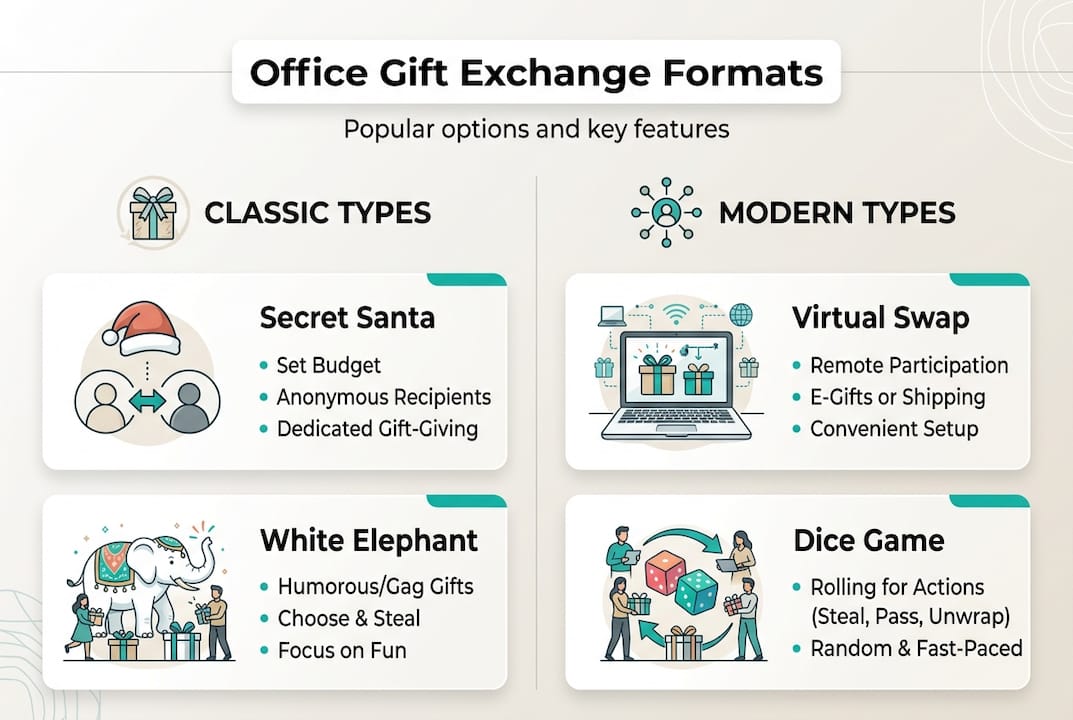
Common mechanics for office gift exchanges include White Elephant, Secret Santa, dice games, and virtual adaptations for remote teams. Each has its own strengths depending on your group size, budget, and culture.
Here is a quick comparison to help you choose:
| Format | Best group size | Anonymity | Budget control | Remote-friendly |
|---|---|---|---|---|
| Secret Santa | 10 to 50 | Yes | Easy | Yes |
| White Elephant | 10 to 30 | No | Moderate | Possible |
| Dice game | 15 to 40 | No | Easy | Limited |
| Musical gifts | 20 or more | No | Easy | No |
| Virtual exchange | Any size | Optional | Easy | Yes |
For large or distributed teams, virtual gift exchanges are increasingly the go-to option. Employees ship gifts directly to each other or use digital gift cards, keeping everyone included regardless of location.
Pro Tip: Always send written rules to participants at least one week before the event. Ambiguity about stealing rules in White Elephant or spending limits in Secret Santa is the number one cause of awkward moments.
Policies, budgets, and inclusivity: what HR managers need to know
Once you pick a format, the real work begins. Clear policies protect everyone and make the experience fair.
Start with participation. Voluntary participation is non-negotiable. Employees should never feel coerced into joining, and opting out should carry zero social penalty. Make this explicit in your communications.
Budgets matter more than most HR teams realize. A suggested range of $15 to $30 per person keeps things equitable across salary levels. Going higher risks making lower-paid employees uncomfortable. Going lower can feel dismissive. Monitor for outliers and address overspending privately.

Here is a quick reference for common policy decisions:
| Policy area | Recommended approach |
|---|---|
| Participation | Voluntary only, no pressure |
| Budget range | $15 to $30 per person |
| Allergens | Ban nuts, gluten items by default |
| Alcohol | Prohibited unless explicitly approved |
| Gag gifts | Prohibited in professional settings |
| Regifting | Discouraged, address in writing |
| Gift cards | Treat as taxable wages |
On the tax side, gift cards are taxable as wages regardless of amount. Non-cash gifts under $100 may qualify as de minimis and avoid taxation, but gift cards never qualify. This is a common mistake that creates payroll headaches.
For building a workplace wishlists guide into your process, consider letting employees share preferences in advance. It reduces the chance of inappropriate or unwanted gifts.
Here are the core best practices every HR team should follow:
- Make participation explicitly voluntary in all communications
- Set a clear, written budget range before sign-ups open
- Publish a banned items list covering allergens, alcohol, and offensive content
- Use inclusive, neutral themes that respect all cultural and religious backgrounds
- Designate a point of contact for questions or concerns
- Follow SHRM-aligned gift policies for documentation and equity monitoring
Pro Tip: If you manage a large team, use a shared spreadsheet or platform to track who has signed up, their budget tier, and any stated preferences or restrictions. It takes 20 minutes to set up and saves hours of back-and-forth.
Managing risks, boundaries, and HR liabilities
Even well-intentioned gift exchanges can go sideways. HR managers need to anticipate problems before they happen.
The most common risks include:
- Exclusion of remote or part-time employees who are left out of in-person exchanges
- Inappropriate gifts that cross professional boundaries or offend recipients
- Financial pressure on lower-paid staff who feel they must match higher earners
- Favoritism when managers give noticeably more expensive gifts to certain team members
- Harassment claims stemming from gifts that are personal, suggestive, or culturally insensitive
Pressure, favoritism, and exclusion are the three most cited HR liabilities in workplace gift exchange contexts. Each one is preventable with the right structure.
"The goal is not to eliminate fun. It is to create conditions where everyone can participate safely and comfortably. That requires intentional design, not just good intentions."
Professional boundaries and inclusivity are your best tools here. Train managers on what appropriate gift-giving looks like. Make opt-out easy and stigma-free. Use anonymous formats like Secret Santa to reduce favoritism. And always have a clear escalation path if someone receives something inappropriate.
For a broader look at celebration planning in the workplace, risk management is always part of the picture. The same applies to party planning tips for any team event.
How to maximize culture and engagement with gift exchanges
Once your policies are solid and your risks are managed, you can focus on making the exchange genuinely enjoyable. This is where HR managers can have real creative impact.
Gift exchanges strengthen company culture most effectively when they reflect the team's actual values and diversity. A generic holiday theme works, but a theme tied to your company's mission or a shared team experience lands much better.
Here are practical ways to boost engagement:
- Use a neutral theme like "things that bring you joy" instead of holiday-specific framing
- Celebrate the exchange publicly with a short team moment, even if it is virtual
- Recognize contributors who helped organize the event, not just the recipients
- Collect feedback after every exchange with a simple two-question survey
- Rotate organizers each year to keep ideas fresh and distribute the labor
- Include remote employees by default, not as an afterthought
For office event organization at scale, consistency matters. Teams that run structured, well-communicated exchanges year after year build a culture of celebration that new hires notice immediately.
Pro Tip: After the exchange, send a short recap to the whole team. Highlight funny moments, thank organizers by name, and share one or two photos if people consented. It extends the positive energy and signals that leadership pays attention.
For team engagement tips that go beyond gift exchanges, think about how celebrations connect to your broader recognition strategy. And if you want employees to actually enjoy the process, let them share preferences through building workplace wishlists before the exchange begins.
Streamline your workplace gift exchanges with Hop Hey Eneney
Running a fair, inclusive, and memorable gift exchange takes real coordination. Tracking who signed up, managing budgets, collecting preferences, and keeping the surprise intact is a lot to juggle in a spreadsheet.
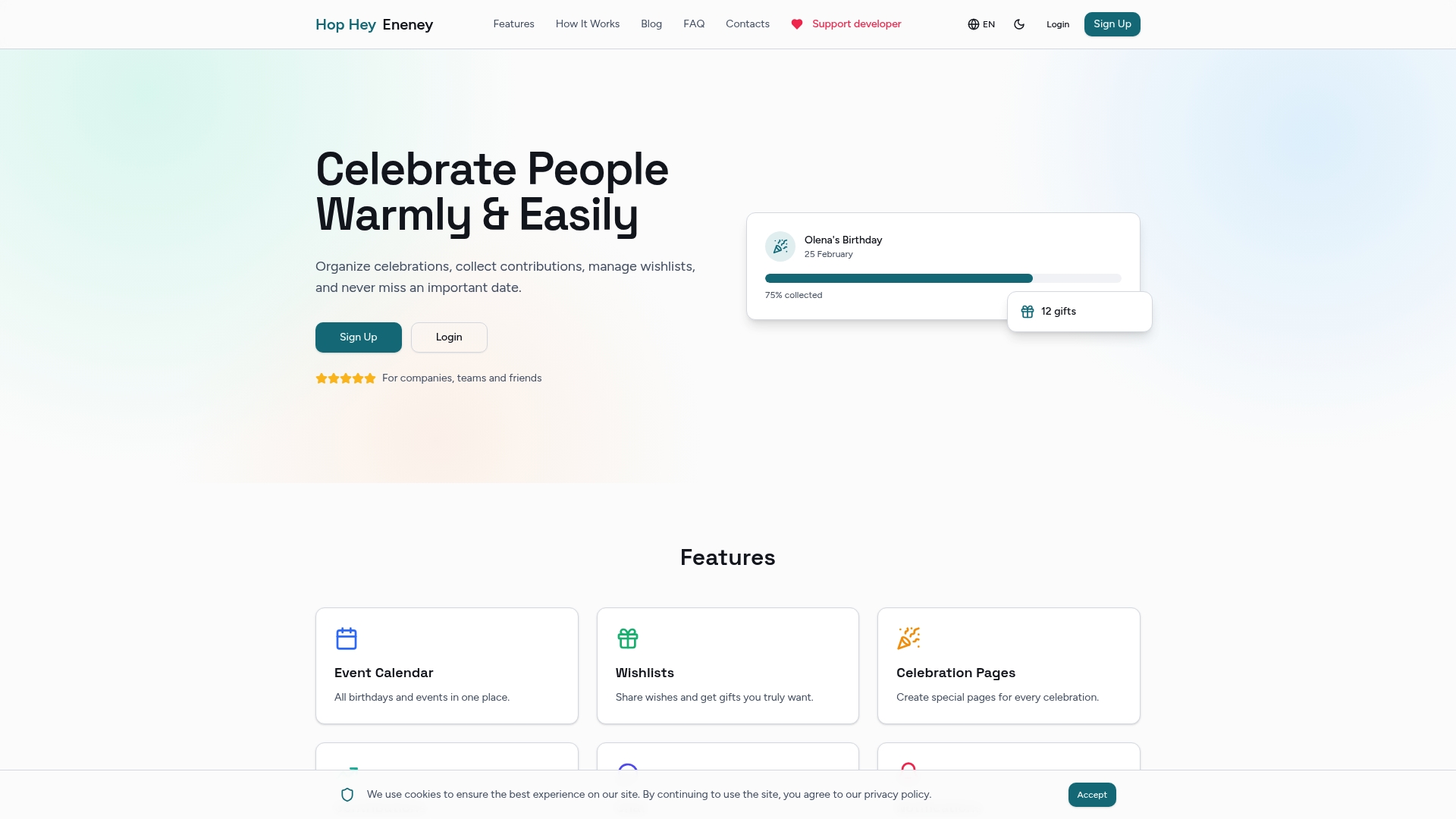
Hop Hey Eneney is a company celebration platform built specifically for this kind of work. It lets HR managers create private event pages, collect contributions transparently, manage wishlists, and coordinate everything in one place without the back-and-forth emails. The platform supports opt-in participation, customizable rules, and automated reminders so nothing falls through the cracks. For hybrid and remote teams, it works just as well as for in-person groups. Explore the solutions for HR teams and see how much simpler your next gift exchange can be.
Frequently asked questions
What is the best format for a workplace gift exchange?
White Elephant and Secret Santa are the most popular office gift exchange formats because they scale easily and work for both in-person and remote teams.
How should HR set budgets for gift exchanges?
A budget of $15 to $30 per person is the standard range, keeping the exchange equitable across different salary levels without putting pressure on lower-paid employees.
Are workplace gift cards or cash gifts taxable?
Gift cards are taxable as wages regardless of amount. Non-cash gifts under $100 may qualify as de minimis, but gift cards are never exempt from this rule.
How can gift exchanges be made inclusive?
Use neutral themes, make participation voluntary, and publish a clear banned items list that covers allergens and offensive gifts before sign-ups open.