
Most team parties are well-intentioned but poorly planned. Someone books a venue, orders food, and calls it a celebration. The result? A forgettable afternoon that does nothing for morale, connection, or retention. Strategic planning with clear goals consistently outperforms ad-hoc events, yet most organizations still treat team parties as an afterthought. This guide gives HR managers and team leaders a practical, research-backed framework to plan team celebrations that actually move the needle on culture, engagement, and retention.
Table of Contents
- Essential criteria for successful team parties
- Timeline, budget, and compliance essentials
- Top team party ideas and activity picks
- Ensuring inclusion, recognition, and lasting impact
- Measuring ROI and sustaining team engagement
- Bring your team parties to the next level
- Frequently asked questions
Key Takeaways
| Point | Details |
|---|---|
| Strategic planning matters | Teams achieve better results and retention with clear event goals, a set budget, and a committee. |
| Plan ahead based on size | Timeline and budget scale with organization size for smooth execution and compliance. |
| Prioritize fun and recognition | Engagement and culture thrive when events focus on fun, inclusion, and meaningful recognition. |
| Measure for continuous improvement | Track participation, feedback, and impact to refine and maximize future team celebrations. |
Essential criteria for successful team parties
Before you book anything, you need a clear answer to one question: what is this event supposed to accomplish? Recognition? Onboarding new hires into the culture? Celebrating a major milestone? The answer shapes every decision that follows, from venue to activities to budget.
Start by defining your event objectives in writing. Engagement, recognition, cultural reinforcement, and team bonding are all valid goals, but they require different approaches. A recognition-focused event needs structured moments where individuals are called out publicly. A bonding event needs unstructured time and shared challenges. Knowing the difference saves money and prevents disappointment.
Next, set a realistic budget based on company size and strategic intent. Budget decisions made in isolation from goals almost always result in overspending on the wrong things. Pair your budget with a diverse planning committee of people who represent different departments, backgrounds, and working styles. Include HR and legal input early, especially for events involving alcohol, off-site venues, or sensitive cultural moments.
Building inclusivity into your criteria from the start is non-negotiable. That means considering dietary restrictions, accessibility needs, time zones for remote workers, and religious or cultural observances. Celebration planning for HR requires thinking about who might feel excluded before the event, not after.
Companies investing in celebrations see 31% lower voluntary turnover, and replacing a single employee can cost 50 to 200% of their annual salary. That makes a well-planned party one of the highest-ROI investments in your HR toolkit.
- Define event objectives before any logistics decisions
- Set budget based on goals, not just headcount
- Form a diverse planning committee with HR and legal representation
- Build inclusivity criteria into the planning checklist from day one
- Align event themes with company values and current team priorities
Pro Tip: Schedule a 30-minute debrief session after every event. Ask the committee what worked, what fell flat, and what one change would make the next event better. This single habit compounds into dramatically better events over time.
Timeline, budget, and compliance essentials
Timing is everything in event planning. Start too late and you lose venue options, catering quality, and the ability to communicate effectively. The right lead time depends on your organization's size.
| Team size | Recommended lead time | Key focus areas |
|---|---|---|
| Small (25 or fewer) | 6 to 8 weeks | Venue, catering, invitations |
| Mid-size (50 to 150) | 10 to 12 weeks | Committee formation, vendor contracts |
| Large (200 or more) | 4 to 6 months | Compliance review, multi-site coordination |
For budget, typical corporate party spend runs $50 to $150 per person. Here is how that typically breaks down: food and beverage takes 35 to 40%, venue costs 25 to 30%, and entertainment accounts for 15 to 20%. The remaining budget covers communications, decorations, and contingency. If you are working with tighter constraints, explore budget-friendly celebration ideas that still deliver high perceived value.
Compliance is the area most planning committees underestimate. Follow this checklist to stay protected:
- Form a planning committee of 3 to 5 people, including at least one HR and one legal representative
- Review alcohol liability policies with legal before finalizing any venue or catering contract
- Confirm accessibility compliance for the venue, including mobility, hearing, and visual needs
- Send communications through official channels and have HR pre-approve all messaging
- Document all vendor agreements and keep copies in a shared HR folder
For timelines for office events, building a shared project tracker visible to all committee members eliminates the most common coordination failures.
Pro Tip: If your event includes alcohol, have HR draft a one-page policy statement that gets included in the event invitation. It sets expectations clearly and reduces liability without killing the mood.
Top team party ideas and activity picks
The best team party is one people actually want to attend. That sounds obvious, but many corporate events are designed around what is easy to organize rather than what employees genuinely enjoy.
73% of employees say their top goal for team events is fun and connection, not professional development or networking. The most popular activities are scavenger hunts and escape rooms, both of which create shared challenges that build trust naturally. Keep that in mind when you are tempted to fill the agenda with structured presentations.
Here is a curated list of high-impact activity formats:
- Scavenger hunts: Work for in-person and hybrid teams; build problem-solving and communication skills organically
- Escape rooms: High engagement, natural team bonding, available virtually and in-person
- Themed parties: Easy to scale, highly customizable to company culture and values
- Skill-building workshops: Best when tied to a team interest, like cooking, improv, or photography
- Virtual team games: Trivia, online game shows, and collaborative puzzles work well for remote teams
- Explore teambuilding activity ideas for formats that fit your team's specific dynamic
Team building ROI can reach 7.5x with smart planning. Virtual events average 12% higher ROI than in-person events and cost 75% less, making them a strong option for distributed teams.
"Fun is the number one driver of employee well-being." Great Place to Work research confirms that organizations prioritizing fun in the workplace see measurable improvements in culture scores and retention.
For hybrid teams, the key is choosing activities with a digital and physical version that run simultaneously. Avoid formats where remote participants are passive observers. They should be active contributors with the same ability to win, contribute, and connect. Learn more about how to boost team culture through events in both in-person and remote settings.
Ensuring inclusion, recognition, and lasting impact
Choosing great activities is only half the job. The other half is making sure every person in the room, or on the call, feels genuinely seen and valued. Recognition without personalization is just noise.

| Format | Inclusivity | Recognition potential | Lasting impact |
|---|---|---|---|
| In-person | High for local teams | Strong with structured moments | Moderate, fades quickly |
| Virtual | High for remote teams | Moderate, requires intentional design | High with recorded highlights |
| Hybrid | Requires deliberate design | Strong if both groups are equally featured | High with shared digital artifacts |
Practical tactics to make every celebration meaningful:
- Personalize recognition by calling out specific contributions, not just tenure or title
- Link activities back to company values explicitly during the event
- Use Employee Resource Groups (ERGs) to co-design events that reflect diverse perspectives
- Offer multiple participation modes so introverts and remote workers are not disadvantaged
- Follow up with a short post-event survey to capture honest feedback
Celebrating values, milestones, and DEI through ERGs is one of the most effective ways to strengthen culture authentically. ERGs bring lived experience to the planning table that a homogeneous committee simply cannot replicate.
High-quality recognition reduces turnover risk by 45% and engaged teams show 14% higher productivity. Those numbers make the case for investing in recognition techniques for teams that go beyond a generic gift card. For more on celebration tips for diverse teams, the approach is always the same: ask, listen, and design accordingly. Research on recognition impact on retention consistently shows that personalized acknowledgment outperforms generic rewards.
Measuring ROI and sustaining team engagement
A celebration's true value shows up in the data. Without measurement, you are guessing at what works and repeating the same mistakes with a bigger budget.
Team building ROI can reach 7.5x with intentional planning and follow-through. Virtual events consistently outperform in-person events on ROI by 12%. Those are not small margins. They are the difference between a party that costs money and one that generates it.
Here is a simple framework for measuring event impact:
- Pre-event baseline: Run a 3-question pulse survey on team connection, morale, and engagement before the event
- During the event: Track participation rates, activity completion, and any real-time feedback tools you use
- Post-event survey: Send within 48 hours while impressions are fresh; ask about inclusion, fun, and perceived value
- 30-day follow-up: Check engagement metrics, absenteeism, and any qualitative feedback from managers
- Retention analysis: At 90 days, compare turnover data against pre-event benchmarks to identify trends
For measuring event impact over time, build a simple dashboard that tracks these metrics across every event. Patterns emerge quickly and make budget conversations with leadership much easier.
Pro Tip: Share the results of your post-event survey with the whole team, not just leadership. Transparency about what you heard and what you plan to change builds trust and increases participation at the next event.
One warning: avoid over-celebrating. When every week has a themed event or recognition moment, the impact of each one drops sharply. Cadence matters. Quarterly signature events tend to outperform monthly low-effort ones in both engagement and memory.
Bring your team parties to the next level
Everything covered in this guide, from setting objectives to measuring ROI, requires coordination across people, timelines, and budgets. That coordination is where most HR teams lose time and energy. The right platform removes that friction entirely.
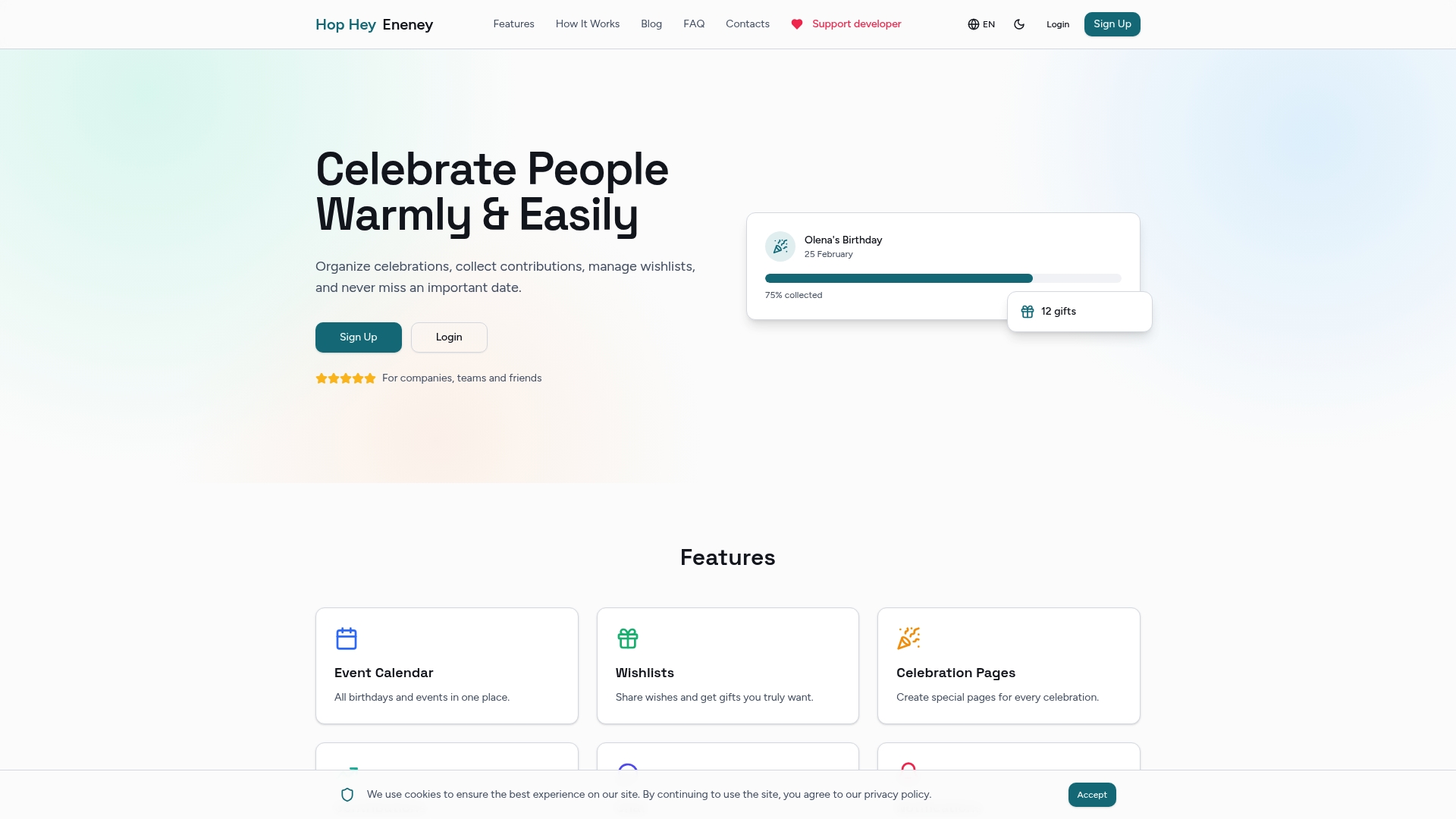
Hop Hey Eneney is built specifically for teams that want to run meaningful, inclusive celebrations without the chaos. The platform handles event calendar management, transparent gift fund collection, private team chat, and personalized wishlists in one place. HR managers can set up automated reminders, manage multi-currency contributions, and keep celebrations a surprise, all from a single dashboard. Explore solutions for team events designed for organizations of every size, or get in touch for a demo to see how it fits your team's workflow.
Frequently asked questions
How far in advance should we plan a team party?
Aim for 6 to 8 weeks for small teams, 10 to 12 weeks for mid-size groups, and 4 to 6 months for large organizations with complex logistics.
What is a typical per-person budget for a team event?
Most organizations allocate $50 to $150 per person, with food and beverage consistently being the largest single expense category.
What are the best team party activities for hybrid or remote teams?
Virtual team games, online escape rooms, and hybrid scavenger hunts work well. Virtual events produce 12% higher ROI than in-person formats and cost significantly less to run.
How can we make team parties more inclusive?
Involve a diverse planning committee with HR and legal representation, offer multiple participation modes, and recognize contributions from all team members, not just the most visible ones.
What KPIs should we track to measure the success of a team event?
Focus on employee engagement scores, retention rates, post-event survey feedback, and productivity metrics. Strategic events track ROI most effectively when baseline data is collected before the event, not after.
Recommended
- How to organize office events that boost team culture
- What is celebration planning: a guide for HR managers
- How to Organize a Birthday at Work
- Hop Hey Eneney — платформа для привітань та подарунків
- Boost team morale in Utah: strategies for leaders
- Teamevents steigern Motivation um 68% und Zusammenarbeit