
TL;DR:
- Effective employee recognition is timely, specific, inclusive, and aligned with individual values, fostering genuine appreciation.
- Successful programs combine formal awards, peer recognition, automated celebrations, and structured team events to meet diverse needs.
HR managers in mid and large companies face a real tension: recognition needs to feel personal, but it also needs to scale. When you're managing hundreds or thousands of employees across departments, time zones, and work setups, building a program that feels genuine rather than performative is genuinely hard. This guide breaks down the most effective employee recognition examples, compares them side by side, and gives you a practical framework for choosing what actually works for your team structure, budget, and culture goals.
Table of Contents
- How to define effective employee recognition
- Top examples of employee recognition in mid and large organizations
- Comparison table: Which recognition style suits your team?
- Tailoring recognition: Matching examples to team needs
- What most HR teams overlook about recognition programs
- Make recognition easy with the right platform
- Frequently asked questions
Key Takeaways
| Point | Details |
|---|---|
| Accessible recognition matters | Programs must give all employees equal opportunity to feel valued and included. |
| Mix formats for impact | Combining awards, peer-to-peer, and automated recognition maximizes engagement. |
| Tailor to your team | Effective recognition matches your team's structure, culture, and tech reach. |
| Automate but personalize | Automation scales recognition but keep touches specific and meaningful. |
How to define effective employee recognition
Before comparing formats, it helps to agree on what "effective" actually means. Recognition that lands well shares a few core traits: it's timely, it's specific to the person or achievement, and it's accessible to everyone on the team, not just those who happen to be in the right office or on the right Slack channel.
The most common pitfalls HR teams run into are surprisingly predictable. Generic delivery is one of them. A mass email congratulating "all employees who hit their targets this quarter" does more harm than good because it signals that no one took the time to notice individual contributions. Inaccessible platforms are another. If your recognition tool requires a desktop login that remote workers or frontline staff can't easily access, the program breaks down before it even starts.
Here's what effective recognition looks like in practice:
- Timely: Delivered within days of the achievement, not months later at an annual review
- Specific: Tied to a named action, project, or behavior rather than vague praise
- Inclusive: Available to every employee regardless of location, device, or role
- Meaningful: Matched to what the individual actually values (public praise, private acknowledgment, a gift, or time off)
- Consistent: Part of a repeatable system, not a one-off gesture
"Recognition programs must be accessible to all employees to avoid feeling like empty gestures." — O.C. Tanner 2025 State of Employee Recognition Report
Pro Tip: Before launching any new recognition initiative, audit your current tools and ask whether every employee in your organization can actually access them. If the answer is no, start there.
One often-overlooked strategy is using celebration platforms that centralize event tracking, gift coordination, and team communication in one place. These tools remove the logistical chaos that typically derails well-intentioned recognition efforts.
With a foundational understanding of what makes recognition successful, let's explore specific, real-world examples.
Top examples of employee recognition in mid and large organizations
Recognition programs come in many shapes. Some are formal and annual. Others are peer-driven and happen every week. The best organizations layer multiple types to cover different moments and different employee preferences.
Annual awards ceremonies
Formal recognition events with named awards and monetary prizes remain one of the most powerful tools for reinforcing company values and building loyalty. Virginia Tech's approach is a strong model: their President's Award for Excellence combines public ceremony, monetary recognition, and institutional prestige to make recipients feel genuinely honored. Annual awards work best when nominations are open and transparent, and when the criteria connect directly to organizational values rather than just performance metrics.
Peer-to-peer recognition programs
These programs shift recognition from a top-down activity to a shared responsibility. When any team member can nominate a colleague for a shoutout, a small reward, or a formal acknowledgment, the volume and authenticity of recognition increases significantly. Peer programs also surface contributions that managers might miss, particularly in large organizations where visibility is uneven.
Automated celebration platforms
Birthdays, work anniversaries, project completions, and personal milestones all deserve acknowledgment. Automated platforms handle the scheduling and reminders so nothing slips through the cracks. The key is making sure automation doesn't strip out personalization. The best systems let you customize messages, coordinate group gifts, and track contributions transparently.
Structured team celebrations
Whether in-person, hybrid, or fully virtual, organized team celebrations build the kind of social bonds that improve day-to-day collaboration. These don't have to be elaborate. A structured team lunch with a clear agenda, a virtual trivia session tied to a project milestone, or a coordinated group gift for a colleague's promotion all count. The structure matters because it signals intentionality.

Here's a quick comparison of these formats across key dimensions:
| Recognition type | Frequency | Cost level | Scalability | Personalization |
|---|---|---|---|---|
| Annual awards ceremony | Yearly | High | Low | High |
| Peer-to-peer programs | Ongoing | Low | High | Medium |
| Automated platforms | Ongoing | Medium | Very high | Medium to high |
| Structured team celebrations | Monthly or quarterly | Medium | Medium | High |
Pro Tip: Don't rely on a single recognition format. Pair annual awards with an ongoing peer program and automated milestone celebrations to cover the full range of employee needs throughout the year.
Effective team celebration strategies combine structure with flexibility, giving HR the framework they need while leaving room for genuine, human moments. And don't underestimate the power of small, personal touches like workplace birthday wishlists, which help teams give gifts that employees actually want rather than defaulting to generic gift cards.
Having outlined the main types, here's how these recognition methods stack up against each other by core criteria.
Comparison table: Which recognition style suits your team?
Choosing the right recognition format isn't just about what sounds good. It's about what will actually work given your team's size, tech setup, and culture. This comparison focuses on the factors that matter most for HR decision-making.
| Factor | Annual awards | Peer-to-peer | Automated platforms | Team celebrations |
|---|---|---|---|---|
| Accessibility | Medium | High | High (with right tools) | Medium |
| Perceived authenticity | High | Very high | Medium | High |
| Day-to-day inclusiveness | Low | High | High | Medium |
| Admin overhead | High | Medium | Low | Medium |
| Engagement impact | High (short term) | High (sustained) | Medium to high | High |
| Suitable team size | 50+ | Any | 20+ | 5 to 100 |
The accessibility column deserves special attention. According to the O.C. Tanner 2025 report, employees with limited tech access are 57% less likely to view recognition as accessible, and 46% more likely to see it as an empty gesture. That's a significant gap, and it means that even a well-designed program can backfire if the delivery mechanism excludes part of your workforce.
Annual awards score lower on day-to-day inclusiveness because they happen once a year. Most employees won't win a formal award, and if that's the only recognition they see, they'll feel overlooked. Peer-to-peer programs score highest on authenticity because the recognition comes from colleagues who directly observe the work, not from a committee that reviews a nomination form months later.
Automated platforms have a mixed reputation. Done well, they're powerful. Done poorly, they feel robotic. The difference usually comes down to whether the platform allows for personalization and whether managers take the time to add a human touch to automated messages.
A note on coordinating group recognition: One of the most common failure points in team-based recognition is the coordination burden. Collecting money for a group gift, agreeing on what to buy, and making sure everyone contributes fairly is genuinely stressful when done manually. Platforms that handle this automatically remove a real friction point and make group recognition sustainable.
With the comparisons clear, let's look at which recognition types serve specific real-world scenarios best.
Tailoring recognition: Matching examples to team needs
No recognition program works equally well across every department, team size, or work arrangement. The goal is to match the format to the context, then refine based on feedback.
Here's a practical process for doing that:
-
Audit your current recognition touchpoints. List every moment where employees currently receive formal or informal recognition. Identify gaps, especially for remote workers, frontline staff, or employees in smaller departments.
-
Segment your workforce by need. A 500-person company likely has multiple distinct groups: office-based teams, remote workers, field staff, and part-time employees. Each group may need a different primary recognition format.
-
Select formats that match each segment. Automated milestone celebrations work well for remote teams who aren't present for in-person moments. Peer-to-peer programs work well in collaborative departments where colleagues have strong visibility into each other's work. Formal awards work best when tied to company-wide values and communicated broadly.
-
Build in personalization at every level. Even automated systems should allow managers to add a personal note. Even annual awards should include a specific, written citation that explains why this person was chosen.
-
Collect feedback quarterly. Survey employees on whether they feel recognized, what formats resonate, and what feels performative. Use that data to adjust. Recognition programs that fail to provide equal access risk being seen as empty gestures, so accessibility should be a standing item on your program review checklist.
-
Assign clear ownership. Every recognition format needs someone responsible for maintaining it. Peer programs need a moderator. Automated systems need an administrator who reviews content and updates it regularly. Annual awards need a committee with clear criteria.
Pro Tip: Ask employees directly how they prefer to be recognized. Some people love public praise. Others find it uncomfortable. A simple annual survey question can prevent well-meaning recognition from landing badly.
When you're ready to formalize your approach, following structured recognition planning steps helps ensure nothing important gets skipped. And if you're building the business case internally, the data on team engagement benefits makes a compelling argument for investing in structured celebration programs.
Now that you know what fits where, here's our take on what HR pros often miss when designing recognition systems.
What most HR teams overlook about recognition programs
Here's an uncomfortable truth: most recognition programs are designed for the organization's comfort, not the employee's experience. Annual awards are easy to schedule and budget for. Peer programs check the "democratized recognition" box. Automated birthday messages require almost no ongoing effort. But none of these formats, on their own, actually build the culture of appreciation that makes employees want to stay.
The real issue is that recognition is often treated as a program rather than a practice. Programs have launch dates, budgets, and KPIs. Practices are embedded in how people actually work together every day. The organizations that get recognition right don't just have a platform or a committee. They have managers who genuinely notice contributions and say so, teams that celebrate each other's milestones without being prompted, and HR leaders who model the behavior they want to see.
Automation is a tool, not a substitute for culture. When a platform sends a birthday message to every employee on their birthday, that's useful. But if the manager never adds a personal note, if the team doesn't use it as a prompt to do something thoughtful, then the automation is doing the minimum and calling it recognition. The best use of automation is to handle the logistics so that humans can focus on the meaningful parts.
Another overlooked factor is the link between recognition and organizational values. Recognition that isn't tied to specific behaviors or values is just applause. When you recognize someone for embodying a company value, you're telling the whole team what actually matters here. That's a much more powerful signal than a generic "employee of the month" plaque.
Corporate celebration strategies that connect recognition to values, use automation for logistics, and preserve space for genuine human moments are the ones that actually move the needle on retention and engagement. The rest are just noise.
Make recognition easy with the right platform
Designing a recognition program is one thing. Keeping it running consistently, at scale, without burning out your HR team is another challenge entirely. The logistics of tracking birthdays, coordinating group gifts, collecting contributions fairly, and making sure remote employees feel as included as office-based ones add up fast.
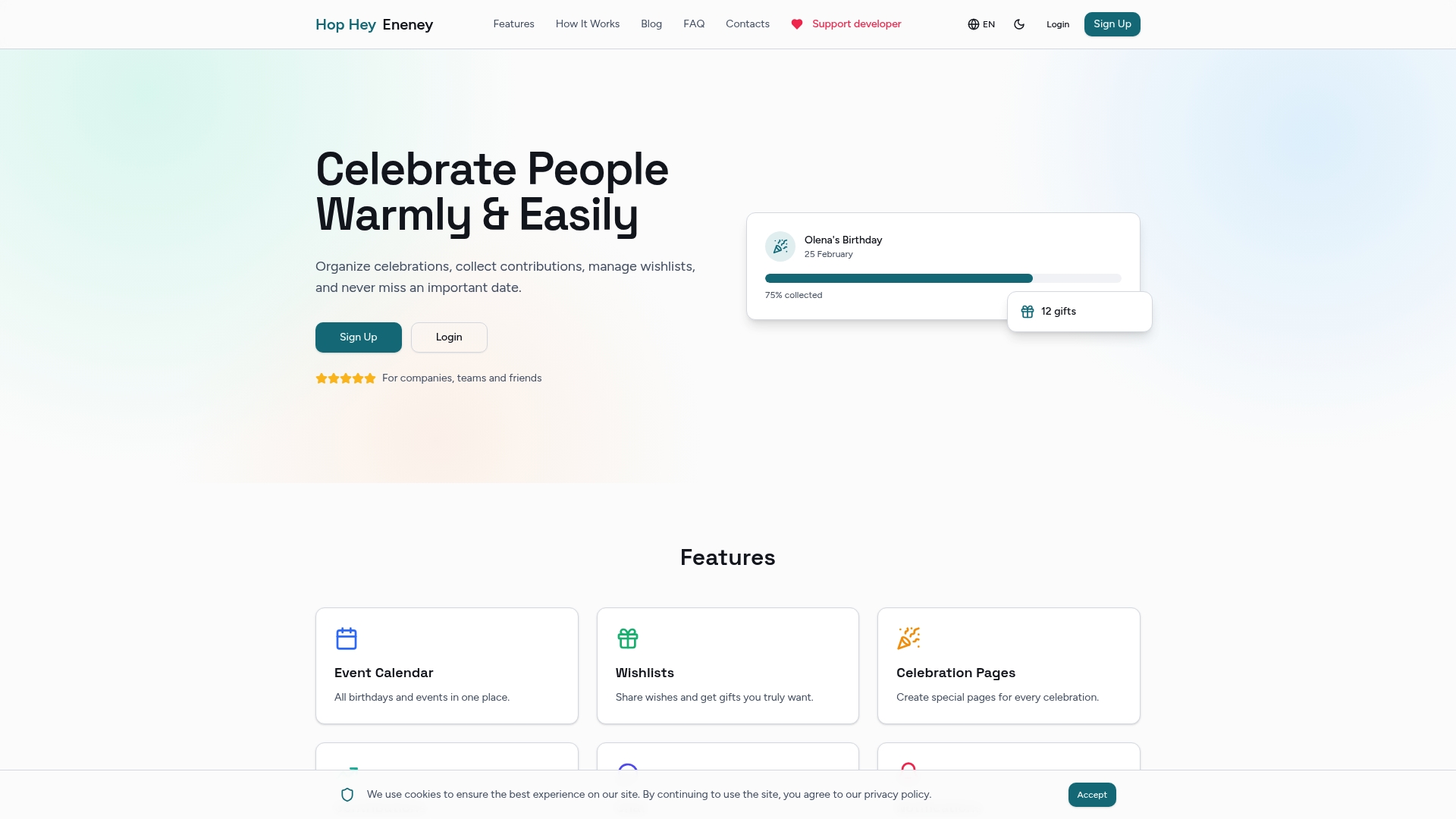
Hop Hey Eneney is built to handle exactly this kind of coordination. The platform lets HR teams create private celebration pages, track upcoming milestones in a shared calendar, collect gift contributions transparently, and communicate in a dedicated chat without spoiling the surprise for the person being celebrated. Automated reminders via email and Telegram mean nothing slips through the cracks, and multi-currency support makes it practical for international teams. If you're ready to bring more structure and less chaos to your team's recognition moments, reach out to the Hop Hey team to see how the platform fits your organization's needs.
Frequently asked questions
What is the most effective way to recognize employees in large companies?
A structured program that combines formal awards with ongoing peer-to-peer recognition is most effective. Annual recognition with awards alongside peer-to-peer programs sustains staff engagement across different levels and departments throughout the year.
How can HR ensure recognition is meaningful and not just a formality?
Recognition must be timely, specific, and accessible to all employees, avoiding generic gestures. Inaccessible programs feel like empty gestures to many employees, so equal access across locations and devices is non-negotiable.
What are some low-cost employee recognition examples?
Handwritten notes, public praise during team meetings, and peer-to-peer shoutouts on a shared channel are budget-friendly and often more impactful than expensive formal programs because they feel immediate and personal.
How can remote or hybrid teams be included in recognition efforts?
Automated celebration software and virtual award ceremonies ensure all employees feel included regardless of location. Recognition must be accessible to all, including those with limited tech access or fully remote setups, which is why platform choice matters as much as program design.