
TL;DR:
- Centralizing event communication creates a single source of truth that improves information flow and decision making. It reduces miscommunication, speeds crisis response, and enhances attendee satisfaction by providing consistent, real-time updates.
What centralizing event communication actually means
Centralizing event communication means pulling every message, update, and coordination thread into one digital hub, so your team stops hunting across email chains, group texts, and spreadsheets for the same piece of information. Instead of a fragmented mess, you get a single source of truth: one place where agendas live, vendor confirmations land, and real-time announcements reach every stakeholder at once.
The immediate payoff is faster access to information. When a speaker cancels an hour before doors open, you need everyone to know in seconds, not after a relay through three different apps. Centralized platforms reduce context-switching and maintain a full conversation history, so decisions are traceable and nothing disappears into a chat thread nobody checks.
Core advantages at a glance:
- One location for all event logistics, updates, and team decisions
- Real-time announcements reach attendees, vendors, and staff simultaneously
- Full conversation history replaces scattered email threads
- Consistent messaging across every stakeholder group
- Faster crisis response when something goes wrong on-site
How fragmented communication breaks event coordination
Scattered communication does not announce itself as a crisis. It shows up as slow, inconsistent coordination: a production update relayed through three people before it reaches venue operations, a guest-flow problem visible to one vendor but invisible to the teams who need to respond. Fragmented channels increase cognitive load and tool-switching fatigue, pulling your team's attention away from execution.
The operational damage compounds fast. Tasks get duplicated or missed entirely. Late-stage changes never reach the right people. Staff spend more time searching for information than acting on it, and frontline teams end up working from outdated instructions.
Common fragmentation pitfalls:
- Lost messages buried in high-volume chat apps
- Conflicting instructions from teams using different platforms
- No audit trail for decisions made verbally or across multiple tools
- Duplicate attendee outreach from marketing and operations teams
- Unclear accountability when something goes wrong
Why a single platform delivers more than convenience
The benefits of centralized communication go well beyond tidiness. Role-based permissions mean your catering vendor sees catering updates, not the AV runsheet. Your sponsors see sponsor logistics, not internal staff briefings. That filtering prevents cognitive overload and keeps every stakeholder focused on what actually concerns them.
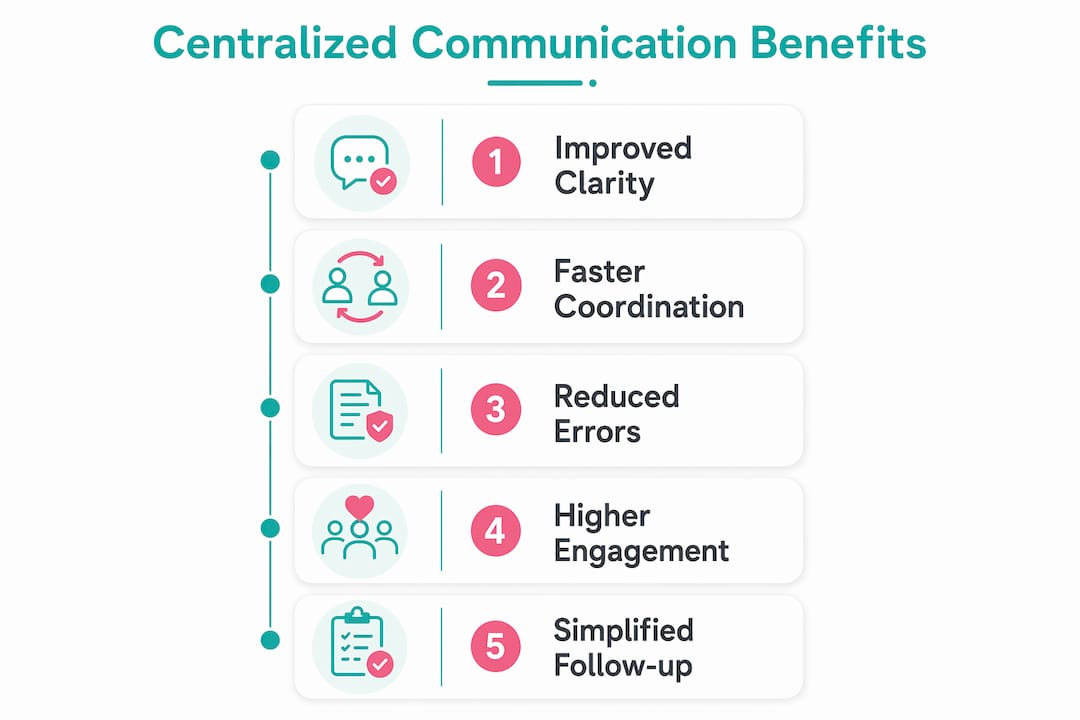
Cost savings are real too. Maintaining five separate tools means five subscription fees, five sets of logins to manage, and five places where something can break. Consolidating onto one platform cuts that overhead and frees budget for the event itself. Consistent branding across every touchpoint also becomes easier when all outgoing messages originate from the same system.
Additional benefits worth noting:
- Reduced tool fatigue for organizers managing multiple workstreams
- Centralized data collection for post-event analysis
- Stronger stakeholder engagement through targeted, relevant messaging
- Better data security with unified access controls and audit logs
Why email and spreadsheets can't keep up with modern events
Traditional methods were not built for the coordination density of a live event. Email lacks event-based context, has no structured task linkage, and creates no automatic escalation path. Legacy tools fail to scale with the complexity of modern events and consistently produce miscommunication when conditions change fast.
Spreadsheets go stale the moment someone edits a local copy. Phone calls leave no record. Group texts bury critical updates under emoji reactions. As event volume and stakeholder count grow, these tools become liabilities.
Specific pitfalls of traditional methods:
- No real-time collaboration on shared documents
- Outdated information circulating after last-minute changes
- Tool-switching fatigue as organizers juggle email, SMS, and chat simultaneously
- Misaligned messaging when different teams send conflicting updates
- Zero visibility into whether a critical message was actually read
How event apps and centralized platforms change the game
Dedicated event platforms centralize agendas, vendor details, live announcements, and attendee communications in one place every stakeholder can access from their phone. The adoption numbers back this up: mobile event apps achieve 60–99% adoption rates at business events, which means your real-time updates actually reach the people who need them.

That reach matters most during a crisis. Pre-loaded push notifications for room changes, speaker delays, or safety alerts can be queued before doors open and triggered in seconds. Attendees get accurate information immediately, rather than hearing conflicting rumors from staff who haven't been briefed yet.
Platform feature benefits:
- Centralized agenda accessible to all attendees without printing
- Push notifications for real-time schedule changes
- Targeted messaging by attendee segment or role
- Vendor and speaker portals that eliminate endless email threads
- Post-event analytics on message engagement and response rates
Pro Tip: Pre-write and queue your crisis messages before the event starts. Assign one person ownership of each trigger scenario so that when a technical failure hits, the response goes out in under two minutes.
Expert practices for managing communication at scale
Communication ownership must be defined before production begins. When field marketing pushes email announcements before the speaker team finalizes bios, miscommunication is inevitable. Formalizing escalation paths and assigning clear owners to each communication thread prevents that overlap.
Role-based permissioning is the other non-negotiable. Large events generate enormous message volume, and without filtering, important updates get buried. Structured permissions keep communication clean and purposeful.
Best practices from experienced event leads:
- Assign a named communication owner for each stakeholder group
- Document escalation paths for high-pressure trigger scenarios
- Use analytics on response times and announcement interactions to refine cadence
- Forbid side-channel discussions that bypass the central platform
- Review engagement data after each event to identify bottlenecks
How centralization improves team collaboration and cuts miscommunication
When every team member works from the same information source, the "which version is real?" problem disappears. Shared visibility means operations, marketing, and vendor teams stay aligned without daily status calls. Effective communication is a core operational requirement, not a soft skill, and centralization is what makes it enforceable rather than aspirational.
Miscommunication drops sharply when there is only one place a policy or update can exist. Teams stop guessing and start executing. For a deeper look at how this plays out in practice, the team event coordination process shows how centralized communication directly lifts team performance.
How centralized communication raises attendee satisfaction
Attendees notice when information is inconsistent or late. Centralized communication directly improves attendee engagement by providing clear, consistent information and eliminating confusion from vague or last-minute updates. Personalized messaging by attendee segment makes the experience feel tailored rather than broadcast.
Post-event follow-up also benefits. When all attendee interactions live in one system, sending targeted thank-you messages, feedback surveys, and next-event announcements becomes straightforward rather than a manual export exercise.
Real-world examples of centralized communication working
A global manufacturing company with over 5,000 employees consolidated email, intranet, mobile apps, and team messaging into a single platform and saved over 20% on communication costs while improving engagement visibility across all teams. Enterprise event teams running multi-day conferences use centralized speaker portals to collect bios, distribute AV instructions, and manage approvals without a single email thread.
Vendor-heavy productions benefit most visibly. When security, production, and registration teams all operate on the same communication structure, issues escalate faster and guest-flow problems get resolved before they affect the attendee experience.
What you need technically to centralize communication
A centralized system needs four things to work: a shared inbox or hub that all stakeholders can access, role-based permissions to filter information by relevance, integration with your existing tools (CRM, ticketing, scheduling), and mobile accessibility so on-site teams stay connected. Without integration, you recreate the fragmentation problem inside a single tool.
For event coordination at the team level, platforms that combine calendar management, private chat, and notification delivery cover the core requirements without requiring enterprise-scale infrastructure.
Potential drawbacks and how to handle them
The biggest challenge is cultural, not technical. Establishing a single source of truth requires forbidding side-channel discussions, and that discipline is hard to enforce when teams are used to texting each other directly. Without buy-in, the central platform becomes one more tool people check occasionally rather than the operational anchor it needs to be.
Platform dependency is a real risk too. If the system goes down during a live event, you need a tested fallback. Assign backup communication owners and pre-distribute emergency contact lists before every event, regardless of how reliable your platform has been historically.
Key Takeaways
Centralizing event communication replaces fragmented tools with one operational hub, cutting miscommunication, accelerating crisis response, and raising attendee satisfaction across every event type.
| Point | Details |
|---|---|
| Single source of truth | All updates, decisions, and logistics live in one place, eliminating conflicting versions. |
| Mobile app adoption | Mobile event apps consistently achieve adoption rates between 60% and 99% at business events, ensuring reliable real-time engagement. |
| Role-based permissions | Filtering by role prevents cognitive overload and keeps each stakeholder focused on relevant information. |
| Cultural buy-in required | Forbidding side-channel discussions is the hardest part of making centralization stick. |
| Cost reduction | Consolidating platforms cuts subscription overhead and reduces duplicated communication effort. |