
TL;DR:
- Office event tracking records workplace activities to improve employee engagement and operational efficiency. Centralized tracking provides full visibility, helping prevent scheduling conflicts and enabling proactive planning. Using focused data on key events, HR can enhance culture, justify budgets, and boost retention through evidence-based decisions.
Office event tracking is the deliberate process of recording and analyzing workplace gatherings and activities to drive better employee engagement and operational efficiency. HR managers who monitor office events gain a clear picture of how people, resources, and time interact across the organization. Teams reviewing event data weekly improve decision-making within four weeks, outperforming 90% of peers. That single finding makes the case for treating event tracking as a core HR discipline, not an afterthought. This guide explains why track office events matters, what the data reveals, and how to build a system that actually works.
Why track office events: the core business case
The primary reason to track office events is to convert isolated workplace activities into measurable organizational intelligence. Without tracking, HR managers operate on assumptions. With it, they operate on evidence.
The benefits fall into three clear categories.
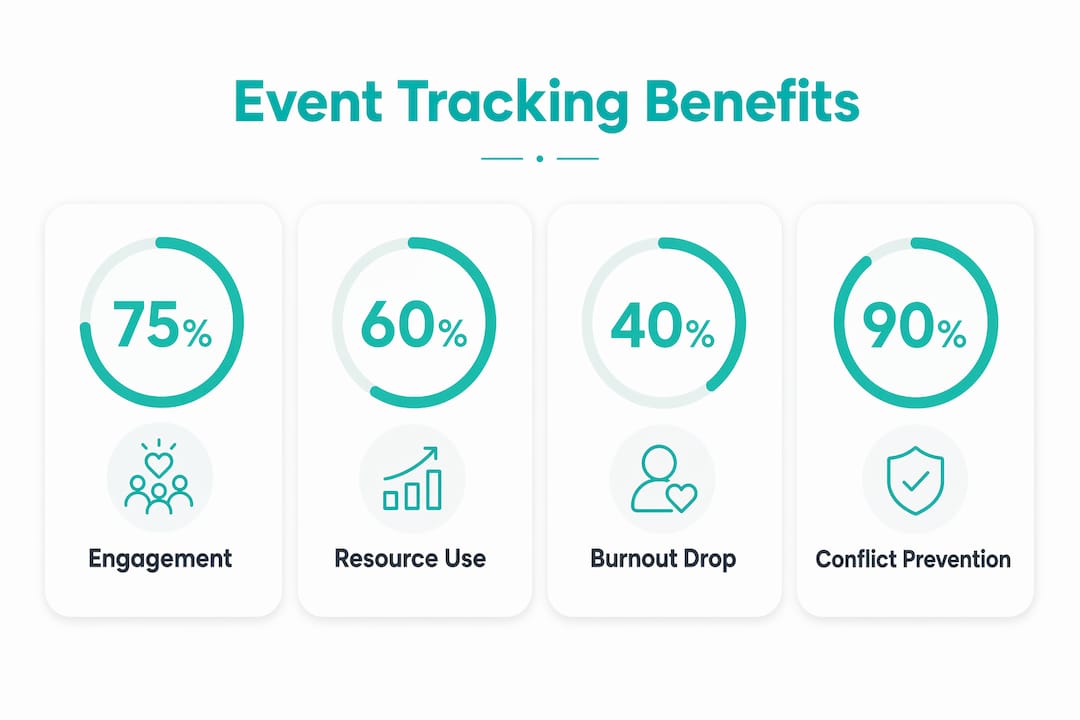
Engagement and morale. Event data measures the effects of office celebrations on employee engagement and morale. Participation rates, attendance trends, and repeat engagement all signal whether your culture initiatives are landing or falling flat. An HR team that sees declining attendance at team lunches has a data point worth investigating, not ignoring.
Resource and space optimization. Workspace analytics tracking event-based occupancy enable HR to optimize layouts and resource allocation effectively. Real-time occupancy data reveals which conference rooms sit empty every Friday and which ones get double-booked every Monday morning. That information directly reduces wasted spend on underused space.
Burnout prevention. Event density matters as much as event quality. Unified event tracking identifies "meeting fatigue" weeks months before it becomes a retention problem. Spotting a quarter where three all-hands meetings, two off-sites, and a product launch overlap gives leadership time to redistribute the load.
Pro Tip: Start by tracking attendance, participation rate, and resource utilization for every event. These three metrics give you the clearest signal with the least effort.
How does centralized event tracking prevent scheduling conflicts?
Siloed tracking is the default state for most organizations, and it creates predictable problems. Each department maintains its own calendar. No one sees the full picture until two critical events collide on the same day.
Fragmented scheduling causes resource clashes and cross-departmental blind spots. A centralized calendar fixes this by giving every stakeholder a single source of truth. Leadership sees the full organizational cadence. Department heads spot conflicts before they escalate. Coordinators book rooms and catering without guessing.
Reactive vs. proactive scheduling
The difference between siloed and centralized tracking is the difference between firefighting and planning. Reactive scheduling means you discover the conflict on the day it happens. Proactive scheduling means you catch it six weeks out and adjust.
Centralizing event tracking shifts schedule management from reactive conflict resolution to proactive organizational visibility. That shift has a direct impact on leadership trust. When executives can see the full event calendar without asking five different people, they make faster, better-informed decisions.
| Siloed tracking | Centralized tracking |
|---|---|
| Conflicts discovered day-of | Conflicts identified weeks in advance |
| Resources double-booked | Resources reserved and confirmed |
| Limited leadership visibility | Full organizational cadence visible |
| Reactive problem-solving | Proactive planning and adjustment |
Pro Tip: Integrate your event calendar directly with your room booking and HR systems. A calendar that lives in isolation defeats the purpose of centralization.
Centralized event calendars improve leadership's ability to oversee organizational rhythm without micromanaging. That is a meaningful distinction. Leaders get visibility without needing to attend every planning meeting.
What are the best strategies for tracking office events?
Effective event tracking starts with scope control. The biggest mistake HR teams make is trying to track everything at once.
Starting with 5–10 high-impact events is the recommended approach to avoid data overload and focus on meaningful insights. Collecting too many events causes analysis paralysis. You end up with a dashboard full of numbers and no clear direction.
Here is a practical framework for building your tracking system.
-
Identify your 5–10 priority events. Choose events directly tied to engagement or efficiency goals. Examples include all-hands meetings, team celebrations, onboarding sessions, performance reviews, and department off-sites. These are the events where attendance and participation data tell you something real about culture and operations.
-
Connect events to workflows and resources. Integrating event tracking with workflows and resource management tools increases organizational efficiency. Link each event to the rooms, budgets, and staff it requires. When an event is created, the system should automatically flag resource conflicts and notify relevant stakeholders.
-
Combine data sources. Occupancy sensors, digital sign-ins, calendar integrations, and post-event surveys each capture a different dimension of the same event. Occupancy data tells you how many people showed up. Survey data tells you whether they found it worthwhile. Together, they give you a complete picture.
-
Establish ethical data practices. Ethical occupancy data collection requires anonymization, transparency, and minimization to build employee trust. Aggregate data protects individual privacy. Clear policies communicated to employees prevent the perception that tracking is surveillance. Trust is the foundation of any data program that depends on honest participation.
-
Review data on a fixed cadence. Weekly reviews work best for operational decisions. Monthly reviews work for cultural trend analysis. Quarterly reviews connect event data to broader HR metrics like retention and satisfaction scores.
The goal is a system where event data flows automatically into the tools your HR team already uses, not a separate spreadsheet someone updates manually every Friday afternoon.
How to use event data to measure workplace culture
Event tracking is not just recording attendance. It is capturing behavioral evidence that validates or challenges your assumptions about workplace culture.

The most direct application is retention analysis. Event tracking delivers quantitative proof to support cultural hypotheses about retention and feature adoption. If employees who regularly attend team celebrations stay 18% longer than those who do not, that correlation is worth acting on. You can increase investment in those events and measure whether retention improves.
Connecting participation to engagement
Participation metrics are a leading indicator of engagement. Declining attendance at voluntary events signals disengagement before it shows up in an annual survey. HR teams that organize office events with clear tracking built in can spot these trends in real time, not six months later.
The table below shows how different event types map to cultural metrics.
| Event type | Cultural metric it measures |
|---|---|
| Team celebrations | Morale and belonging |
| All-hands meetings | Organizational alignment |
| Onboarding events | Early engagement and retention risk |
| Voluntary social events | Discretionary effort and culture fit |
| Training and development sessions | Growth mindset and manager effectiveness |
Validating team-building investments
HR budgets face scrutiny. Event data gives you the evidence to defend or redirect spending. If a quarterly off-site consistently produces a measurable spike in collaboration metrics over the following four weeks, that is a defensible investment. If it produces no measurable effect, that is equally useful information.
The role of HR in team celebrations has shifted from logistics coordinator to data-informed culture architect. That shift only happens when tracking is in place. Without data, HR is guessing. With data, HR is advising.
Key Takeaways
Tracking office events converts isolated workplace activities into measurable evidence that drives smarter HR decisions, prevents resource conflicts, and builds a stronger organizational culture.
| Point | Details |
|---|---|
| Start focused | Track 5–10 high-impact events first to avoid analysis paralysis and get clear signals. |
| Centralize your calendar | A unified event calendar prevents scheduling conflicts and gives leadership full organizational visibility. |
| Connect data sources | Combine occupancy data, attendance records, and surveys for a complete picture of each event. |
| Use data to defend budgets | Participation metrics and retention correlations give HR concrete evidence to justify event investments. |
| Protect employee privacy | Anonymize occupancy data and communicate tracking policies clearly to maintain trust. |
What I've learned from watching organizations track the wrong things
Most HR teams I've observed don't have a tracking problem. They have a prioritization problem. They track everything they can measure and end up measuring nothing that matters.
The organizations that get real value from event tracking share one habit: they decide what question they want to answer before they build the system. "Does attendance at team celebrations correlate with 90-day retention?" is a question. "Let's track all events" is not.
The second pattern I've noticed is that centralization matters more than sophistication. A shared calendar that every department actually uses beats a complex analytics platform that three people check once a month. The event management guide principle holds here: simplicity drives adoption, and adoption drives data quality.
The third thing worth saying plainly is that 2026 workplace trends are making this more urgent, not less. Hybrid work means fewer organic touchpoints between employees. Every planned event carries more cultural weight than it did five years ago. Tracking which events people choose to attend, and which ones they skip, tells you more about your culture than any survey.
The organizations that treat event tracking as a strategic HR function will have a measurable advantage in retention and engagement over those that treat it as an administrative task.
— Konstantin
How Hophey supports event tracking for HR teams
HR teams that want to connect event planning with real engagement data need a platform built for that purpose.
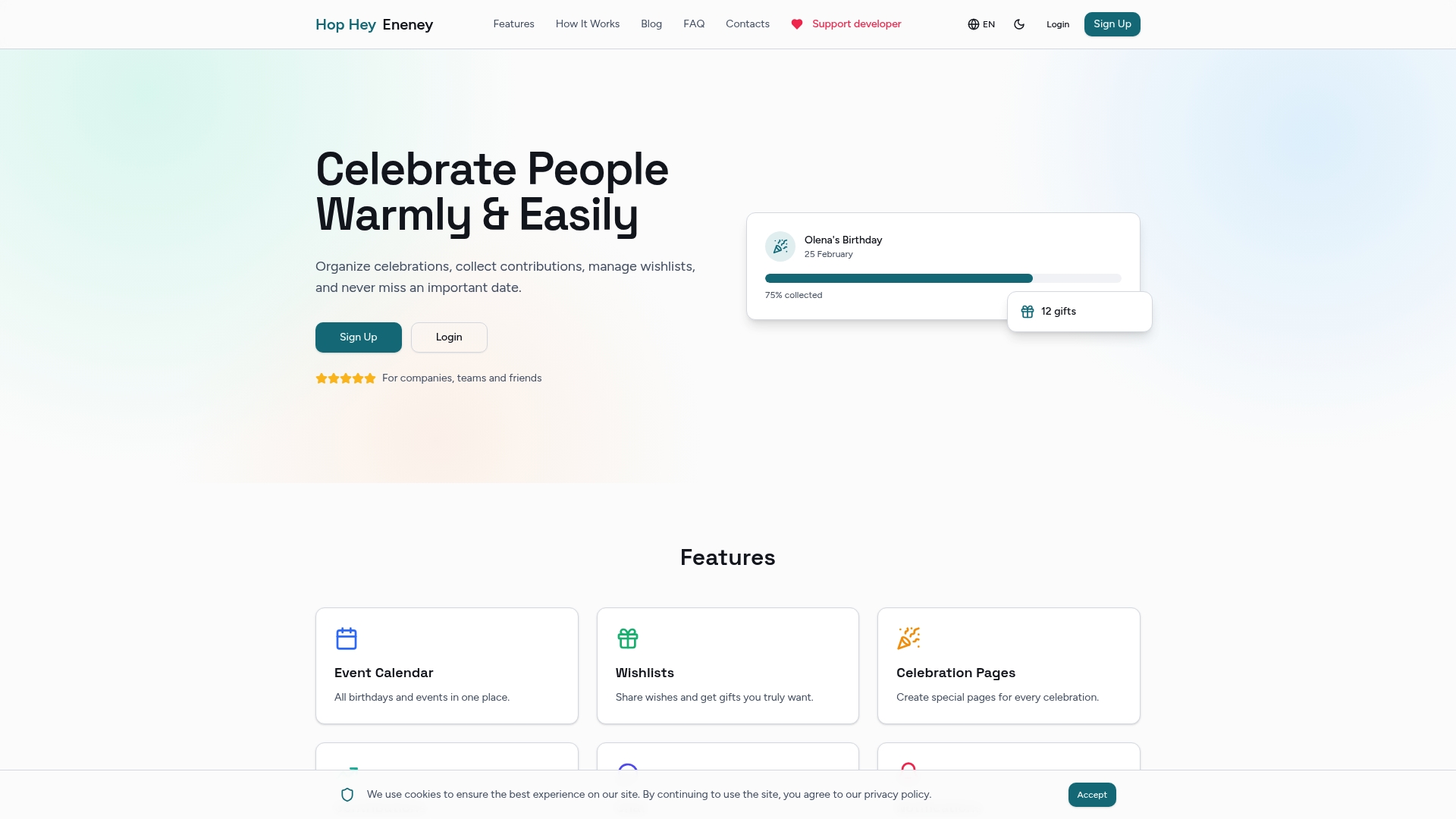
Hophey gives teams a shared event calendar, private celebration pages, and transparent gift contribution tracking, all in one place. HR managers can coordinate birthdays, work anniversaries, and team milestones without the usual back-and-forth across email threads. Automated reminders and Telegram notifications keep everyone informed without manual follow-up. The platform supports multi-currency contributions in UAH, USD, and EUR, making it practical for distributed teams. If you want to see how Hophey handles team celebration management, the for-teams page walks through every feature built specifically for HR and people operations.
FAQ
Why should HR managers track office events?
Tracking office events gives HR managers measurable data on employee engagement, resource utilization, and cultural health. Teams that review event data weekly improve decision-making within four weeks, outperforming 90% of peers.
What is the biggest risk of not tracking workplace events?
Siloed or absent tracking leads to scheduling conflicts, double-booked resources, and missed signals about declining employee engagement. Centralized tracking prevents these problems by giving all stakeholders a shared view of the organizational calendar.
How many events should you start tracking?
Start with 5–10 high-impact events tied directly to engagement or efficiency goals. Tracking too many events at once causes analysis paralysis and dilutes the quality of insights.
How does event tracking protect employee privacy?
Ethical event tracking uses anonymized, aggregated data rather than individual-level surveillance. Clear policies communicated to employees build the trust that makes participation data accurate and reliable.
Can event tracking data improve employee retention?
Yes. Event tracking delivers quantitative proof of the correlation between participation in team events and employee retention. HR teams can use this data to justify and refine investment in culture-building activities.