
TL;DR:
- HR's strategic role in team celebrations involves designing inclusive events that enhance retention and organizational culture. Measuring success through post-event surveys and key metrics at set intervals enables HR to demonstrate impactful ROI and continuous improvement. Incorporating employee co-creation, timely follow-up, and proper infrastructure maximizes celebration effectiveness and supports long-term engagement.
HR's role in team celebrations is to design and execute strategic, inclusive events that directly improve employee retention, motivation, and organizational cohesion. This is not a peripheral perk function. Recognition programs tied to structured celebrations produce measurable business results: companies with strong recognition programs see up to 40% lower turnover, and employees are twice as likely to stay where they feel consistently recognized. HR professionals who treat team celebrations as deliberate engagement tools, rather than ad hoc social events, are the ones building cultures that retain top talent in 2026.
What is the role of HR in team celebrations?
HR owns the full lifecycle of team celebrations, from defining why an event exists to measuring what it produced. The industry term for this function is employee recognition program management, and it sits at the intersection of culture strategy, event logistics, and people analytics. Understanding both the strategic and operational dimensions is what separates HR teams that run memorable celebrations from those that spend budget without impact.
Setting objectives before any planning begins
Every celebration HR organizes should start with one to three measurable objectives. According to strategic HR event planning frameworks, post-event surveys distributed within 48 hours maintain the highest response rates, but only if HR defined what success looks like before the event. Objectives might include increasing cross-departmental connection scores by 10 points, recognizing a specific milestone publicly, or reinforcing a company value like collaboration. Without this clarity, you cannot evaluate whether the event worked.

Core HR responsibilities in celebration planning
The operational responsibilities HR carries through a celebration program are specific and sequential:
- Define the objective and audience. Identify whether the event serves a team milestone, a company anniversary, individual recognition, or a cultural moment. Each requires a different format.
- Set a budget and timeline. Build in buffer time for vendor confirmation, communication, and contingency. Late vendor confirmations are the single most common cause of last-minute event failures.
- Coordinate vendors and logistics. Use a vendor scorecard from the start. Completing spend reconciliation within two weeks post-event improves budget accuracy and vendor relationship management for future events.
- Build an inclusive program. If any team member cannot or does not want to participate, the event fails its core purpose. Design for hybrid attendance, deskless workers, and cultural sensitivity from the outset.
- Communicate and promote. Use multiple channels, including Slack, email, and Telegram, to build anticipation. Pre-event communication increases participation rates significantly.
- Execute post-event follow-up. Share photos, recognition posts, and stories within 48 hours. Event impact is split equally between the event itself and the follow-up activities that amplify it.
Pro Tip: Build a vendor Provider Scorecard immediately after each event. Rate caterers, venues, and facilitators on responsiveness, quality, and value. This single habit cuts planning time for your next event by 30% or more.
How does HR measure the ROI of team celebrations?
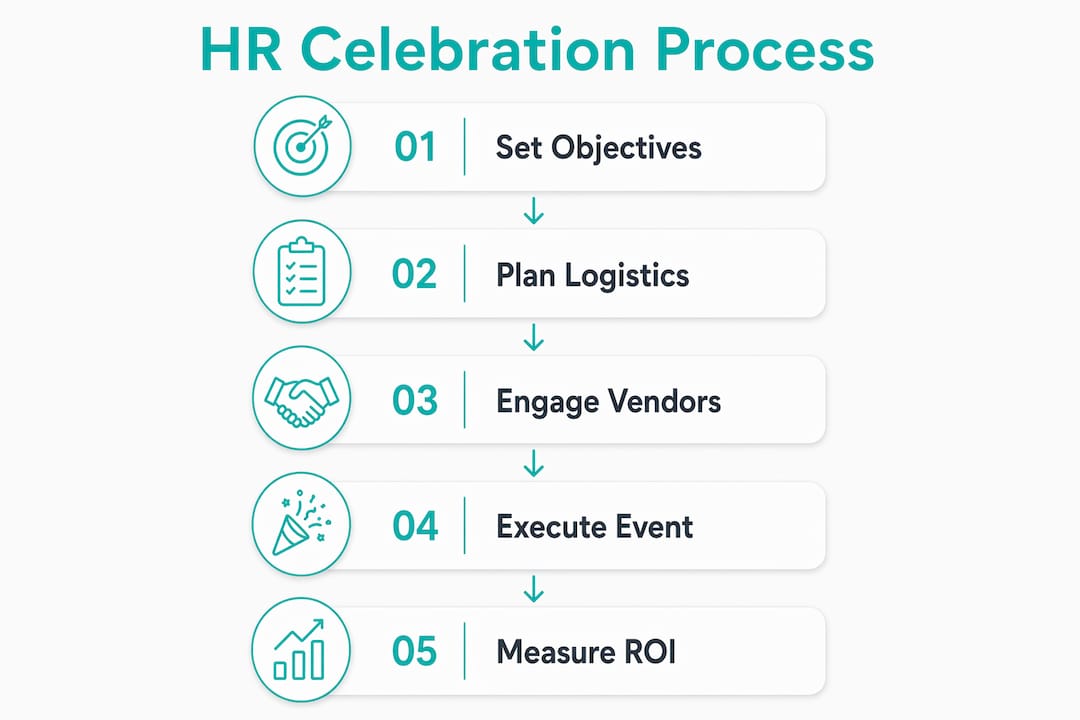
Measuring the return on celebration investment is the function that earns HR a seat at the leadership table. The standard ROI formula is (Gains from Investment minus Cost) divided by Cost, multiplied by 100. The challenge is defining "gains" in people terms, which requires baseline data collected before the event.
Metrics that matter to leadership
HR should track three core metrics at 30, 90, and 180 days after a major celebration: voluntary turnover rate, absenteeism frequency, and engagement survey scores. Companies with high engagement have 59% lower turnover, and preventing just two resignations can offset the entire cost of a well-run recognition program. That is the number your CFO needs to see.
| Metric | When to measure | What it tells you |
|---|---|---|
| Voluntary turnover rate | 30, 90, 180 days post-event | Whether recognition is reducing exit intent |
| Absenteeism frequency | 30 and 90 days post-event | Whether morale and belonging improved |
| Engagement survey score | 90 days post-event | Whether the event shifted culture perception |
| Post-event survey response rate | Within 48 hours | Whether participation was genuine and broad |
| Vendor scorecard rating | Within 2 weeks post-event | Whether logistics quality supports future planning |
Corporate team-building programs tied to specific business challenges can yield ROI of up to 237% when aligned with organizational pain points. That figure is not a ceiling. It reflects what happens when HR stops treating celebrations as morale boosters and starts treating them as targeted interventions.
Pro Tip: Present your ROI case to the CFO using a two-column format: "Cost of the program" on the left, "Cost of two voluntary resignations" on the right. The comparison is immediate and persuasive.
What are the benefits of HR-led team celebrations?
The benefits of HR-led celebrations extend well beyond the day of the event. When HR designs recognition into the fabric of team life, the effects compound over time.
- Retention lift. An employee who is recognized is 63% more likely to stay at their job. Frequent recognition has a stronger retention effect than higher pay, and recognition embedded in daily work increases long-term retention odds by up to 17 times.
- Belonging and morale. Celebrations create shared memory. Teams that celebrate together develop stronger interpersonal trust, which directly improves collaboration quality and communication speed on projects.
- Productivity gains. Employees recognized visibly are 3.7 times more likely to be engaged. Engagement is the most reliable predictor of discretionary effort, the work people do beyond their job description.
- Culture reinforcement. Celebrations make values visible. When HR recognizes a team for embodying a company value like customer obsession or creative problem-solving, that behavior becomes a cultural reference point others aspire to.
- Equity across work models. HR-led celebrations that deliberately include remote and hybrid employees close the belonging gap that remote work creates. Without intentional design, remote employees consistently report lower connection scores than in-office peers.
"Providing structure and scaffolding but letting team members fill celebrations with their own stories leads to organic, meaningful engagement that no top-down program can manufacture." — Oyster HR
The data on retention is particularly striking. 72% of employees say they would stay longer at a company where they feel supported, even over a 30% salary increase elsewhere. HR-led celebrations are one of the most cost-effective tools for creating that sense of support at scale.
What HR strategies maximize the effectiveness of team celebrations?
Effective HR strategies for team bonding through celebrations share one characteristic: they treat employees as co-creators, not audiences. The difference between a celebration people remember and one they tolerate is whether they had a hand in shaping it.
- Co-create before the event. Use collaborative digital boards, photo submission contests, or team storytelling prompts in the weeks before a celebration. Co-creation mechanics build shared ownership and generate organic content that extends the event's reach. Oyster HR used this approach for their five-year anniversary and produced a celebration that felt genuinely community-driven rather than corporate.
- Design for low-intensity participation. Not every employee is comfortable in high-energy group settings. Offering quiet contribution options, like written recognition walls, async video messages, or individual reflection prompts, ensures that introverted or neurodivergent team members can participate meaningfully.
- Use branded storytelling. Connect the celebration to the company's origin story, mission, or a specific team achievement. Branded elements create lasting identity anchors that employees reference long after the event ends.
- Plan around work rhythms. Scheduling celebrations during high-deadline periods signals that HR does not understand the business. Map events to natural breathing points in the fiscal or project calendar.
- Leverage recognition platforms. Tools like Achievers, pulse survey platforms, and dedicated celebration management tools give HR the data infrastructure to track participation, collect feedback, and demonstrate impact. For workplace celebration planning steps, having a centralized platform removes the coordination chaos that derails well-intentioned programs.
Pro Tip: Send your post-event survey within 48 hours, not a week later. Response rates drop sharply after the first two days, and the qualitative feedback you lose is the most useful data you have.
The inclusion floor matters here too. If any team member cannot or does not want to participate, the event fails its core purpose. HR's job is to design a floor that everyone can stand on, then build upward from there with optional higher-engagement activities for those who want them.
Key takeaways
HR-led team celebrations drive measurable retention, engagement, and culture outcomes when built on clear objectives, inclusive design, and disciplined post-event measurement.
| Point | Details |
|---|---|
| Set objectives first | Define one to three measurable goals before planning any celebration to enable real ROI tracking. |
| Follow up within 48 hours | Post-event surveys and recognition posts distributed quickly capture the highest response rates and extend impact. |
| Measure at 30, 90, 180 days | Track turnover, absenteeism, and engagement scores at three intervals to show leadership a credible ROI case. |
| Co-create with employees | Collaborative digital boards and storytelling prompts before the event produce organic engagement no top-down program can replicate. |
| Design an inclusion floor | Every celebration format must accommodate remote, hybrid, deskless, and low-intensity participants to succeed. |
Why celebrations are the most underused strategy in HR's toolkit
I have spent years watching HR teams pour budget into annual all-hands events and wonder why engagement scores barely move. The problem is almost never the celebration itself. It is the absence of everything around it: the pre-event co-creation, the 48-hour follow-up, the 90-day survey, the vendor scorecard, the CFO-ready ROI summary.
Most HR professionals I talk to treat the event as the product. The event is actually the midpoint. The real work happens in the two weeks before and the three months after. When Achievers published data showing that recognition embedded in daily work increases long-term retention odds by up to 17 times, the implication was clear: a single annual celebration is not a recognition program. It is a single data point in a program that needs to run continuously.
The hybrid and remote challenge is real, and I will not minimize it. Designing celebrations that feel equally meaningful to someone in a Kyiv home office and someone in a Chicago headquarters requires genuine creative effort. The teams that solve this problem do not do it by making remote employees watch a livestream. They do it by giving remote employees a co-creation role that in-office employees do not have, which creates a different kind of belonging.
My honest recommendation: stop asking whether your celebration budget is big enough and start asking whether your measurement infrastructure is good enough. The data will tell you exactly where to invest next.
— Konstantin
How Hophey helps HR run celebrations that actually work
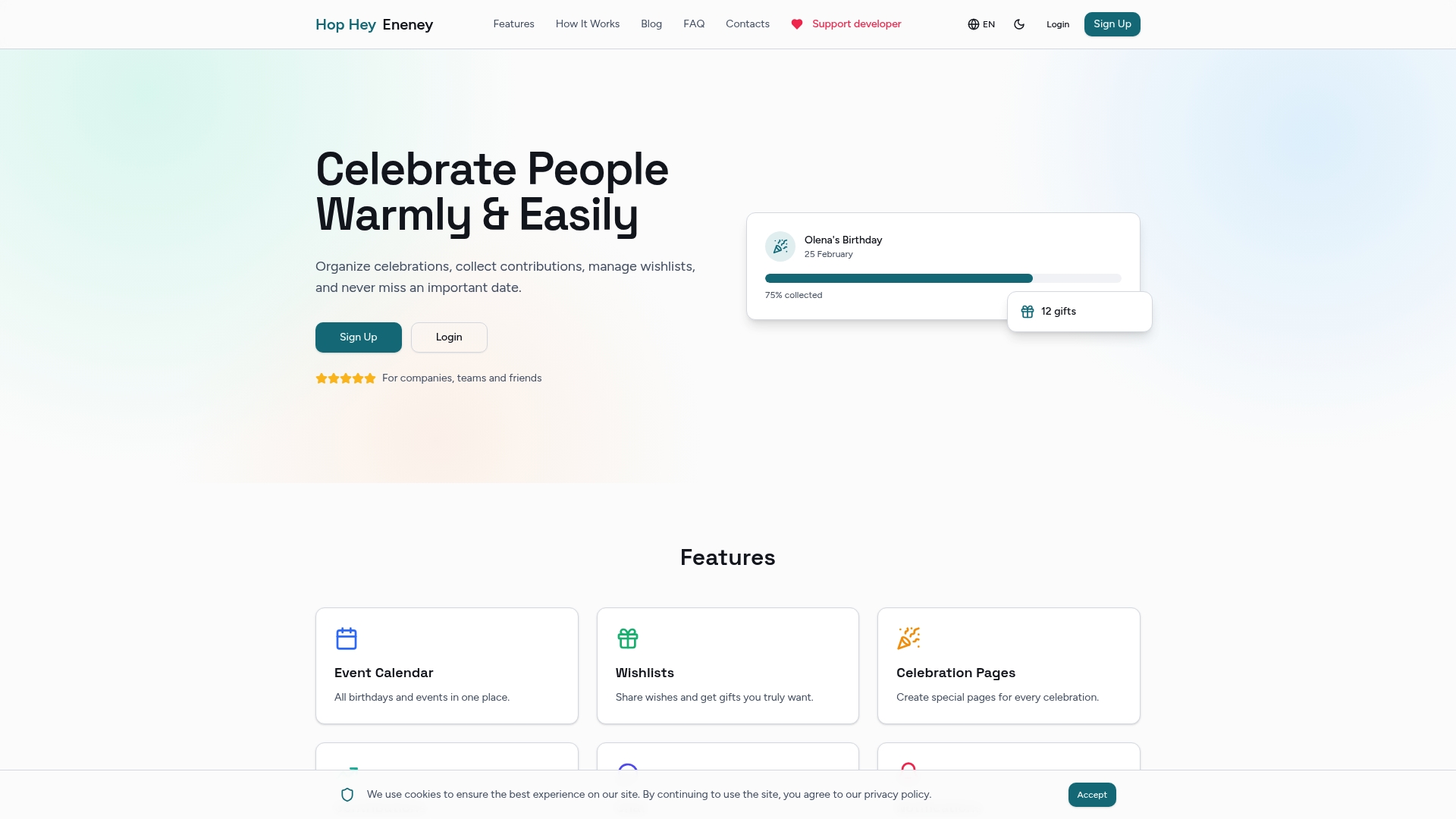
HR teams that want to move from chaotic celebration planning to structured, measurable programs need a platform built for exactly that purpose. Hophey gives HR departments a centralized space to create private celebration pages, coordinate gift contributions transparently, manage shared event calendars, and communicate with team members without spoiling the surprise for the person being celebrated. Automated reminders, Telegram notifications, and real-time contribution tracking remove the coordination overhead that burns out HR coordinators. For teams managing corporate celebrations with clear tools, Hophey provides the infrastructure to plan with intention and demonstrate impact. Start organizing smarter celebrations with Hophey today.
FAQ
What is the role of HR in team celebrations?
HR's role is to design, execute, and measure team celebrations as strategic employee recognition programs that improve retention, engagement, and company culture. This includes setting measurable objectives, coordinating logistics, ensuring inclusivity, and tracking post-event impact at 30, 90, and 180 days.
How does HR measure the impact of team celebrations?
HR uses the ROI formula (Gains minus Cost divided by Cost, multiplied by 100), tracking voluntary turnover, absenteeism, and engagement survey scores before and after events. Companies with high engagement report 59% lower turnover, making even modest celebration investments financially justifiable.
Why are inclusive celebrations important for HR to prioritize?
If any team member cannot or does not want to participate in a celebration, the event fails its core engagement purpose. HR must design low-intensity participation options and hybrid-accessible formats to create an inclusion floor that supports genuine belonging across all work models.
How soon should HR send post-event surveys?
Post-event surveys should go out within 48 hours of the event. Response rates and qualitative feedback quality drop sharply after the first two days, and that early feedback is the most actionable data HR has for improving future celebrations.
What recognition tools support HR-led team celebrations?
Platforms like Achievers, pulse survey tools, and celebration management platforms like Hophey give HR the data infrastructure to track participation, collect feedback, coordinate gift contributions, and demonstrate measurable ROI to leadership.