
TL;DR:
- Multi-organization event planning requires standardized systems to manage complex collaboration effectively across multiple stakeholders. Clear governance, dependency mapping, and shared tools reduce coordination failures and streamline execution. Adopting portfolio thinking with templates and continuous teams enhances efficiency, consistency, and outcome quality over multiple events.
Multi-organization event planning is the coordinated management of events across two or more distinct organizations, unified under a shared operating system, standardized processes, and clear governance structures. Unlike single-organization projects, this practice requires every team, vendor, and stakeholder to operate from the same playbook while preserving the flexibility each group needs to deliver its part. The complexity scales fast. A corporate summit involving three business units, two external agencies, and a venue partner is not just a bigger event. It is a fundamentally different coordination challenge that demands systems, not instincts.
What is multi-organization event planning and why does it need systems?
Multi-organization event planning is defined as the structured practice of designing and executing events that involve multiple organizations working under a unified operating framework. Standardized systems and coordinated teams are the foundation that maintains quality when the number of stakeholders grows beyond what any single planner can manage through relationships alone.
The core infrastructure includes four interconnected components. First, a centralized event management platform gives every organization a single source of truth for schedules, budgets, and task ownership. Second, standardized briefing templates and runsheets eliminate the ambiguity that causes last-minute scrambles. Third, a master calendar integrates timelines from multiple teams and vendors into one visible sequence. Fourth, budget tracking and approval workflows create financial accountability across organizational boundaries.
Post-event evaluation frameworks complete the system. Without structured debriefs feeding back into templates and processes, teams repeat the same coordination mistakes across every event cycle. Systems clarify accountability and make processes repeatable, which is the only way to reduce firefighting at scale.
Pro Tip: Standardization governs process, not creativity. Lock the workflow and the documentation structure, then give each organization full creative latitude within those guardrails. The result is consistency without uniformity.
- Centralized platforms: tools like Cvent, Bizzabo, or Eventbrite for Enterprise give all parties shared visibility into registrations, logistics, and timelines
- Briefing templates: pre-built documents that each organization fills in rather than invents, cutting onboarding time for new vendors
- Master calendars: a single integrated timeline that surfaces dependency conflicts before they become day-of emergencies
- Budget workflows: approval chains that route spending decisions to the right authority without creating bottlenecks
How does governance prevent execution failures in multi-organization events?
Coordination gaps between vendors, not vendor incompetence, are the primary cause of execution failures in multi-organization events. A vendor who is excellent in isolation becomes a liability when no one has mapped how their work connects to the next team's starting point.
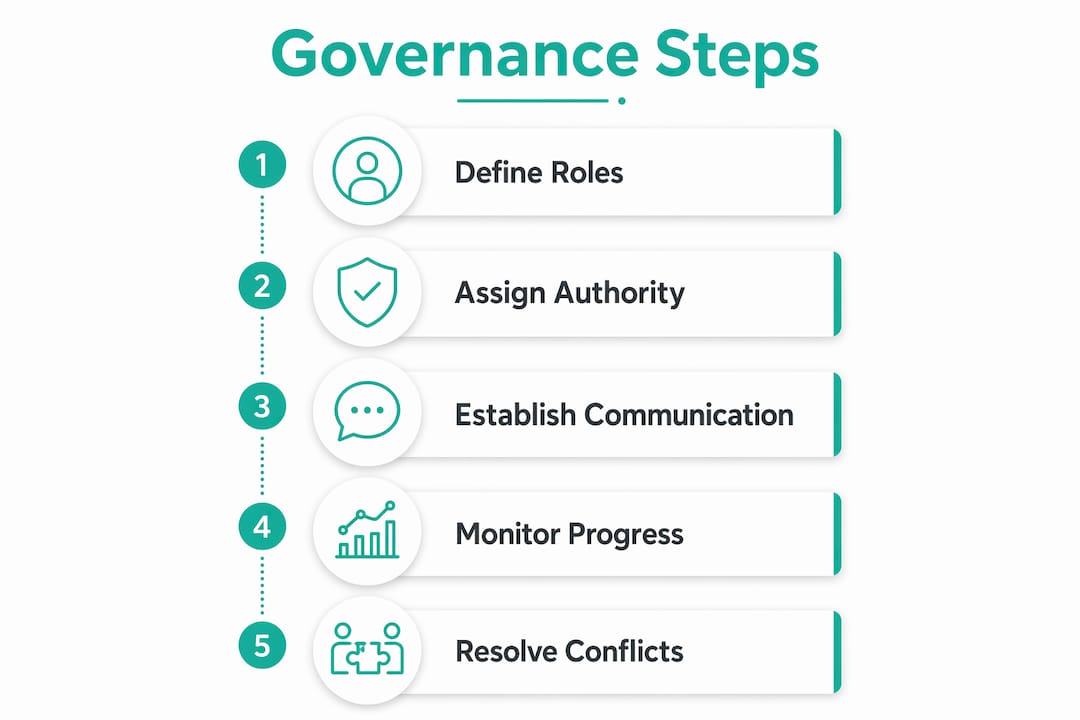
Effective governance rests on five structural decisions made before the event enters production:
- Designate a single point of command. One person or team holds final authority on day-of decisions. Distributed authority sounds collaborative but produces paralysis when two organizations disagree at 7 a.m. on event day.
- Define roles and scope in writing. Every organization and vendor receives a document specifying what they own, what they do not own, and who they escalate to. Verbal agreements dissolve under pressure.
- Map dependencies explicitly. Dependency mapping and unified timelines surface the handoffs where failures concentrate, such as AV setup completing before speaker arrival, or catering access before registration opens.
- Adopt an incident command structure. Borrowed from emergency management, this model assigns clear tiers of authority so that any problem gets routed to the right decision-maker within seconds, not minutes.
- Document communication protocols. Specify which channel handles which type of message. A Slack thread for real-time updates, a shared drive for documentation, and a single phone number for escalations eliminates the confusion of parallel communication streams.
"Coordination must be actively managed, not assumed. The moment you treat it as a background function, you create the conditions for a mis-timed handoff." — Multi-Vendor Coordination in Events
A RACI-style authority model established in the first planning meeting prevents the most common governance failure: two organizations both believing they own the same decision. RACI charts assign Responsible, Accountable, Consulted, and Informed roles to every major task, making authority visible and unambiguous.
What mindset shift separates portfolio thinking from single-event planning?
Multi-event management frames planning as running a portfolio, not executing isolated projects. This distinction changes every operational decision. A single-event planner optimizes for one outcome. A portfolio planner builds systems that produce consistent outcomes across ten, twenty, or fifty events without rebuilding the wheel each time.
The operational shift involves three practices that single-event planners rarely adopt:
Decentralized ownership with clear boundaries. Each workstream, registration, logistics, communications, and production, gets an independent owner with defined authority. This removes the central coordinator as a bottleneck and lets parallel work proceed without constant check-ins.
Template cloning and knowledge inheritance. Separating locked from local elements in templates is the mechanism that makes this work. Locked elements are the standardized components every event inherits: approval workflows, safety protocols, vendor briefing formats. Local elements are the customizable components each organization adapts: branding, agenda specifics, venue details. Without this separation, teams waste hours in meetings and email threads rebuilding decisions that were already made for a previous event.
Data dashboards and continuous feedback loops. Portfolio-level analytics reveal patterns invisible at the single-event level. Which vendor category consistently runs over budget? Which event format produces the highest attendee satisfaction? These answers only emerge when data flows into a shared system across events.
| Approach | Single-event planning | Portfolio planning |
|---|---|---|
| Process design | Built per event | Inherited from templates |
| Decision authority | Centralized | Decentralized by workstream |
| Knowledge retention | Lost after event | Captured in documentation |
| Improvement cycle | Informal debrief | Structured feedback into systems |
Pro Tip: Treat your first multi-organization event as a template-building exercise, not just an execution challenge. Every decision you document becomes an asset for the next event. Every decision you leave undocumented becomes a cost.
Which tools best support collaborative event management across organizations?
Shared dashboards and role-based access controls are the technical foundation of effective collaborative event coordination. Without them, different organizations operate on independent information sets, which produces duplicated effort and conflicting decisions.
The technology stack for multi-organization events typically includes:
- Event management platforms with multi-user access, such as Cvent, Bizzabo, or Whova, which allow each organization to view and update their workstream without accessing data outside their scope
- RACI chart tools integrated into project management software like Asana or Monday.com, making authority visible to every stakeholder in real time
- Vendor schedule integrations that sync external calendars into the master timeline, surfacing conflicts automatically rather than through manual comparison
- Registration and marketing automation connections that route attendee data to the right team without requiring manual exports
- Portfolio-level analytics dashboards that aggregate performance data across events, enabling the continuous improvement cycle that separates high-performing programs from one-off successes
Unified master timelines reduce the hidden cost of context switching on event day. When every team member and vendor can see the same sequence of events in the same document, the number of "what happens next?" questions drops sharply. That reduction in micro-coordination frees the lead planner to manage exceptions rather than narrate the schedule.
For teams managing event coordination across departments, role-based access controls are not just a security feature. They are a clarity feature. Each organization sees exactly what it needs to see and nothing that creates confusion or scope creep.

Practical strategies to reduce risk and strengthen collaboration
Investing in a core continuous team that works across multiple events builds the institutional knowledge that no onboarding document fully replaces. Shared trust and familiarity between team members reduce escalation frequency and accelerate decision-making when time pressure is highest.
Beyond team continuity, these practices consistently improve outcomes in multi-organization environments:
- Assign roles and ownership in the first planning meeting, before any work begins. Late role assignment creates orphaned tasks and duplicated effort.
- Schedule regular alignment sessions, not just milestone check-ins. Weekly 30-minute syncs between organization leads surface misalignments before they compound.
- Build buffer zones into unified timelines at every dependency handoff. A 15-minute buffer between AV setup completion and speaker soundcheck costs nothing and prevents cascading delays.
- Standardize incident escalation plans so every team member knows the exact path from problem identification to resolution authority.
- Train all teams on the shared platform and communication protocols before the planning cycle begins. A team that discovers the tools on event day is a coordination liability.
Pro Tip: The organizations that execute multi-organization events most reliably are not the ones with the best vendors. They are the ones with the clearest documentation. Invest in flexible role structures and written protocols before you invest in premium services.
Understanding event planning terminology shared across all participating organizations also prevents the subtle miscommunications that derail handoffs. When one organization calls it a "run of show" and another calls it a "production schedule," you have a coordination risk hiding in plain sight.
Key takeaways
Multi-organization event planning succeeds when standardized systems govern process, clear governance assigns authority, and portfolio thinking replaces the single-event mindset.
| Point | Details |
|---|---|
| Systems over instincts | Centralized platforms, master calendars, and standardized templates are the infrastructure that makes coordination scalable. |
| Governance prevents failures | A single point of command, RACI charts, and dependency mapping eliminate the coordination gaps that cause execution breakdowns. |
| Portfolio mindset scales results | Treating events as a portfolio with locked and local template elements reduces rebuilding effort and retains institutional knowledge. |
| Technology enables visibility | Shared dashboards and role-based access controls give every organization the information it needs without creating confusion or overlap. |
| Core teams build trust | A continuous team working across multiple events develops the shared familiarity that speeds decisions under pressure. |
Why systems thinking changed how I approach joint events
The first time I coordinated an event involving four organizations, I made the classic mistake: I assumed that because everyone was professional, coordination would happen naturally. It did not. The AV team arrived 40 minutes after the venue access window opened because two organizations each thought the other had confirmed the load-in time. The catering vendor had a different start time in their contract than what appeared in the master schedule. Neither failure was anyone's fault in isolation. Both were coordination failures.
What I learned from that experience is that the quality of a multi-organization event is almost entirely determined by the quality of its documentation and governance structure, not by the talent of the individual teams. Talented teams executing against ambiguous authority and misaligned timelines produce chaotic events. Average teams executing against clear documentation and explicit dependencies produce smooth ones.
The shift to portfolio thinking was equally transformative. Once I stopped treating each event as a fresh project and started treating it as an iteration on a system, the planning cycles shortened, the error rate dropped, and the team stopped dreading the next event. Templates that inherited decisions from previous events meant we spent our energy on what was genuinely new, not on rediscovering what we already knew.
The uncomfortable truth about multi-organization event planning is that most of the work happens before the event enters production. The planners who invest in communication strategies and team culture early in the process are the ones who look calm on event day. That calm is not personality. It is preparation.
— Konstantin
How Hophey supports multi-organization event coordination
Managing celebrations, milestones, and recognition events across multiple teams does not have to mean separate spreadsheets, missed contributions, and fragmented communication.
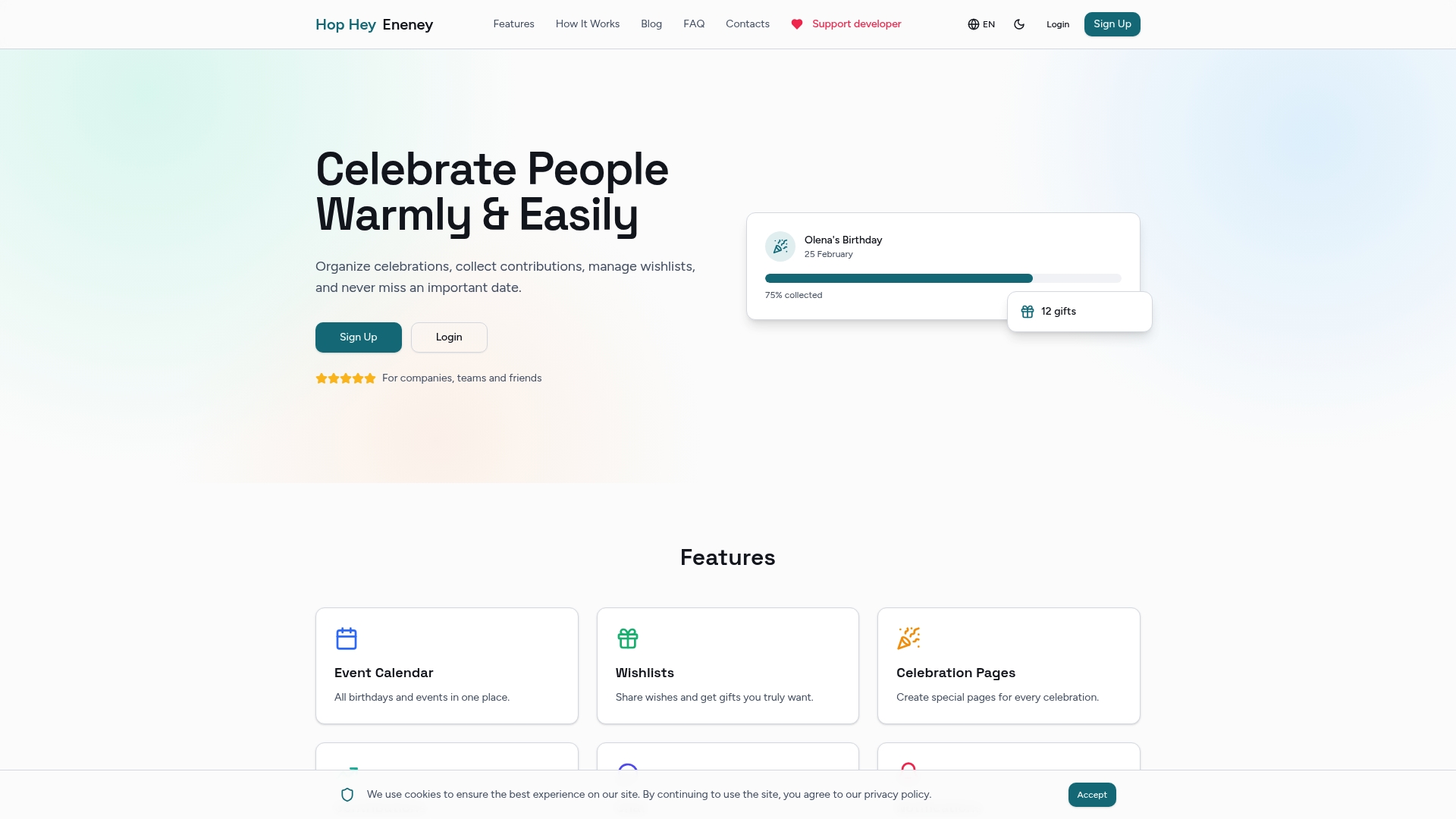
Hophey is built for exactly this environment. The platform gives HR departments, team leads, and coordinators a single space to organize celebration pages, track gift contributions transparently, and communicate in a private chat without involving the person being celebrated. With role-based permissions, automated reminders, multi-currency support, and Telegram notifications, Hophey removes the operational chaos from coordinating recognition events across departments and organizations. If your team is ready to make every milestone feel intentional and organized, explore Hophey and see how it fits your coordination workflow.
FAQ
What is multi-organization event planning?
Multi-organization event planning is the coordinated management of events involving two or more distinct organizations operating under a shared system of standardized processes, unified timelines, and clear governance structures. It differs from single-organization planning primarily in the complexity of authority, dependency management, and cross-party coordination required.
What causes most failures in multi-organization events?
Coordination gaps between vendors and teams, not individual incompetence, are the primary cause of execution failures. Unclear responsibilities, misaligned timelines, and the absence of a single point of command are the specific conditions that produce these gaps.
How do RACI charts help with multi-organization event planning?
A RACI chart assigns Responsible, Accountable, Consulted, and Informed roles to every major task, making authority visible to all stakeholders. Establishing this model early prevents two organizations from simultaneously claiming ownership of the same decision, which is one of the most common sources of day-of conflict.
What is the difference between locked and local elements in event templates?
Locked elements are standardized components every event inherits, such as approval workflows and safety protocols. Local elements are the customizable components each organization adapts, such as branding and agenda specifics. Separating these two categories accelerates planning and maintains consistency across an event portfolio without eliminating flexibility.
Why does a continuous core team matter for multi-organization events?
A core team that works across multiple events builds institutional knowledge and shared trust that documentation alone cannot replicate. This familiarity reduces the need for constant escalation and speeds decision-making precisely when time pressure is highest.