
TL;DR:
- Effective group event planning starts with clear goals, built-in budgets, and early timelines to ensure smooth coordination. Prioritizing venue suitability, engaging activities, precise vendor communication, and comprehensive risk management creates memorable, inclusive experiences. Strong role assignment and ongoing attendee communication are essential for event success and attendee satisfaction.
Organizing a group event feels manageable until you are actually doing it. Suddenly you are juggling dietary restrictions, competing schedules, budget surprises, and a group chat that has gone completely off the rails. The good news: solid group event organization tips cut through that chaos before it starts. Whether you are planning a corporate offsite, a birthday party for thirty people, or a community celebration, the same core principles apply. Get the foundation right, plan for what can go wrong, and design an experience your attendees actually want. Here is exactly how to do that.
Table of Contents
- Key takeaways
- 1. Set clear goals before you plan anything else
- 2. Build a realistic budget with contingency built in
- 3. Lock in your planning timeline early
- 4. Choose the right venue for your specific group
- 5. Design activities that actually engage your group
- 6. Coordinate vendors and catering with precision
- 7. Build a risk management plan before you need it
- 8. Assign clear roles and build your planning team
- 9. Communicate early and often with attendees
- What I've learned from watching events succeed and fail
- How Hophey takes the coordination work off your plate
- FAQ
Key takeaways
| Point | Details |
|---|---|
| Start with clear goals | Define the event's purpose and success criteria before booking anything else. |
| Build in budget buffer | Reserve 15 to 20% of your total budget for unexpected costs. |
| Plan your timeline early | Standard events need 8 to 12 weeks of lead time; large events need 6 to 12 months. |
| Design for inclusion | Go beyond basic compliance and consider sensory, dietary, and communication needs. |
| Prepare for risk | Confirm backup vendors 14 days out and distribute incident command sheets to all staff. |
1. Set clear goals before you plan anything else
Every solid event planning step by step process starts here. Before you choose a venue, set a date, or send a single invite, you need to know exactly why this event exists.
Are you celebrating a team milestone? Building relationships across departments? Raising money for a cause? The answer shapes every decision that follows, from the format and activities to the budget allocation. Using a SMART framework at the start keeps every planning decision tied to a real purpose rather than personal preference.
- Write down the primary goal of the event in one sentence
- Define who your attendees are and what they need from this experience
- Set 2 to 3 measurable outcomes you will use to evaluate success afterward
- Tailor all venue, activity, and communication choices to those outcomes
Pro Tip: Ask yourself "How will I know this event succeeded?" If you can't answer that clearly, your goal is not specific enough yet.
When you align people, place, and purpose early, you move from reactive planning to intentional engagement, and your attendees feel the difference.
2. Build a realistic budget with contingency built in
Budget surprises kill good events. The fix is not having more money. It is planning more honestly from the start.
Break your budget into categories: venue rental, catering, entertainment, audio or visual equipment, decorations, communications, and incidentals. Professional planners recommend reserving 15 to 20% of your total budget as a contingency fund specifically for unexpected costs. That is not optional padding. It is standard practice.
- Venue: typically 25 to 35% of total budget
- Catering: 30 to 40%, depending on format (sit-down vs. standing reception)
- Entertainment and activities: 10 to 15%
- Marketing or invitations: 10 to 15%
- Contingency reserve: 15 to 20%
Cost-saving ideas that do not hurt the experience include booking venues on off-peak days (Thursday instead of Saturday), partnering with local caterers instead of hotel food and beverage packages, and using digital invitations instead of printed ones. These swaps can free up hundreds or even thousands of dollars that go straight into your contingency fund.
Budget reality check: An event with no contingency fund is not a well-planned event. Something will cost more than expected. That is not pessimism. That is experience.
3. Lock in your planning timeline early
One of the most overlooked group event coordination tips is simply starting earlier than feels necessary. Planning timelines vary by event type: standard corporate or community events need 8 to 12 weeks, large conferences or weddings require 6 to 12 months, and smaller private parties can work with 4 to 6 weeks.
Most organizers start too late, which compresses every decision and increases cost. Popular venues book out. Good vendors get taken. And the planning team burns out before the event even happens.
Map your timeline backward from the event date. Identify the critical path items first: venue contract, catering contract, keynote speaker or entertainment booking. Then schedule all communication touchpoints including save-the-date messages, formal invitations, and reminder nudges. Event professionals consistently recommend starting earlier than your instinct tells you to. Trust that advice.
4. Choose the right venue for your specific group
Venue selection is one of the most consequential group event planning decisions you will make. Get it wrong and no amount of great programming fixes it. Get it right and the event runs itself more smoothly.
Key factors to evaluate:
- Capacity: The space should feel comfortably full, not crammed or echoing. Aim for 80 to 90% of maximum capacity as your target occupancy.
- Accessibility: Beyond ramp access, consider parking availability, proximity to public transit, and ease of navigation inside the space.
- Technology: Does the venue have reliable Wi-Fi, built-in AV equipment, and adequate power outlets for your needs?
- Catering flexibility: Can you bring outside vendors, or are you locked into an in-house package?
Pro Tip: Visit the venue at the same time of day your event will occur. Lighting, noise levels, and foot traffic change dramatically between a Tuesday morning and a Friday evening.
| Venue type | Best for | Watch out for |
|---|---|---|
| Hotel ballroom | Large corporate events, galas | High food and beverage minimums |
| Outdoor space | Community festivals, team picnics | Weather risk, sound restrictions |
| Rented restaurant | Intimate dinners, milestone birthdays | Limited capacity, fixed menus |
| Office or co-working space | Internal team events | After-hours access and setup time |
Managing RSVPs carefully at this stage also matters. Use a clear deadline, send reminders, and always plan for 10 to 15% attrition from confirmed guests. People cancel. Venues do not give refunds because your count changed.
5. Design activities that actually engage your group
Passive events are forgettable. 78% of attendees now prefer unique, interactive experiences over traditional formats. That is not a trend. That is a signal about what people actually value.
The key is designing a program with variety. Not every moment should be high-energy and interactive, but there should be clear peaks of engagement built into the schedule. Consider structuring your program around a central hub (a shared space everyone returns to between activities) rather than isolated sessions spread across disconnected areas.
| Format | Pros | Cons |
|---|---|---|
| Guided group activity | High engagement, everyone participates | Less flexible, can feel forced |
| Free-roam stations | Attendees choose their pace | Lower energy, some will disengage |
| Facilitated discussion | Builds real connection | Requires skilled facilitation |
| Competitive team games | High energy, memorable | Can exclude less competitive personalities |
Accessibility also belongs in this section, not as an afterthought but as a design requirement. True event accessibility goes beyond ADA compliance. It includes publishing accessibility statements in advance so attendees can make informed decisions, offering low sensory zones for guests who experience overstimulation, and using clear visual signage throughout the space.
6. Coordinate vendors and catering with precision
Vendor coordination is where event planning checklists earn their keep. Once contracts are signed, the real work shifts to communication and confirmation.

The single most important number to remember: assume 10 to 15% of your guests will have dietary restrictions such as vegan, gluten-free, or allergy-related needs. Collect this information during registration, not the week of the event. Share a finalized dietary requirements list with your caterer at least two weeks in advance.
For all vendors, set up a confirmation schedule. Confirm two weeks out that everything is on track. Confirm again 48 hours before the event. Assign one person on your team as the single point of contact for all vendor communications. When everyone is emailing the caterer directly, things fall through the cracks fast.
7. Build a risk management plan before you need it
Most organizers skip this until something goes wrong. That is a mistake you only make once.
A solid risk management plan covers four categories: vendor failure, weather (for outdoor events), budget overruns, and safety incidents. For each risk, you need a response plan ready before event day arrives.
- Identify your top five risks based on event type and location
- Assign a probability and impact score to each (high, medium, or low)
- Define the response action for each risk in writing
- Assign one person as the owner of each risk category
- Confirm backup vendors 14 days before the event, and again 48 hours out
For safety, even small community events benefit from printed incident command sheets. Having printed incident sheets with roles and emergency contacts means your team can respond quickly without fumbling through a phone in a stressful moment. Digital is great until the Wi-Fi goes down.
Pro Tip: Share a one-page run-of-show document with every vendor and staff member the day before. A run-of-show document is the single most effective day-of coordination tool available.
8. Assign clear roles and build your planning team
One person cannot run a group event alone. Trying to is the fastest route to burnout and mistakes. Effective flexible roles in event planning give each team member ownership over a specific domain without creating confusion about who decides what.
Typical roles for a mid-size event include a logistics lead, a vendor coordinator, an attendee communications lead, a day-of MC or host, and a setup and breakdown crew. For smaller teams, one person can hold two roles. But every critical function needs a named owner.
Document every role in writing before planning kicks off. When people know what they are responsible for and who to escalate to, the entire planning process moves faster and with less friction.
9. Communicate early and often with attendees
Your event communication strategy is part of the attendee experience, not a logistics formality. What you say, when you say it, and how you say it sets expectations and builds anticipation.
Send a save-the-date as early as your timeline allows. Follow up with a formal invitation containing all practical details. Send a reminder one week out and another the day before. Each touchpoint should add value: a preview of the agenda, a note about what to bring, or a fun detail about the program.
For corporate events especially, consider event communication strategies that go beyond email. Text reminders, calendar invites, and Telegram notifications all reach different people more reliably. Do not assume one channel is enough.
What I've learned from watching events succeed and fail
I've seen beautifully catered events fall flat because no one defined what success actually looked like. And I've watched modest, low-budget gatherings generate real connection because the organizer spent time understanding what their group actually needed.
The most consistent difference between events that work and events that disappoint comes down to two things: early goal clarity and role ownership. When the person organizing the event cannot articulate in one sentence why it exists, every downstream decision becomes a guess.
What I find genuinely underrated is how much the planning team dynamic affects the event itself. When roles are clear and people feel ownership, they bring energy and problem-solving instincts on event day. When everything is centralized in one overwhelmed person, you get a stressed host who cannot be present for the actual experience.
The other thing I would push back on: the idea that more budget automatically fixes problems. I've seen teams spend twice the industry average and still deliver a forgettable event because the program was designed for the organizer's preferences, not the attendees'. Know your audience before you spend anything.
— Konstantin
How Hophey takes the coordination work off your plate
If you have ever tried to coordinate group gift contributions over a group chat, you already know how chaotic that gets. Hophey was built specifically to remove that layer of stress from any group celebration or corporate event.
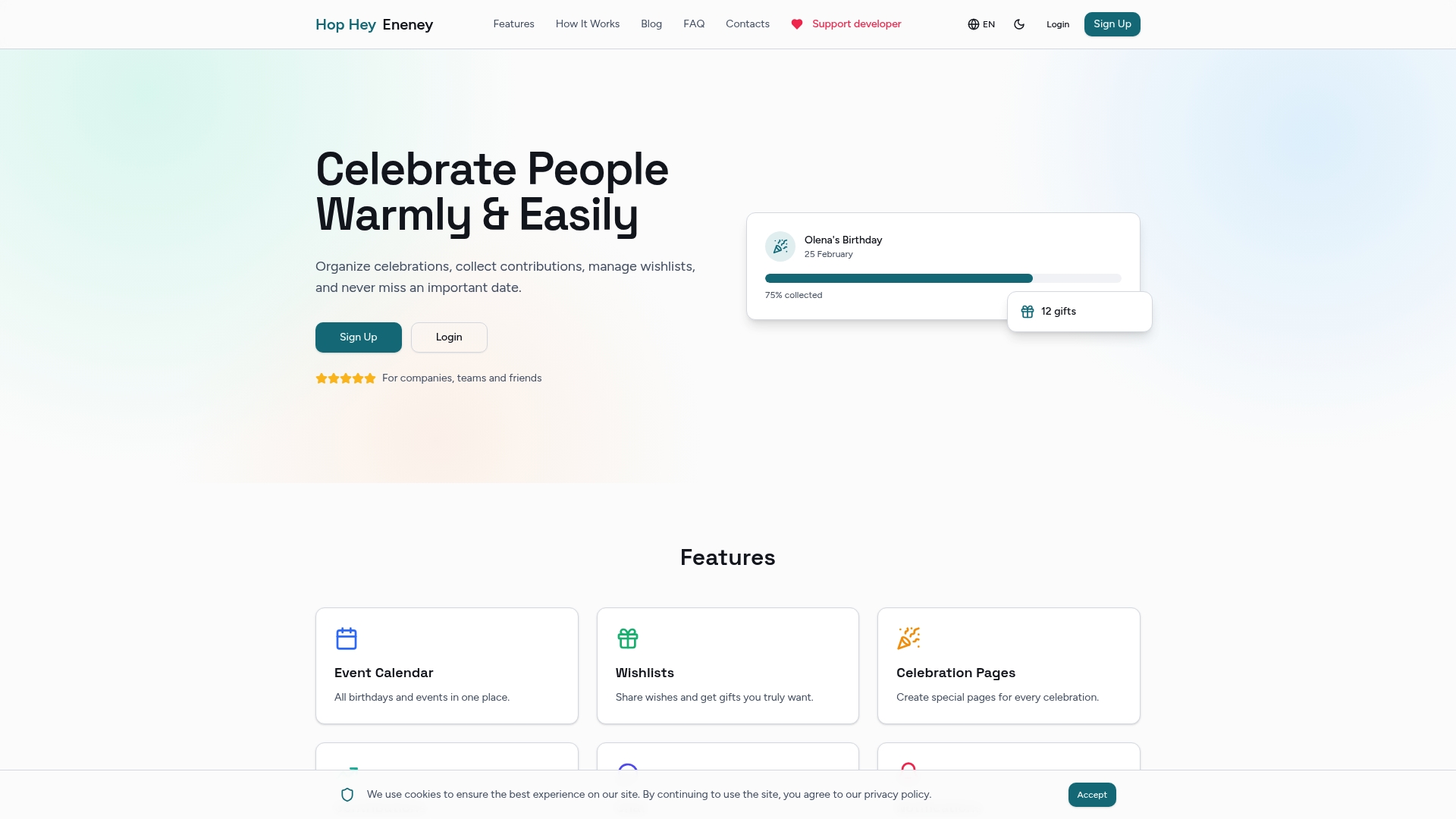
With Hophey, teams can create private celebration pages, collect funds transparently, manage wishlists, and coordinate through a dedicated chat without involving the person being celebrated. HR departments use it to automate employee recognition, and remote teams rely on it to make milestone moments feel real regardless of geography. Automated reminders, Telegram notifications, and real-time contribution tracking mean nothing slips through the cracks.
If you are planning team events regularly, the Hophey for teams platform gives you a structured home for all of it. For more practical guidance, check out how to organize office events that actually strengthen team culture.
FAQ
How far in advance should you start planning a group event?
Standard group events need 8 to 12 weeks of planning time, while large conferences or weddings require 6 to 12 months. Smaller private parties can work with 4 to 6 weeks if the guest list and logistics are simple.
What percentage of the budget should go to contingency?
Industry practice is to reserve 15 to 20% of the total budget as a contingency fund to cover unexpected costs, vendor changes, or last-minute additions.
How do you handle dietary restrictions for group events?
Collect dietary information during registration and share a finalized list with your caterer at least two weeks before the event. Plan for 10 to 15% of guests having some form of dietary restriction.
What is a run-of-show document and why does it matter?
A run-of-show is a minute-by-minute schedule shared with all vendors and staff before event day. It is the most reliable tool for keeping everyone aligned and responding quickly when anything deviates from the plan.
How do you make a group event more inclusive?
Go beyond basic ADA compliance by publishing accessibility statements in advance, offering low sensory areas, and ensuring registration and communication are accessible to everyone. True accessibility means every attendee can participate fully, not just physically enter the building.