TL;DR:
- Celebration collaboration is a shared process of planning and executing recognition events to strengthen team bonds. It involves distributed ownership, clear roles, and genuine input from all contributors. Implementing it consistently improves employee engagement, trust, and organizational culture.
Celebration collaboration is defined as the intentional, shared process of planning and executing recognition events to build team cohesion, validate collective effort, and strengthen social bonds. This is the industry term used by organizational psychologists and HR professionals. It goes far beyond passive recognition, where a manager sends a quick email or posts a note in a channel. Celebration collaboration involves shared task ownership, transparent communication, and coordinated logistics where every contributor brings genuine expertise to the event. Gallup and ATD research consistently show that recognition done well is one of the strongest drivers of employee engagement, and collaborative celebrations are the most effective vehicle for delivering that recognition at scale.
What is celebration collaboration, and how does it differ from recognition?
Celebration collaboration is not the same as recognition, and the difference matters. Recognition is a one-way act. A manager acknowledges an employee's output. Collaboration in celebrations is a two-way, multi-contributor process where the team jointly owns the planning, the execution, and the meaning of the event.

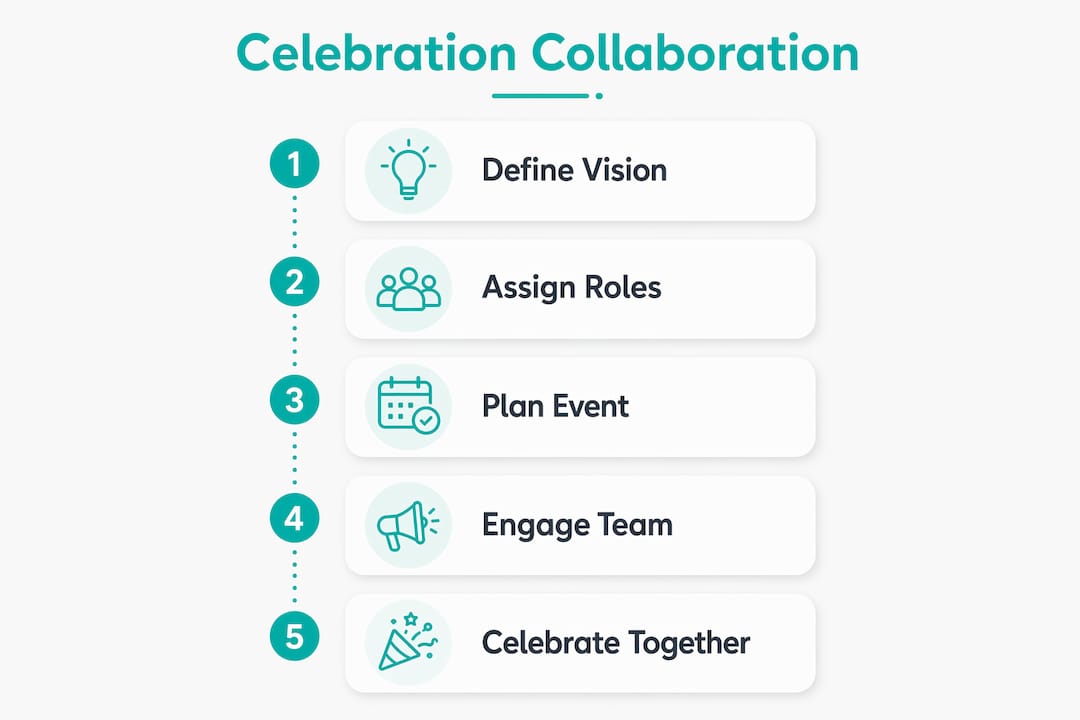
True collaboration means shared ownership of both process and outcome, with each contributor bringing specific expertise. Applied to celebrations, this means one person does not simply "organize the party" while others show up. Instead, roles are distributed: someone coordinates the budget, another manages the guest list, a third handles the surprise logistics, and a fourth leads the tribute message.
Three concepts often get confused in this space:
- Coordination means dividing tasks without shared decision-making. One person assigns jobs and others execute them.
- Consensus means everyone agrees before anything moves forward, which often stalls planning.
- Collaboration means each person contributes their expertise to a shared goal, with real input shaping the outcome.
Celebration collaboration sits firmly in the third category. The result feels cohesive because it was built cohesively.
Pro Tip: Assign a single "celebration lead" who holds the overall vision, then let each team member own a specific domain. This prevents the chaos of too many cooks while preserving genuine shared ownership.
What are the benefits of celebration collaboration for teams?
The benefits of celebration collaboration are measurable, not just cultural. Employees who receive excellent recognition are 20 times more likely to be engaged than those who receive poor recognition. That gap is enormous, and it signals that how recognition is delivered matters as much as whether it happens at all.
Shared celebrations build something that individual recognition cannot: social bonds rooted in shared experience. When a team plans a birthday surprise together, they communicate across silos, solve problems jointly, and create a memory that belongs to all of them. Celebrating cross-team achievements fosters deeper relationships and commitment that outlast the event itself.
"Celebration fuels improved communication, transparency, and feedback flow, which translate into stronger collaboration. Shared positive experiences deepen trust and engagement in ways that task-focused interactions rarely achieve." — Wellness Works Canada
The cultural impact runs deeper than morale. What a team chooses to celebrate signals its core values and actively fosters psychological safety. A team that celebrates a failed experiment that produced useful data sends a clear message: learning matters here, not just winning. That signal reduces fear, opens communication, and ultimately drives better performance. Leaders who emphasize the "who" over the "what" in their teams build mental well-being and higher engagement through this mindset shift.
How to implement celebration collaboration effectively
Effective implementation starts with structure, not spontaneity. Teams that wait for a "good moment" to celebrate rarely do it consistently. The most successful approach integrates celebration into the regular workflow so it becomes a habit rather than an exception.
Here is a practical framework for getting started:
- Create a dedicated appreciation space. A Slack channel like #kudos-korner or a standing agenda item in weekly meetings gives celebration a home. Without a designated space, recognition gets buried in task updates.
- Assign clear roles for each event. Designate a budget lead, a communication lead, and a logistics lead for every celebration. Clear roles prevent duplication and gaps.
- Celebrate progress, not just outcomes. Recognizing a team for completing a difficult phase, not just the final launch, keeps morale high throughout long projects.
- Use centralized communication that excludes the celebrant. For surprise events, a private group chat or a dedicated platform channel keeps planning confidential while keeping everyone aligned.
- Set a recurring celebration calendar. Monthly or quarterly milestones give teams predictable moments to look forward to and plan around.
Pro Tip: For remote or hybrid teams, collaborative celebration ideas work best when they include both synchronous moments (a live video call) and asynchronous contributions (recorded video tributes, shared digital gift collections).
The table below maps common team sizes to the most practical celebration collaboration approaches:
| Team size | Recommended approach | Key tool type |
|---|---|---|
| 2–10 people | Shared group chat with rotating celebration lead | Private messaging channel |
| 11–50 people | Dedicated celebration calendar with assigned roles | Shared calendar plus fund collection |
| 51+ people | Structured HR-led program with automated reminders | Celebration management platform |
Integrating recognition into regular workflows with recurring rituals prevents recognition fatigue and keeps team morale high over the long term.
What challenges should teams expect in collaborative celebrations?
Collaborative celebrations fail more often from logistical problems than from lack of goodwill. Understanding the common pitfalls lets teams design around them before they cause friction.
The most frequent challenges include:
- Recognition fatigue. When every week brings another celebration, the meaning drains out. Spacing events thoughtfully and varying the format keeps appreciation feeling genuine.
- One-size-fits-all planning. Not every team member wants a public shout-out. Tailoring celebration methods to individual comfort levels, whether public or private recognition, ensures genuine engagement and avoids alienating quieter team members.
- Logistical chaos in surprise events. Managing a surprise celebration requires centralized communication that excludes the person being celebrated. Clearly defined contributor roles prevent chaos in planning and keep the surprise intact.
- Misalignment with team values. A celebration that feels performative or disconnected from what the team actually cares about does more harm than good. Anchoring events to real achievements and genuine team culture keeps them meaningful.
- Unequal participation. When the same two or three people always organize events, others disengage. Rotating the celebration lead role distributes both the effort and the ownership.
Avoiding these pitfalls requires honest conversation about what the team values and how individuals prefer to be recognized. That conversation is itself a form of collaboration.
What does celebration collaboration look like in practice?
Real-world celebration collaboration takes many forms, and the best examples share one trait: everyone involved feels ownership of the outcome.
A remote engineering team might use a shared digital board to collect tribute messages for a colleague's work anniversary, pool contributions for a gift card, and schedule a surprise video call where each person delivers their message live. The group celebration coordination process is distributed across the team, but the experience feels unified.
An HR department at a mid-size company might build a quarterly recognition ritual where team leads nominate peers, the group votes on a shared gift, and the celebration is announced in a company-wide meeting. The team celebration culture becomes self-reinforcing because everyone participates in both giving and receiving.
Weekly shout-out rituals, monthly milestone dinners, and annual achievement awards all qualify as celebration collaboration when the planning is shared and the recognition is genuine. The format matters less than the process. Learning how to improve team collaboration for events specifically can sharpen the logistics side of these rituals significantly.
| Celebration type | Collaboration method | Best for |
|---|---|---|
| Birthday surprise | Private group chat, pooled gift fund | Small to mid-size teams |
| Work anniversary | Shared tribute board, video call | Remote and hybrid teams |
| Project milestone | Team vote on recognition format | Cross-functional groups |
| Company-wide award | Peer nomination plus group contribution | Large organizations |
Key Takeaways
Celebration collaboration works because it distributes ownership across the team, turning recognition into a shared act that builds trust, communication, and lasting social bonds.
| Point | Details |
|---|---|
| Core definition | Celebration collaboration is the intentional, shared process of planning and executing recognition events together. |
| Engagement impact | Employees with excellent recognition are 20 times more likely to be engaged than those with poor recognition. |
| Shared ownership | Effective collaboration assigns distinct roles so every contributor shapes the outcome, not just the organizer. |
| Prevent recognition fatigue | Integrate celebrations into regular workflows with recurring rituals rather than treating them as one-off events. |
| Respect individual preferences | Tailor public versus private recognition to each person's comfort level to keep celebrations genuine. |
Why celebration collaboration changed how I think about team culture
Most teams treat celebration as a reward that comes after the real work is done. I used to think the same way. After watching dozens of teams go through the motions of birthday cakes and end-of-quarter emails, I realized the problem was not the celebration itself. The problem was that one person planned everything while everyone else just showed up.
The shift happens when the team owns the process together. I have seen a quiet team of developers become genuinely close after they spent two weeks secretly coordinating a surprise for a colleague who had carried a brutal project. The planning was the bonding. The party was just the proof.
The harder lesson is that this requires leaders to model it first. If a manager never participates in planning, only in attending, the signal is clear: celebration is not real work. When leaders take on a role, even a small one, the rest of the team follows. That is not a soft cultural observation. It is a direct driver of the psychological safety that collaborative learning in events research consistently identifies as foundational to high performance.
Celebration collaboration is not a program you launch. It is a habit you build, one shared event at a time. The teams that do it well are not the ones with the biggest budgets. They are the ones where everyone knows their role and genuinely wants to show up for each other.
— Konstantin
How Hophey makes celebration collaboration practical
Coordinating a team celebration sounds simple until you are managing a surprise, collecting contributions from twelve people, and trying to keep the honored person from finding out. That is where most well-intentioned efforts fall apart.
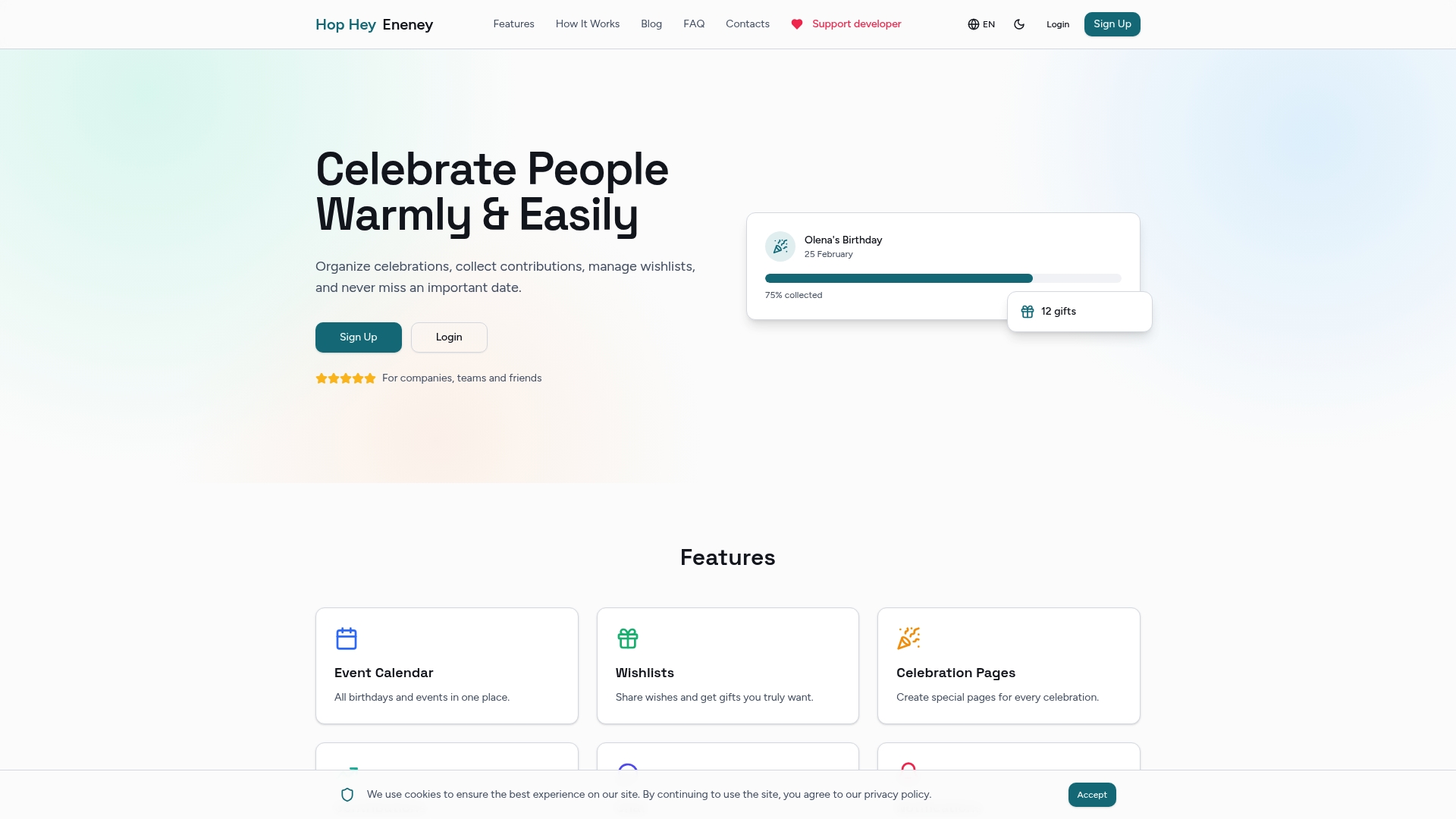
Hophey is built specifically for this problem. The platform gives teams a private celebration page, a shared event calendar, a transparent fund collection system, and a dedicated chat that excludes the person being celebrated. HR departments use it to automate employee recognition across large organizations. Remote teams use it to coordinate meaningful team celebrations across time zones. Friend groups use it to organize surprise parties without the usual chaos. Hophey supports multi-currency contributions in UAH, USD, and EUR, sends automated reminders via email and Telegram, and keeps every contributor aligned from the first idea to the final gift.
FAQ
What is celebration collaboration in simple terms?
Celebration collaboration is the shared, intentional process where a group jointly plans and executes a recognition event rather than leaving it to one person. Every contributor owns a part of the process and the outcome.
How does celebration collaboration improve team engagement?
Employees who receive excellent recognition are 20 times more likely to be engaged than those who receive poor recognition. Collaborative celebrations deliver that recognition in a way that also builds trust and social bonds across the team.
What are the most common mistakes in collaborative celebrations?
The most common mistakes are one-size-fits-all planning, recognition fatigue from too-frequent events, and logistical chaos in surprise celebrations caused by unclear roles and scattered communication.
How do you celebrate collaboratively with a remote team?
Remote teams can collaborate on celebrations by using a shared digital platform for tribute messages, pooled gift contributions, and a private planning channel that excludes the celebrant. Synchronous video calls and asynchronous recorded messages both work well.
What tools support celebration collaboration?
Platforms that combine event calendars, fund collection, private group chat, and automated reminders give teams the structure they need. Hophey is designed specifically for this use case, supporting both small friend groups and large HR departments.