
TL;DR:
- Team celebration culture is an intentional practice that recognizes achievements to boost morale, relationships, and performance. It directly drives engagement, retention, and collective trust by making contributions visible and fostering psychological safety. Leaders must embed timely, specific recognition into daily routines using appropriate methods and technology to cultivate lasting celebration practices.
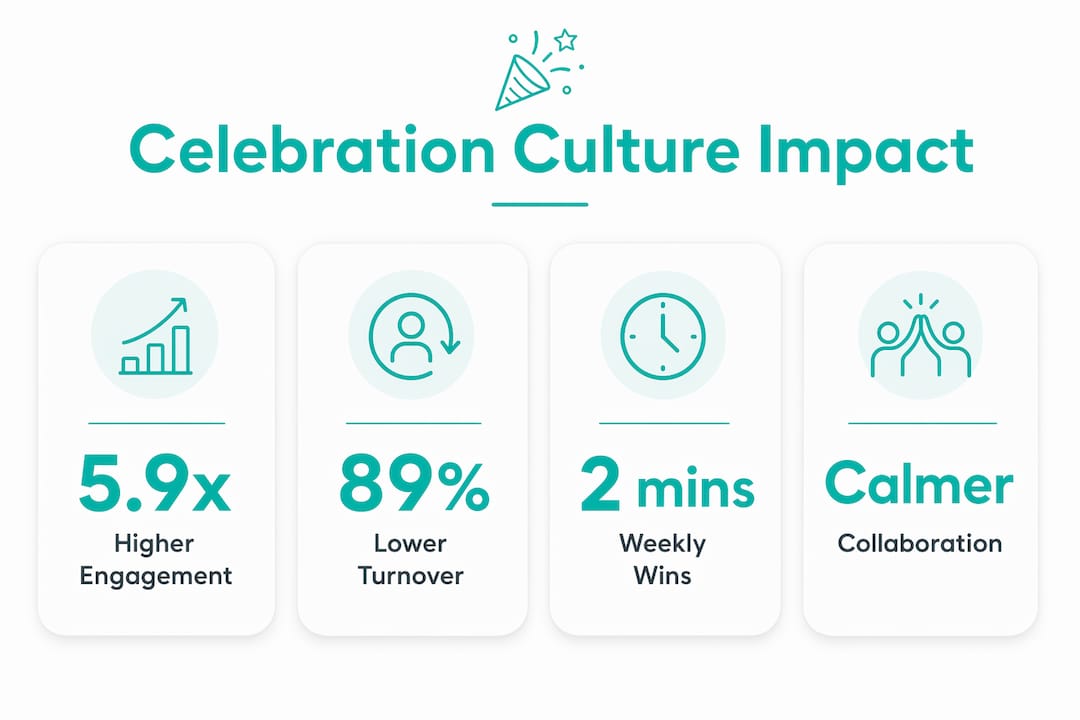
Team celebration culture is the intentional, recurring practice of acknowledging achievements, milestones, and contributions to strengthen morale, relationships, and performance across an organization. It is not a perk. It is a management strategy with measurable outcomes. Employees who receive consistent personal recognition are 2.2x more likely to innovate and 37% report feeling encouraged to perform at a higher level. The importance of team celebration culture becomes clear when you connect those numbers to retention, engagement, and the kind of discretionary effort that separates high-performing teams from average ones.
Why team celebration culture is the foundation of engagement
Recognition is not a soft benefit. It is a direct driver of engagement, and the data from Achievers and Leapsome in 2026 makes that case without ambiguity. 69% of employees say they would work harder if they felt better appreciated, yet only 1 in 5 currently report a strong sense of belonging at work. That gap is where team leaders and HR professionals have the most leverage.
The connection between celebration and retention is equally direct. Companies with formal recognition programs report significantly lower turnover rates than those relying on annual reviews or ad hoc praise. When employees feel seen consistently, not just during performance cycles, their commitment to the organization deepens. This is not about loyalty programs. It is about the basic human need to know that your work matters.
Celebrating team achievements also shifts the dynamic from individual competition to collective ownership. When a team hits a project milestone and the entire group is recognized, each member's contribution becomes visible. That visibility builds the kind of trust that makes people willing to take risks, ask for help, and stay through difficult quarters.
Key benefits of consistent team celebration include:
- Higher discretionary effort from employees who feel genuinely appreciated
- Reduced turnover risk, particularly among mid-level contributors who are often overlooked
- Stronger peer relationships that carry teams through high-pressure periods
- Clearer alignment between individual work and organizational goals
Pro Tip: Track recognition frequency alongside engagement scores in your quarterly HR reviews. If recognition drops, engagement scores typically follow within 60 to 90 days.
What does celebration actually do to the brain and team dynamics?
The psychological case for celebration is grounded in neuroscience, not motivation theory. Judith Glaser, organizational anthropologist and author of Conversational Intelligence, identified that public and private recognition stimuli activate brain pathways linked to inclusion, innovation, and appreciation. Specifically, celebration drives neurochemical responses that support clearer thinking and stress resilience. This is why teams that celebrate regularly tend to communicate better under pressure, not just when things are going well.
Shared positive experiences also build psychological safety, the condition Google's Project Aristotle identified as the single most important factor in high-performing teams. When a team celebrates together, they create a shared emotional reference point. That reference point becomes a resource during conflict or uncertainty. The team has evidence, from their own experience, that they can succeed together.
"Meaningful recognition is a more powerful motivator than bonuses. Shared positive experiences increase trust and problem-solving capacity in ways that financial rewards alone cannot replicate." — Wellness Works Canada
For hybrid and remote teams, this dynamic is especially significant. Without the informal social fabric of a shared office, celebration becomes one of the few structured opportunities for genuine human connection. A well-executed virtual team celebration is not a consolation prize for remote workers. It is a deliberate investment in the social infrastructure that keeps distributed teams cohesive.
The biological response to celebration supports calmer work environments and better collaboration. This makes the role of recognition in teams functional, not optional. Leaders who treat celebration as a nice-to-have are, in effect, choosing to operate with a less resilient, less creative team.

Pro Tip: Build a brief "wins round" into your weekly team meeting. Even two minutes of shared acknowledgment activates the neurochemical benefits Judith Glaser describes, without requiring a formal event.
Public vs. private, formal vs. informal: which recognition type works best?
The answer is not one type. It is the right type at the right moment. Understanding when to use each mode of recognition is what separates leaders who build genuine celebration cultures from those who generate performative ones.
| Recognition Type | Best Used When | Key Risk |
|---|---|---|
| Public recognition | Celebrating team-wide wins or exemplary behavior aligned with company values | Can embarrass introverted employees or create resentment if perceived as favoritism |
| Private recognition | Acknowledging personal growth, sensitive achievements, or individual effort | Can feel invisible to the broader team; misses the social reinforcement effect |
| Formal recognition | Annual awards, structured programs, milestone ceremonies | Infrequency reduces impact; can feel disconnected from daily work |
| Informal recognition | Spontaneous praise in meetings, Slack messages, peer shoutouts | Inconsistency risks leaving key contributors unacknowledged |
| Team-wide celebration | Project completions, collective milestones, cultural moments | Risks diluting individual contributions if not paired with specific acknowledgment |
Celebrating collective effort avoids the most common pitfall in recognition programs: focusing exclusively on star performers. When only top contributors receive visible acknowledgment, the rest of the team receives an implicit message that their work is invisible. That message is corrosive to morale and directly increases turnover risk among mid-tier performers, who are often the backbone of execution.
Timeliness and specificity are the two variables that determine whether recognition lands or falls flat. Praise delivered three weeks after the fact feels like an afterthought. Generic praise like "great job this quarter" communicates nothing about what behavior to repeat. Specific, timely recognition tied to observable behaviors and company values is what drives the engagement outcomes the research describes.
The most effective approach integrates recognition into existing workflows rather than reserving it for special events. A shoutout in a Monday standup, a peer nomination in your project management tool, or a milestone flag in your HR platform all count. The goal is to make celebration a rhythm, not a calendar event.
How to build celebration rituals that actually stick
Sustainable celebration culture does not emerge from a single team offsite or an annual awards dinner. It is built through repeated, low-friction practices that become part of how the team operates. Here is a practical framework for embedding recognition into everyday team management.
-
Start with peer-to-peer recognition. Weekly recognition correlates with 5.9x higher appreciation and engagement. Peer-to-peer programs, like those available through Achievers or Leapsome, distribute the recognition function beyond management and make appreciation a team-wide behavior rather than a top-down gesture.
-
Celebrate small wins consistently. Small, frequent celebrations stimulate continuous motivation more effectively than rare, large events. A team that marks the completion of each sprint, each client onboarding, or each training milestone maintains visible momentum. That momentum compounds over time.
-
Tie celebrations to company values. Celebrating team success makes abstract company values tangible. When you recognize a team member for "taking ownership" or "putting the client first," you are not just praising the individual. You are defining what good looks like for the entire team.
-
Use technology to make recognition timely and transparent. Platforms like Leapsome integrate with Slack and Microsoft Teams to keep recognition timely and visible across the organization. Removing friction from the recognition process is the single most effective way to increase its frequency.
-
Personalize celebration to the individual. Some employees want a public shoutout. Others prefer a handwritten note or a meaningful gift. Knowing the difference requires one conversation. That conversation also signals that you see the person, not just the output.
-
Include cultural and personal milestones. Work anniversaries, cultural holidays, and personal achievements like completing a certification or welcoming a new family member all qualify as celebration moments. Teams that acknowledge the full person, not just the professional, build deeper loyalty. You can explore practical celebration ideas that work across in-person and remote contexts.
The common thread across all of these practices is intentionality. Celebration culture does not happen by accident. It requires leaders who decide, explicitly, that recognition is part of their job description.
Key takeaways
Team celebration culture drives measurable gains in engagement, retention, and innovation when it is specific, timely, and embedded in daily team rhythms rather than reserved for annual events.
| Point | Details |
|---|---|
| Recognition frequency matters | Weekly recognition produces 5.9x higher engagement than infrequent acknowledgment. |
| Celebrate the team, not just stars | Focusing only on top performers alienates the majority and increases turnover risk. |
| Specificity drives impact | Vague praise produces no behavioral change; tie recognition to observable actions and company values. |
| Small wins build momentum | Frequent, low-key celebrations sustain motivation more effectively than rare large events. |
| Technology removes friction | Tools like Leapsome and Achievers make recognition timely, transparent, and scalable across teams. |
Why I think most leaders are still getting celebration wrong
I have worked with enough teams to know that the biggest obstacle to celebration culture is not resources or time. It is the belief that recognition should be earned through exceptional performance only. That belief produces recognition deserts, long stretches where the team hears nothing unless something goes wrong.
The research from Achievers and Leapsome is unambiguous: the teams that celebrate most frequently are not the ones lowering the bar. They are the ones building the psychological safety and trust that allows people to take on harder challenges. The leaders I have seen build the strongest cultures treat celebration as a communication tool, not a reward mechanism. They use it to signal what matters, who is contributing, and where the team is headed.
The post-pandemic shift to hybrid work made this more urgent, not less. Remote employees lose the ambient social signals that make people feel included. A Slack message, a virtual milestone card, or a coordinated team gift organized through a platform like Hophey is not a substitute for in-person connection. It is a deliberate act of inclusion that says: you are part of this team regardless of where you sit.
The leaders who will build the most resilient teams in the next five years are the ones who treat employee engagement through celebrations as a core management competency, not a HR initiative they delegate and forget. Start with one consistent ritual. Build from there. The compounding effect is real.
— Konstantin
How Hophey helps teams celebrate with less chaos
Building a celebration culture requires more than good intentions. It requires a system that removes the coordination burden from HR and team leaders so recognition actually happens consistently.
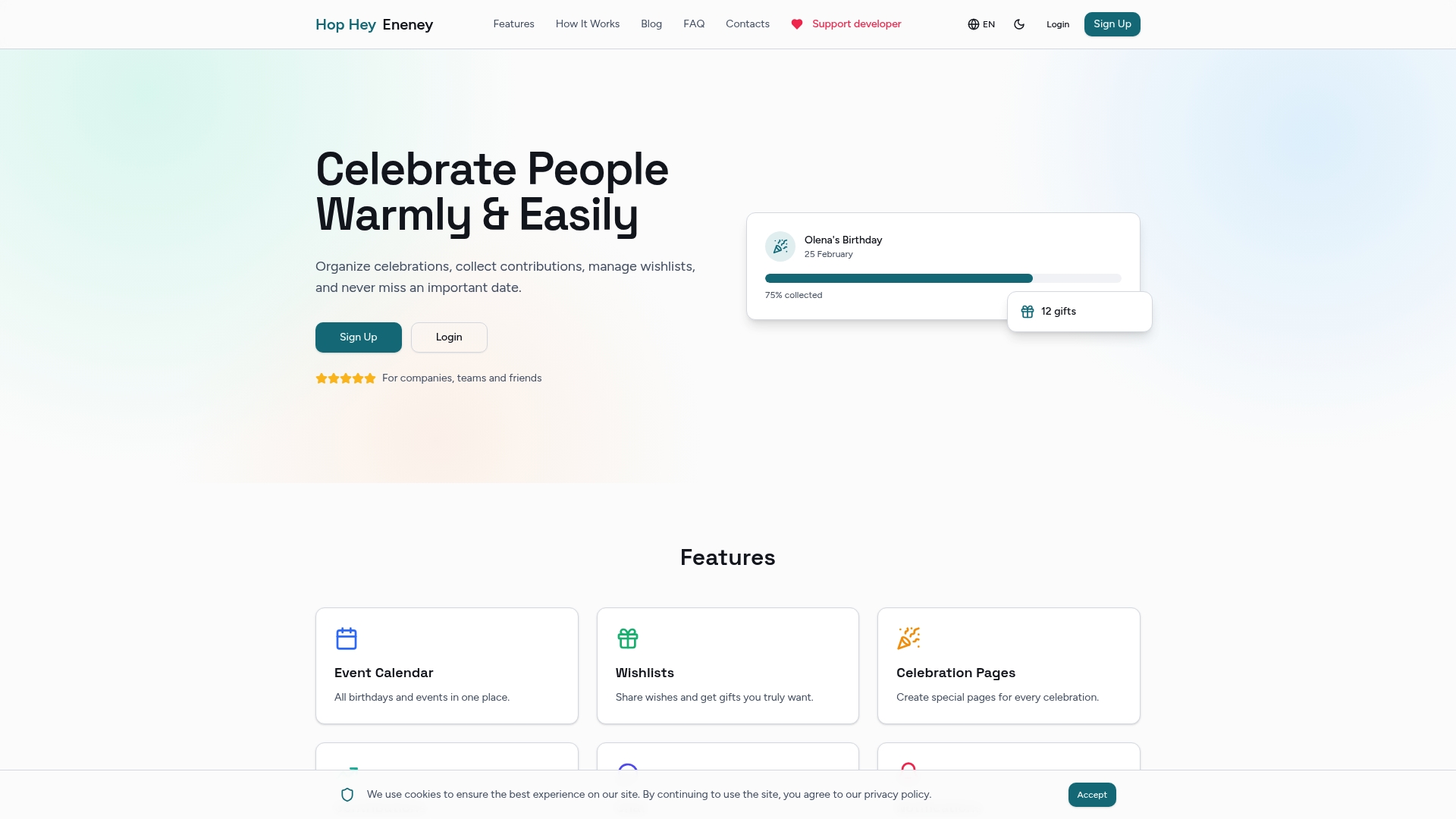
Hophey is a celebration management platform built for exactly this. HR teams use it to track employee milestones, coordinate group gift contributions transparently, and communicate in a private chat without spoiling the surprise. Remote and hybrid teams use it to organize meaningful events across time zones without the usual back-and-forth. Every celebration gets its own private page, shared calendar entry, and contribution tracker. You can start organizing team celebrations today and turn recognition from a good idea into a repeatable practice your team actually feels.
FAQ
What is team celebration culture?
Team celebration culture is the intentional practice of regularly acknowledging achievements, milestones, and contributions within a team to strengthen morale, belonging, and performance. It includes both formal recognition programs and informal daily practices.
How does recognition affect employee retention?
Companies with consistent recognition programs report significantly lower turnover. Research from Achievers shows that 69% of employees would work harder if they felt better appreciated, making recognition one of the most cost-effective retention tools available.
What is the difference between public and private recognition?
Public recognition reinforces team-wide values and makes contributions visible to peers, while private recognition suits personal achievements or introverted employees. The most effective leaders use both, matching the type to the individual and the context.
How often should teams celebrate wins?
Weekly recognition correlates with 5.9x higher appreciation and engagement according to Achievers research. Small, frequent celebrations are more effective at sustaining motivation than large, infrequent events.
How can HR teams manage celebrations at scale?
HR teams can use platforms like Leapsome for recognition automation and Hophey for coordinating group celebrations, gift contributions, and milestone tracking. You can also review HR celebration strategies for a structured implementation approach.