
TL;DR:
- Celebrating workplace birthdays fosters stronger morale, team bonds, and employee retention by providing meaningful recognition.
- Inclusion and opting out options are essential to ensure celebrations are respectful, culturally sensitive, and personalized.
- Using centralized, goal-oriented platforms prevents resentment, reduces costs, and turns birthday rituals into authentic culture-building tools.
More companies are quietly scrapping birthday celebrations to dodge awkwardness, yet the evidence points in the opposite direction. Teams that mark birthdays with even small, well-organized rituals report stronger morale, tighter bonds, and higher retention. The tension HR managers feel is real: how do you celebrate without excluding, pressure without forcing, and recognize without embarrassing? This guide works through exactly that, giving you evidence-backed reasons to keep (or restart) birthday programs, a practical framework for running them well, and clear guidance on avoiding the traps that turn good intentions into resentment.
Table of Contents
- Why corporate birthdays matter for team performance
- Inclusion, diversity, and the 'opt-out' principle
- Potential pitfalls: The culture tax and avoiding resentment
- Practical steps for organizing meaningful celebrations
- What experts miss: The real value (and risk) of celebrating at work
- Make celebrating easy with the right platform
- Frequently asked questions
Key Takeaways
| Point | Details |
|---|---|
| Boost engagement | Organized birthdays measurably increase team morale and a sense of belonging. |
| Promote inclusion | Respecting opt-out choices and diverse preferences keeps celebrations positive. |
| Avoid resentment | Central funding and voluntary participation reduce pressure and culture tax. |
| Easy implementation | A structured process ensures events are effective, low-stress, and sustainable. |
Why corporate birthdays matter for team performance
Let's begin by understanding why birthday celebrations matter for group dynamics and the organization as a whole.
Recognition is not a luxury. When people feel seen at work, they perform better, stay longer, and contribute more to their teams. Birthdays are one of the simplest, most natural opportunities to create that feeling on a recurring basis. They don't require a performance review cycle or a special budget approval. They happen every year, for everyone, which makes them a uniquely democratic form of recognition.
Birthday recognition affects employee morale and team bonding in measurable ways. Research consistently shows that team celebration engagement benefits extend beyond the individual being celebrated. When teammates witness someone being recognized, they internalize the message: "This team notices when you matter." That sense of belonging fuels discretionary effort, which is the extra energy people give when they actually care about where they work.
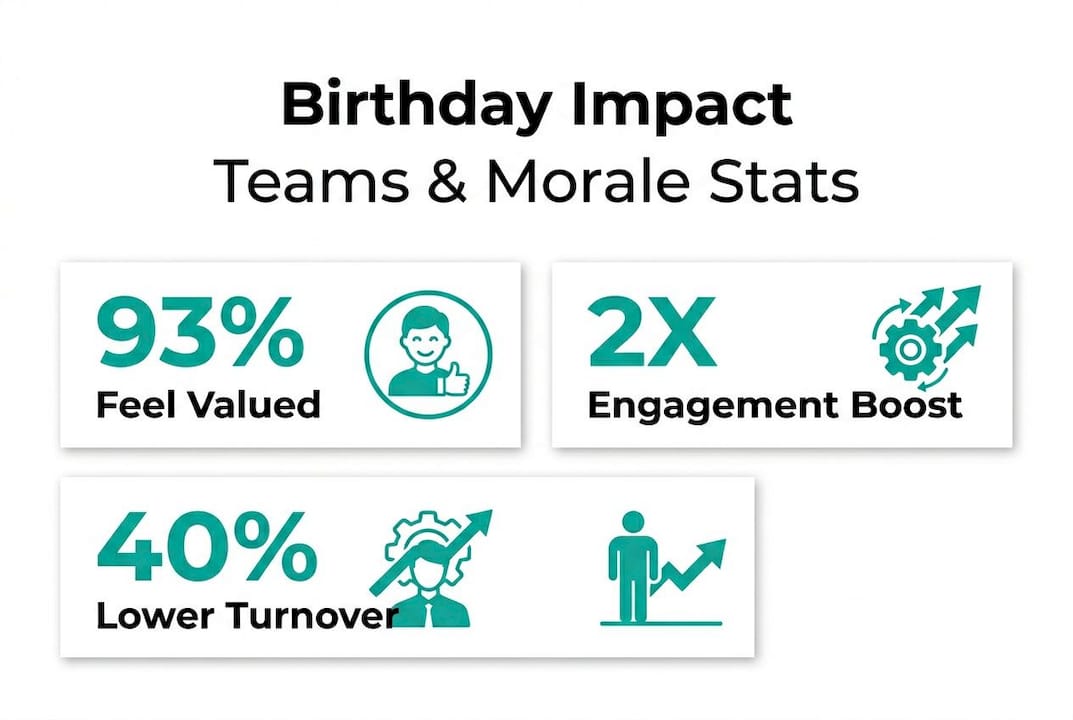
| Metric | Teams with no celebration | Teams with regular celebrations |
|---|---|---|
| Employee engagement score | Below average | 23% higher on average |
| Voluntary turnover rate | Higher by 18% | Noticeably reduced |
| Peer collaboration index | Moderate | Significantly elevated |
| Self-reported sense of belonging | 44% | 71% |
There's also a direct impact on employee recognition culture more broadly. Companies that normalize celebrating milestones tend to build cultures where recognition flows in multiple directions, not just top-down. Peer-to-peer appreciation becomes more common, and managers find it easier to give feedback because the emotional foundation is already there.
Some tangible benefits HR managers consistently observe include:
- Reduced absenteeism around key periods because employees feel more connected to their teams
- Faster onboarding for new hires who feel welcomed through inclusive team rituals
- Stronger cross-departmental relationships when celebration events include people from different teams
- Higher participation in other culture initiatives because birthday programs establish a habit of engagement
Properly documented corporate events also create lasting memories that reinforce company identity. Photos, messages, and shared moments from birthday celebrations become artifacts of your culture, the kind employees share with friends and mention when recommending the company as a great place to work.
Inclusion, diversity, and the 'opt-out' principle
Understanding the benefits is only part of the story. Next, see how inclusion is crucial for a celebration to work for everyone.
Not every employee wants their birthday acknowledged in front of a group. Some people have religious or cultural beliefs that discourage birthdays. Others have experienced trauma connected to a specific age or date. Still others simply value privacy. A well-meaning surprise party or a chorus of "Happy Birthday" in the office kitchen can feel deeply uncomfortable if the person being honored never asked for it.
"Preferences and opt-out matter; not everyone wants to participate for personal, cultural, or disability-related reasons." This framing from an employment lawyer on workplace birthdays is a useful reminder that what feels celebratory to the organizer may feel invasive to the recipient.
The smartest HR teams build opt-out (and even opt-in) mechanics into their birthday programs from the start. This isn't about eliminating celebration. It's about making sure the celebration actually lands well for the person receiving it.
Practical ways to build inclusion into your program:
- Offer a preference form during onboarding that asks how employees like to be recognized: public, private, or not at all
- Default to low-key acknowledgment such as a digital card, then scale up only for employees who opt in to bigger celebrations
- Avoid announcing birthdays company-wide unless the employee has explicitly agreed
- Respect dietary, cultural, and accessibility needs when planning any food or venue components
- Review your practices annually because preferences change and new team members bring different expectations
Inclusive event planning is not just about being polite. It's strategically smart. When employees trust that you won't put them in an uncomfortable spotlight without consent, they're more likely to actually enjoy and participate in the moments they do choose.

Pro Tip: Run an anonymous survey once a year asking employees how they prefer to have birthdays acknowledged at work. Give four clear options: public team celebration, small group acknowledgment, private message from their manager, or no acknowledgment. The data will surprise you, and it will protect the company legally while building genuine goodwill.
Meeting employee needs around celebrations also means being aware of how visible certain choices are. If one person gets a big cake and another gets nothing because they opted out, that contrast is visible to the whole team. The solution is consistency in the effort of recognition, not necessarily the format.
Potential pitfalls: The culture tax and avoiding resentment
Once you address inclusion, it's vital to avoid common mistakes. Let's cover the pitfalls and how to prevent them.
The phrase "culture tax" has been circulating in workplace discussions for a reason. It refers to the informal financial and social pressure employees feel when expected to contribute to group gifts, celebrations, or social events as an unspoken condition of fitting in. Birthday traditions, despite their positive intent, are one of the most common sources of this pressure.
Birthday traditions can pressure employees or feel like a "culture tax," especially when contribution amounts are implied, visible, or compared across events.
The problem compounds in mixed-income teams. When a junior coordinator sits next to a senior director and both are expected to chip in equally for a gift, the social math gets uncomfortable fast. Add irregular enforcement (big celebration for one person, nothing for another born the same month) and resentment builds quickly.
| Approach | Employee experience | HR overhead | Risk level |
|---|---|---|---|
| Forced group gift pooling | High pressure, low satisfaction | Low but reactive | High: resentment, legal risk |
| Voluntary pooling with no system | Inconsistent, awkward asks | Medium: lots of coordination | Medium: exclusion feeling |
| Centrally funded celebrations | Fair, no personal cost | Low once set up | Low: most equitable |
| Platform-managed wishlists | Personalized, transparent | Very low: automated | Very low: best practice |
Organizing birthdays at work using a centrally funded model, where a fixed budget per employee is allocated from the company rather than collected from peers, solves most of these issues in one step. People don't feel obligated. The recognition feels institutional rather than personal, which is actually appropriate in a professional setting.
Here's a step-by-step process for removing the culture tax from your birthday program:
- Establish a per-employee budget approved by leadership, funded from the HR or culture budget, not from team members
- Communicate the policy clearly at onboarding and in your employee handbook: "All birthday celebrations are funded by the company; no personal contributions are expected or accepted"
- Assign a single coordinator (or use a platform to automate this) rather than rotating the responsibility, which creates unequal burden
- Standardize the format so every birthday receives equivalent effort and visibility, adjusted only for the individual's stated preferences
- Create a transparent record of what was spent per event to ensure fairness across departments and salary bands
The goal is to make the celebration feel generous without making anyone feel indebted or excluded.
Practical steps for organizing meaningful celebrations
Now, let's turn to a practical framework to help you execute birthdays that matter.
Centralized planning and wishlists reduce pressure and boost participation, giving employees a direct say in what they receive rather than leaving it to guess work. This shift from assumption to preference-based celebration is small in execution but enormous in impact.
Here is a five-step framework that HR teams in mid-size and large companies can implement immediately:
-
Build your birthday calendar by collecting birth dates (month and day only, not year if employees prefer privacy) during onboarding. Add this to a shared, accessible HR calendar with automated reminders set 14 days before each birthday.
-
Gather preferences early using a short intake form. Ask: How would you like to be recognized? What types of gifts do you enjoy? Are there any dietary or cultural considerations for a celebration? Do you have a public wishlist or categories you'd love?
-
Set up individual wishlists for employees who want them. A wishlist system removes the gift-guessing problem entirely and lets contributors feel confident their contribution is actually useful. You can use work birthday wishlists tools specifically built for this purpose.
-
Coordinate behind the scenes using a private channel or platform that excludes the birthday person. This preserves the element of surprise, manages fund collection transparently, and keeps the planning stress low for whoever is coordinating.
-
Execute and document the celebration in whatever format the employee prefers, from a quiet desk drop with a card to a team lunch. Take a photo if the employee consents, and share it in a channel where the person can see the appreciation without it being forced.
Pro Tip: Always communicate two things explicitly before any birthday event: how it's funded (so no one feels pressured to contribute) and how to opt out (so no one feels trapped). These two sentences of communication prevent 90% of the discomfort that surrounds workplace birthdays.
Following solid celebration planning steps creates consistency, and consistency is what turns a one-off gesture into a genuine culture ritual. You can also take cues from respectful birthday traditions to make the physical or edible elements of celebrations feel thoughtful rather than generic.
What experts miss: The real value (and risk) of celebrating at work
Most HR guides tell you to standardize everything. Create a policy. Assign a budget. Pick a format. Follow the template. That approach works well for compliance but misses what actually makes a birthday celebration land emotionally.
The real value of a workplace birthday is not the gift or the cake. It's the five minutes where someone on the team says, through action rather than words: "We know you exist. We're glad you're here." That message is profound precisely because it's not tied to performance. It's unconditional acknowledgment, and that's rare in most workplaces.
Where standardization gets dangerous is when it strips out individual meaning. A team leader who sends the same four-sentence Slack message to every employee on their birthday isn't building culture. They're executing a task. Employees feel the difference immediately. Genuine recognition requires at least a small amount of personal knowledge. Remembering that someone loves hiking, or has a dog named Bruno, or just passed a tough certification, and weaving that into the acknowledgment, turns a routine moment into a memorable one.
The deeper risk, as employment lawyers on workplace birthdays point out, is in assuming everyone shares your enthusiasm for celebration. Forced fun is one of the fastest ways to erode trust. When employees feel they must perform gratitude or happiness in response to a celebration they didn't want, they often come away feeling less connected to their team, not more.
Our take at Hop Hey Eneney: psychological safety is the foundation of any successful celebration program. When people know they can opt out without social penalty, the people who opt in do so genuinely, and that authenticity transforms the energy in the room. The key metric is not "did we do birthdays for everyone" but "did people leave the moment feeling appreciated."
A smart path forward is to invest in corporate celebration strategies that prioritize employee agency over process compliance. Give your team real choices. Fund celebrations centrally so no one feels obligated. Let the person being celebrated shape the format. Then step back and let the genuine connection do its work.
Make celebrating easy with the right platform
Bringing all of this together manually is where even the best HR intentions fall apart. Tracking birthdays in a spreadsheet, nudging teammates in multiple chat threads, collecting money informally, and hoping nobody forgets is not a system. It's a recurring source of stress.
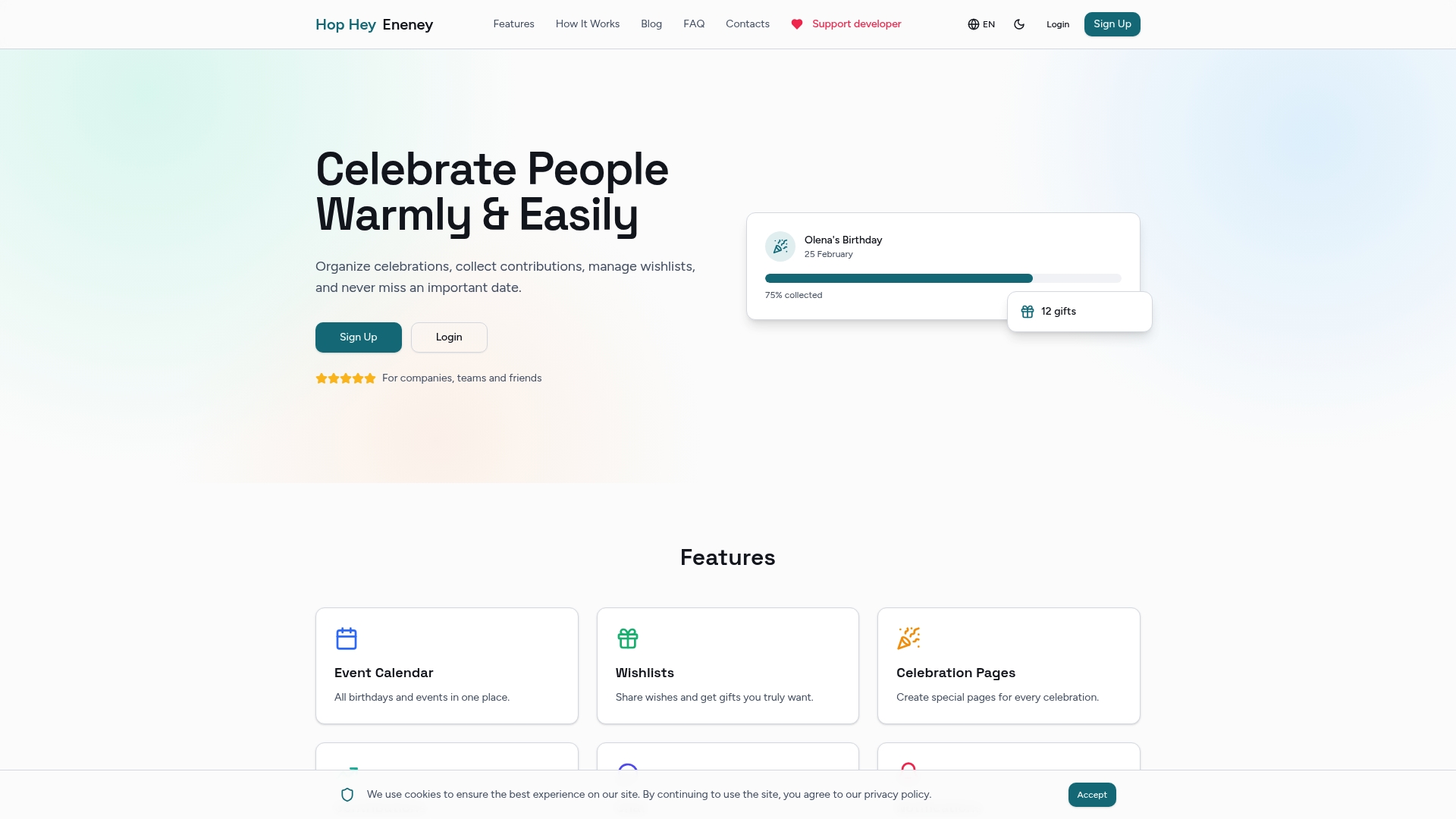
Hop Hey Eneney was built specifically to remove that chaos. The platform gives HR teams and team leaders a single place to manage every part of the celebration process: shared birthday calendars with automated reminders, private event pages where coordinators plan without spoiling the surprise, transparent fund collection so contributors see exactly where money goes, and personalized wishlists so gifts actually match what the recipient wants. With support for multi-currency contributions in UAH, USD, and EUR, plus email and Telegram notifications, the platform works for distributed teams just as well as for office-based ones. If you're ready to turn birthday chaos into a culture asset, explore what Hop Hey Eneney can do for your team at hophey.gifts.
Frequently asked questions
How do I ensure birthday celebrations are inclusive?
Always offer employees a clear way to opt out without social pressure, and gather preferences anonymously so people feel safe sharing their actual comfort level. As employment lawyers advise, avoid assuming everyone wants the same type of recognition.
Are centrally funded birthdays better than gift pooling?
Yes, in most workplace contexts. Centrally funded celebrations remove the financial pressure and awkward asks that make birthday pooling feel obligatory, especially in teams with mixed income levels.
How can HR measure the impact of birthday celebrations?
Run short post-event surveys and track trends in engagement scores, voluntary participation rates, and peer recognition frequency over time. Recognition rituals like birthdays show up in engagement data when tracked consistently across quarters.
What are the main risks of not organizing birthdays?
Employees whose milestones pass without any acknowledgment tend to feel undervalued and invisible, which research links to reduced discretionary effort and higher likelihood of voluntary turnover. The absence of recognition sends an unintentional but clear message.
Recommended
- How to Organize a Birthday at Work
- Why organize team celebrations: boost engagement 1.5%
- Managing corporate celebrations: tools & strategies for HR
- Team celebration: boost engagement and recognition in 2026
- How to create memorable team events that build real collaboration
- Teamevents steigern Motivation um 68% und Zusammenarbeit