
TL;DR:
- Structured wishlists improve transparency, personalization, and record-keeping in workplace gifting.
- They reduce organizer workload and minimize fairness and participation issues.
- Using platforms for wishlists turns gifting into ongoing cultural feedback and engagement tools.
Managing group gifts at work has a reputation for being chaotic. Someone sends a message in Slack, half the team misses it, and you end up with a generic gift card nobody wanted. But that story is outdated. Wishlists have quietly shifted from personal shopping tools into structured HR assets that save time, reduce awkwardness, and actually make people feel seen. This guide breaks down how wishlists work in a team context, what benefits they deliver for HR managers, where the pitfalls hide, and how to roll them out in a mid-to-large organization without creating new headaches.
Table of Contents
- Understanding wishlists: From consumer tool to HR asset
- How wishlists transform group gifting workflows
- Benefits and challenges: Personalization, efficiency, and pitfalls
- Best practices for implementing wishlists in your company
- Our perspective: What most HR teams miss about wishlists
- Streamline your team gifting with Hop Hey
- Frequently asked questions
Key Takeaways
| Point | Details |
|---|---|
| Gifting made easy | Wishlists automate group gift selection and contributions, reducing HR workload and errors. |
| Personalization drives morale | Allowing team members to choose their own gifts boosts satisfaction and workplace engagement. |
| Compliance and transparency | Structured wishlist solutions support fair, auditable gifting while avoiding favoritism and pressure. |
| Track results for improvement | Modern platforms enable HR to review impact and engagement, informing better future celebrations. |
Understanding wishlists: From consumer tool to HR asset
A wishlist, at its core, is a curated list of desired items or experiences that someone shares with others to guide gift selection. Most of us first encountered them on retail sites during the holidays. You add a few things you actually want, share the link, and avoid the awkward sweater exchange. Simple, effective, personal.
For years, workplace gifting ignored this model entirely. HR teams relied on email chains, shared spreadsheets, or the classic "everyone chip in" approach that always left someone feeling guilty for contributing less. The result was predictable: generic gifts, wasted budget, and an organizer who spent three hours coordinating something that should have taken thirty minutes.
The shift started when companies recognized that workplace wishlist management could bring the same clarity and personalization into professional settings. Instead of guessing what a colleague wants for their work anniversary, HR can invite the recipient to build a curated list. Contributions become transparent, choices become intentional, and the whole process becomes auditable.
Here is what structured wishlists bring to an HR workflow:
- Transparency: Every contributor sees what is being collected and how much has been raised.
- Personalization: Recipients get something they actually want, not a generic gift basket.
- Record-keeping: Platforms log contributions, selections, and delivery confirmations automatically.
- Scalability: The same process works whether you are celebrating one person or running a company-wide recognition campaign.
- Compliance support: Unused funds can be tracked and returned, which matters for finance and legal teams.
Amazon Business supports wishlist-like gifting via Business Giving, simplifying HR gift campaigns at scale. That kind of infrastructure signals that wishlists are no longer a consumer novelty. They are a legitimate HR tool.
Pro Tip: Before choosing any platform, confirm it offers an audit trail. Finance teams will thank you when budget reconciliation comes around.
How wishlists transform group gifting workflows
Knowing what wishlists are, it is time to see how they work in a real-world team gifting scenario. The mechanics matter because a poorly structured process can create as much confusion as the spreadsheet it replaced.
Here is a practical step-by-step for running a wishlist-based gift campaign for a team event:
- Create the event page. Set up a private celebration page for the recipient, including the occasion, date, and contribution deadline.
- Invite the recipient to build their list. Give them a window to add items across a range of price points so contributors at different budget levels can participate comfortably.
- Share the campaign with the team. Automated reminders handle follow-ups so the organizer is not chasing people manually.
- Collect contributions transparently. Each team member sees the running total, which builds momentum and reduces the "I'll do it later" effect.
- Confirm the gift selection. Once the target is reached, the platform confirms the choice and initiates delivery or fund transfer.
- Track outcomes. HR gets a record of participation, amounts contributed, and delivery confirmation.
"Admins can upload recipient lists, curate item catalogs, and track redemptions in real time," making the entire process visible and manageable without constant manual oversight.
The tracking piece is where seamless group gifting platforms genuinely outperform informal methods. When a contribution goes unclaimed or a campaign falls short of its target, structured platforms flag it immediately. Funds can be returned or redirected rather than disappearing into an ambiguous pool.
For HR managers running multiple celebrations across departments, birthday list tools that integrate with calendar systems mean no event slips through the cracks. The system reminds you. You approve. The team celebrates. That is the workflow shift wishlists make possible.
One underappreciated benefit is the reduction in organizer burnout. In most companies, the same two or three people end up coordinating every celebration. Structured wishlist platforms distribute that load by automating reminders and contribution tracking, so the burden does not fall on one person every single time.

Benefits and challenges: Personalization, efficiency, and pitfalls
Having covered the mechanics, let us weigh the advantages and issues HR leaders should consider before rolling out wishlists company-wide.
The benefits are real and measurable. Personalized gifting increases recipient satisfaction because people receive items they chose, not items someone guessed they might like. That distinction matters more than it sounds. A gift that reflects genuine attention to preference signals that the company sees the employee as an individual, not just a headcount.
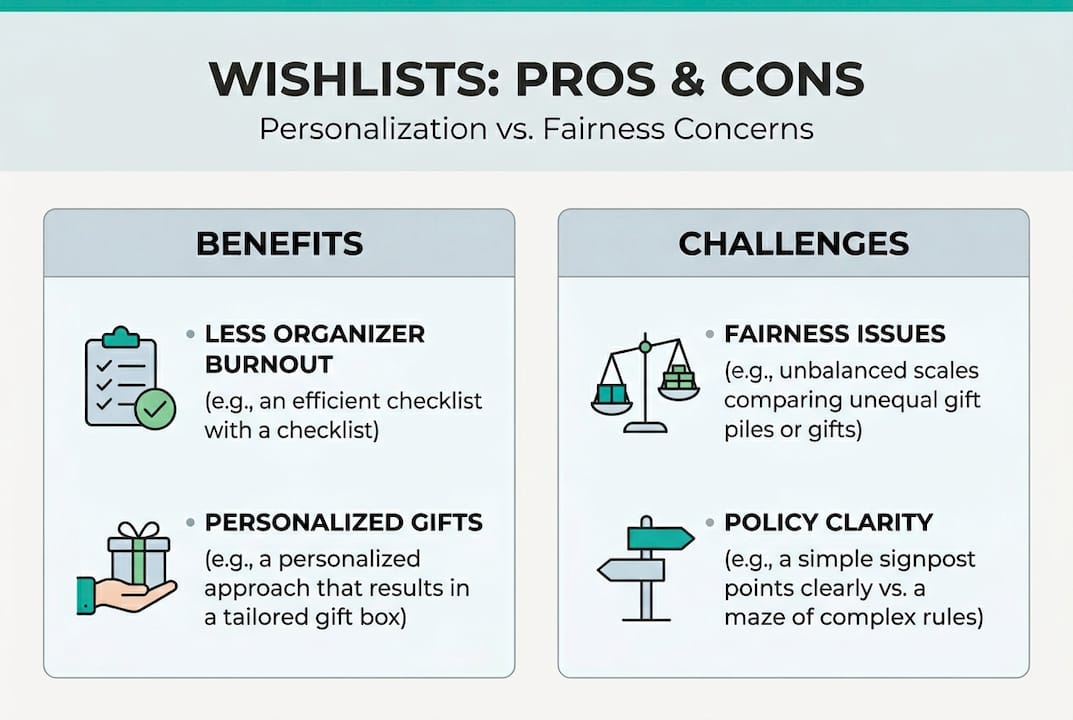
Wishlists boost personalization and efficiency but can raise fairness concerns if managed informally. That caveat deserves attention.
Here is a quick comparison of informal versus structured wishlist approaches:
| Factor | Informal wishlist (email/chat) | Structured platform |
|---|---|---|
| Transparency | Low | High |
| Audit trail | None | Automated |
| Contribution equity | Uneven | Trackable |
| Organizer workload | High | Low |
| Compliance support | Minimal | Built-in |
| Recipient experience | Inconsistent | Personalized |
The risks worth flagging for HR:
- Social pressure on junior staff. If contribution amounts are visible to managers, lower-level employees may feel compelled to give more than they can afford.
- Inequity across departments. Teams with larger budgets or more enthusiastic organizers may celebrate more lavishly, creating visible disparity.
- Assumption of participation. Opt-in should be genuinely optional, not socially mandatory.
Structured platforms resolve most of these issues by setting contribution caps, anonymizing amounts if needed, and enforcing consistent rules across the organization. Pairing your platform with clear HR gift exchange rules closes the remaining gaps.
Pro Tip: Publish your gifting policy alongside your wishlist rollout. When employees understand the rules upfront, participation feels voluntary rather than obligatory.
If you are evaluating options, reviewing top wishlist apps side by side will help you identify which platforms include the compliance and equity features your organization actually needs.
Best practices for implementing wishlists in your company
To maximize benefits and minimize pitfalls, clear steps and structures matter. Here is how to roll out wishlists effectively in a mid-to-large organization.
Start by choosing the right tool. Informal lists shared via chat create more problems than they solve at scale. A dedicated platform gives you the infrastructure for tracking, reminders, and reporting. Amazon Business's approach includes CSV uploads, curated options, and redemption tracking as baseline best practices for enterprise gifting programs.
Here is a rollout sequence that works:
- Select your platform based on team size, budget, and compliance requirements.
- Define your gifting policy covering contribution limits, eligible occasions, and opt-in language.
- Onboard HR administrators with a short training session covering the platform's key features.
- Pilot with one department before rolling out company-wide. Collect feedback on the experience.
- Communicate broadly using clear, jargon-free messaging that explains what wishlists are and why the company is using them.
- Track outcomes after each campaign: redemption rate, participation percentage, and any unused funds.
Here is a sample data snapshot from a mid-size company's first quarter using structured wishlists:
| Metric | Before wishlists | After wishlists |
|---|---|---|
| Avg. organizer time per event | 3.5 hours | 45 minutes |
| Redemption rate | 62% | 91% |
| Employee satisfaction score | 6.4/10 | 8.7/10 |
| Unused fund rate | 18% | 3% |
Those numbers reflect what happens when structure replaces improvisation. Reviewing corporate celebration strategies alongside your rollout plan helps you connect gifting to broader engagement goals rather than treating it as an isolated task.
For ongoing improvement, use team celebration insights to benchmark your participation rates and identify which event types generate the strongest response from your team.
Our perspective: What most HR teams miss about wishlists
Most HR teams adopt wishlists to solve a logistics problem. That is a reasonable starting point, but it stops short of the real opportunity.
Wishlists are not just task-savers. They are a feedback mechanism. When you see which items employees choose, at what price points, and how enthusiastically colleagues contribute, you get a window into what your team actually values. That data is more honest than an annual survey.
The biggest missed opportunity we see is treating wishlists as a one-off tool rather than an ongoing culture signal. Companies run a birthday campaign, it goes well, and then nothing changes in how they think about recognition. The wishlist becomes a convenience rather than a strategy.
The teams that get the most from this approach debrief after each campaign. Which gifts generated the most excitement? Which occasions had the lowest participation? Those answers shape the next celebration and, over time, the broader recognition culture.
Another common error is assuming the platform does all the work. Technology handles logistics. Humans handle meaning. Organizing team celebrations with intention, not just efficiency, is what turns a gift into a genuine moment of connection. The wishlist is the structure. The culture is what you build around it.
Streamline your team gifting with Hop Hey
If you are ready to implement these wishlist strategies, here is how you can get started right now.
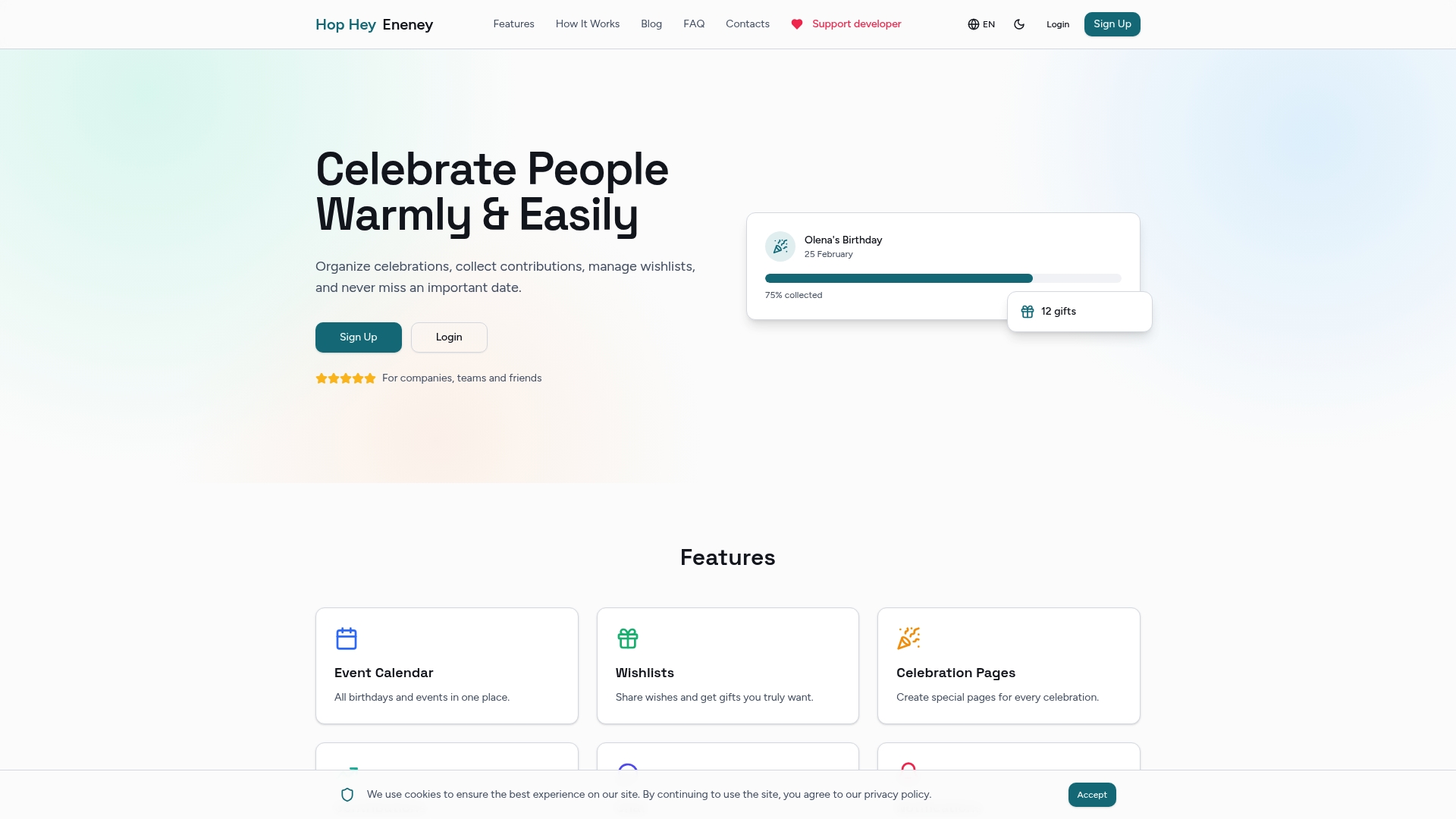
The Hop Hey gifting platform was built specifically for teams and organizations that want structure without complexity. HR managers can create private celebration pages, collect contributions transparently across multiple currencies, send automated reminders via email and Telegram, and track every campaign from a single dashboard. Role-based permissions mean the right people see the right information, and the person being celebrated stays in the dark until the moment is right. Whether you are managing a team of 20 or a company of 2,000, Hop Hey gives you the tools to make every celebration feel personal and every process feel effortless.
Frequently asked questions
How do wishlists support fair team gifting in large organizations?
Wishlists on structured platforms let everyone choose gifts transparently, track contributions, and ensure equal participation. Platforms track redemptions and unused funds for compliance, making fairness auditable rather than assumed.
What's the main HR benefit of using wishlists for work celebrations?
HR saves time and avoids manual tracking while offering personalized, meaningful gifts matched to team members' preferences. Personalized and efficient gifting reduces HR workload and increases engagement simultaneously.
How do you avoid favoritism or pressure with workplace wishlists?
Adopting formalized wishlist tools ensures all choices are visible, rules are clear, and contributions are fair, reducing bias. Structured platforms solve informal wishlist pitfalls like social pressure and contribution inequity.
Can wishlists help track the impact of gifting on engagement?
Yes, platforms with analytics let HR see which gifts resonate and monitor participation to improve future celebrations. Platform tracking of redemptions and unused funds provides actionable engagement data over time.