
TL;DR:
- A corporate gifting checklist ensures gifts are appropriate, timely, and within budget by promoting deliberate planning. Effective programs segment recipients, set tiered budgets, choose meaningful gifts, and incorporate policies to enhance consistency and impact. Success depends on early planning, subtle branding, and coordinated execution to foster genuine loyalty and goodwill.
A corporate gifting checklist is a structured planning tool that ensures every gift sent on behalf of your company is appropriate, on time, and within budget. The best programs treat gifting as a deliberate business practice, not an afterthought. That means defining recipient segments, setting tiered budgets, choosing gifts that reflect company values, and building in enough lead time to avoid costly mistakes. This guide walks HR managers and team leaders through each critical step, from first planning meeting to final delivery.

1. Build your corporate gifting checklist before anything else
The first mistake most teams make is skipping the planning document entirely. A written checklist forces you to answer the hard questions upfront: Who receives gifts? What is the budget per person? What occasions trigger a gift? Without this structure, gifting becomes reactive and inconsistent, which undermines the goodwill it is supposed to create.
Your checklist should cover six core areas: recipient segmentation, budget tiers, gift selection criteria, approval workflows, delivery timelines, and compliance rules. Each area depends on the others. A budget tier that does not match your recipient categories will produce awkward mismatches, like a $10 gift card sent to a key client who generates $500,000 in annual revenue.
Pro Tip: Create the checklist in a shared document that HR, finance, and team leaders can all access and update. Gifting decisions made in silos produce inconsistent results.
2. Segment your recipients and set gifting tiers
Recipient segmentation is the foundation of any effective gifting program. The five main categories are employees, clients, executives, business partners, and remote team members. Each group has different expectations, relationship depths, and appropriate gift values.
Tiered budget frameworks align investment with relationship significance. Tier levels commonly range from $8 to $250 per recipient. That spread reflects the real difference between a bulk employee appreciation gift and a premium present for a VIP client who has been with your company for a decade.
| Tier | Recipient type | Budget range | Gift examples |
|---|---|---|---|
| Entry | All-staff, large groups | $8–$25 | Branded notebooks, drinkware, snack kits |
| Mid | Loyal employees, regular clients | $25–$75 | Tech accessories, wellness kits, coffee sets |
| Premium | Executives, key clients, VIPs | $75–$250 | Curated gift boxes, premium drinkware, experiences |
Pro Tip: Start by listing every recipient group before you pick a single gift. Categories clarify budget decisions faster than any other step.
3. Choose gifts that recipients actually want
The best corporate gifts solve a daily problem or improve someone's work life. Effective gifts are items the recipient would purchase for themselves. High-quality insulated bottles and premium notebooks consistently outperform novelty items because people use them every day.
Sustainability matters more in 2026 than it did five years ago. Eco-friendly materials like cotton canvas and jute rank highly among recipients who care about environmental impact. Gifts with longevity and reusability signal that your company thinks beyond the moment.
Do's:
- Choose practical items that fit professional daily life
- Use subtle branding as a finishing touch, not the centerpiece
- Prioritize quality over quantity
- Consider wishlist-based gifting to let recipients guide selections
Don'ts:
- Send clothing, perfume, jewelry, or religion-related gifts. Culturally sensitive items create discomfort rather than goodwill
- Plaster your logo across every surface. Recipients feel marketed to, not appreciated
- Choose gifts based on what is easy to source rather than what the recipient values
- Send single-use swag that ends up in a drawer within a week
Pro Tip: Before finalizing any gift, ask yourself: "Would this person buy this for themselves?" If the answer is no, keep looking.
4. Plan your timeline and operational steps
Lead time is the single most underestimated factor in corporate gifting. Custom gifts require 6–12 months of lead time before major events. Late planning triggers rush fees, inventory shortages, and quality compromises that reflect poorly on your brand.
For holiday gifting, start planning in summer. For milestone or event-based gifts, work backward from the delivery date and add a two-week buffer for shipping delays and customization errors.
Operational checklist:
- Set your gifting calendar for the full year, including holidays, company anniversaries, and employee milestones
- Define budget allocations by tier and get finance approval before ordering
- Identify and vet vendors based on quality, lead times, and minimum order quantities
- Submit gift designs and branding assets for approval through your internal workflow
- Place orders with enough time to allow for production, quality checks, and shipping
- Track all orders with confirmation numbers and expected delivery dates
- Confirm receipt with recipients or team coordinators after delivery
Vendor evaluation criteria:
- Minimum order quantities and per-unit pricing at each tier
- Production lead times for custom and branded items
- Shipping options, including international delivery for remote teams
- Return and replacement policies for damaged goods
- Sustainability certifications if eco-friendly gifting is a program priority
A structured contribution workflow also helps when multiple team members are pooling funds for a single gift. Tracking who has contributed and how much prevents the awkward follow-up conversations that slow down execution.
5. Align gifting with company culture and policy
Ad-hoc gifting produces inconsistent results. Integrating gifting into a governance policy with approval workflows and tier frameworks transforms it from a one-off task into a repeatable brand initiative. That shift reduces administrative burden and increases the program's overall impact.
A written gifting policy should include:
- Approved gift tiers and budget limits by recipient category
- Prohibited gift types, including cash equivalents and items above regulatory thresholds
- Approval chain for gifts above a defined value
- Record-keeping requirements for audit and compliance purposes
- Annual training for anyone involved in purchasing or distributing gifts
Aligning gifting occasions with company milestones, work anniversaries, and cultural values makes the program feel intentional rather than obligatory. A gift sent on a work anniversary with a personal note from a team leader carries more weight than a generic holiday package. Involving HR and team leaders in gift selection also ensures that choices reflect the actual culture of the team, not just the preferences of a single procurement manager.
Measuring program success closes the loop. Simple post-gift surveys, tracking redemption rates for digital gifts, and monitoring employee satisfaction scores tied to recognition events all provide data to refine future gifting cycles. Gift exchange policies within the workplace also benefit from clear documentation that all team members can reference.
6. Coordinate group gifting across teams
Group gifting introduces coordination challenges that solo purchases do not. When ten people contribute to one gift, someone has to collect funds, track contributions, send reminders, and confirm the final order. Without a clear system, that process creates friction and delays.
Assigning defined gifting roles within a team solves this problem. One person manages fund collection, another handles vendor communication, and a third confirms delivery. Clear roles prevent duplicated effort and ensure accountability at each stage.
For remote teams, digital coordination tools become non-negotiable. Email threads and spreadsheets work for small groups but break down quickly when you are managing gifts for 50 or 100 employees across multiple time zones. Platforms that centralize fund collection, send automated reminders, and track contributions in real time remove the manual overhead that makes group gifting feel like a burden.
Coffee and specialty food gifts work particularly well for remote teams because they are easy to ship and universally appreciated. A coffee gift guide can help you identify options that travel well and suit a wide range of tastes without requiring personal knowledge of each recipient's preferences.
7. Apply subtle branding that enhances rather than advertises
Branding on corporate gifts is a finishing touch, not the main event. Subtle logos that feel like a thank-you outperform heavy branding that makes recipients feel like walking billboards. A small embossed logo on a leather notebook communicates quality and care. A giant printed logo on a cheap tote communicates neither.
The rule of thumb for 2026 gifting is this: if the branding would embarrass you on a premium retail product, it does not belong on a corporate gift. Apply your logo in one location, use brand colors as accents rather than backgrounds, and let the quality of the item carry the message.
Personalization adds more value than branding in most cases. A gift with the recipient's name or a reference to a shared milestone creates a stronger emotional connection than any logo. Standardized compliance policies that include branding guidelines help maintain consistency across large programs without requiring individual review of every order.
Key takeaways
A successful corporate gifting program requires structured planning, recipient segmentation, and a written policy that governs every decision from budget to delivery.
| Point | Details |
|---|---|
| Start with a written checklist | Define recipient groups, budgets, occasions, and compliance rules before selecting any gift. |
| Use tiered budgets | Match gift value to relationship significance, from $8 entry-level gifts to $250 premium presents. |
| Choose practical gifts | Select items recipients would buy themselves; prioritize quality, usability, and subtle branding. |
| Plan 6–12 months ahead | Custom gifts require long lead times; late orders trigger rush fees and inventory problems. |
| Build a governance policy | Written policies with approval workflows and record-keeping transform gifting into a repeatable program. |
What I have learned from watching gifting programs succeed and fail
The most common gifting failure I see is not a bad gift choice. It is a good gift that arrives three days after the event it was meant to celebrate. Timing is the silent variable that determines whether a gift lands as thoughtful or careless. Teams that treat gifting as a last-minute task consistently undercut the goodwill they are trying to build.
The second pattern I notice is an over-reliance on branded merchandise that serves the company's marketing goals rather than the recipient's actual preferences. A mug with a giant company logo is not a gift. It is an advertisement the recipient is expected to store in their kitchen. The best gifts I have seen are the ones where the branding is so subtle you almost miss it, and the quality is so obvious you do not.
My honest recommendation for any HR manager building a gifting program from scratch: spend 80% of your planning time on the recipient list and the selection criteria, and 20% on logistics. Most teams do it the other way around. They spend weeks comparing vendors and then rush the gift selection in the final days before a deadline.
The programs that build genuine loyalty are the ones that treat each recipient as an individual, even within a structured tier framework. That does not require a custom gift for every person. It requires enough thought to avoid sending a generic item that signals you did not think about them at all.
— Konstantin
How Hophey helps teams run gifting programs without the chaos
Running a corporate gifting program across a large team is a coordination problem as much as a selection problem. Hophey is built specifically for that coordination layer.
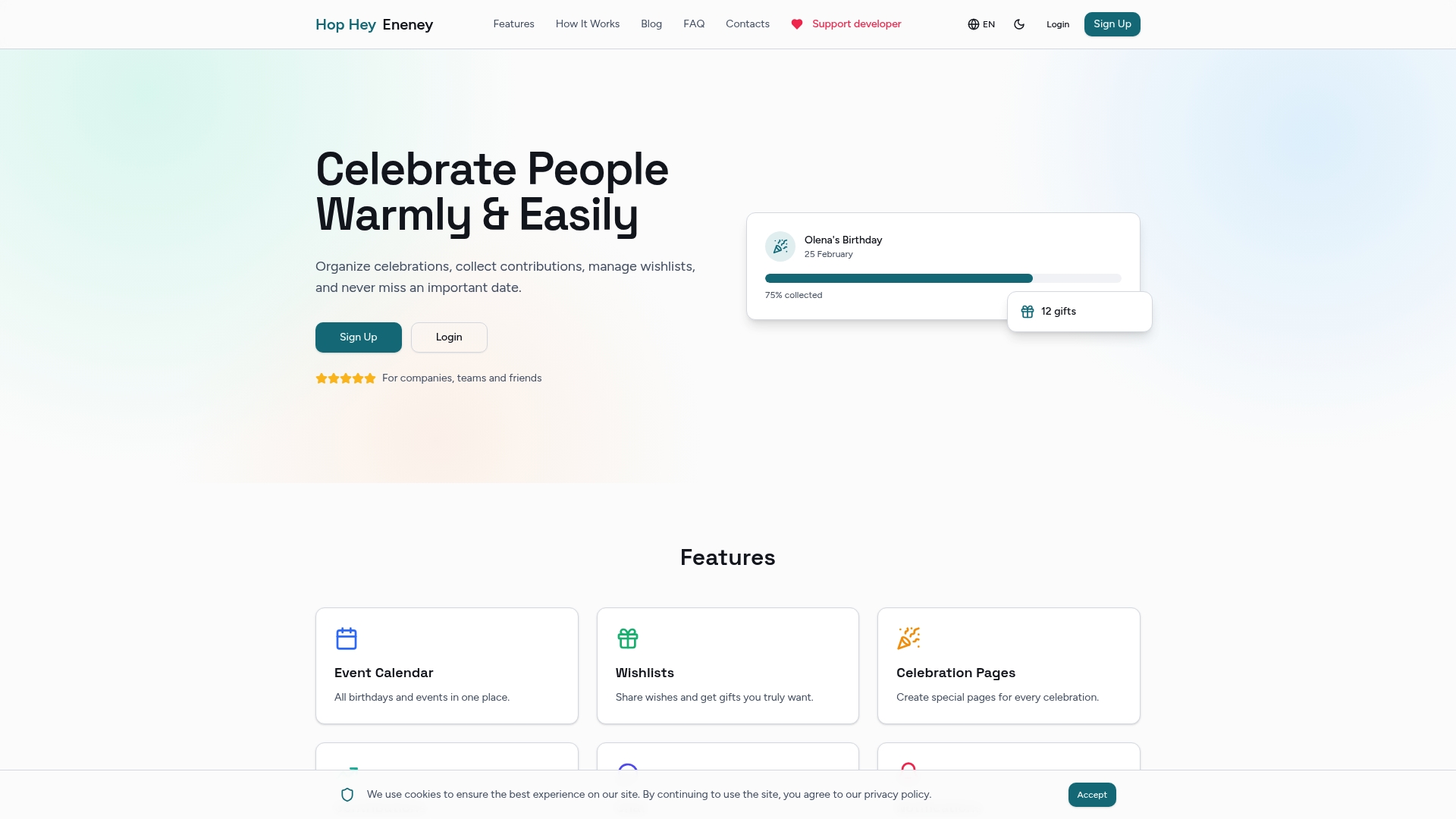
With Hophey, HR managers and team leaders can organize team gifting through private celebration pages, shared event calendars, and transparent fund collection that everyone can track in real time. Automated reminders via email and Telegram mean no one misses a contribution deadline or a delivery window. Role-based permissions let you assign the right responsibilities to the right people without creating confusion. Multi-currency support in UAH, USD, and EUR makes Hophey practical for distributed teams working across borders. If your gifting program needs structure, Hophey provides it without the spreadsheet overhead.
FAQ
What should a corporate gifting checklist include?
A corporate gifting checklist covers recipient segmentation, tiered budgets, gift selection criteria, approval workflows, delivery timelines, and compliance rules. Each element depends on the others to produce a consistent and effective program.
How far in advance should you plan corporate gifts?
Custom corporate gifts require 6–12 months of lead time before major events. For holiday gifting, start planning in summer to avoid rush fees and inventory shortages.
What gifts should you avoid in a workplace setting?
Avoid clothing, perfume, jewelry, cash equivalents, and religion-related items. These categories are either too personal or culturally sensitive for a professional gifting context.
How do you set a corporate gift budget?
Align budget tiers with recipient significance. Entry-level gifts for large employee groups typically fall in the $8–$25 range, while premium gifts for key clients or executives can reach $250 per recipient.
How do you measure whether a gifting program is working?
Track recipient satisfaction through post-gift surveys, monitor redemption rates for digital gifts, and review employee recognition scores over time. These data points reveal which gift categories and occasions generate the strongest response.