
TL;DR:
- Effective corporate event planning focuses on clear objectives that guide all decisions and measure success.
- Budgets should be based on objectives, with contingency funds reserved for unexpected costs and accurate headcount forecasts.
Corporate event planning is the process of designing and executing business events that build team engagement, reinforce company culture, and deliver measurable outcomes through deliberate goal alignment. Most professionals treat it as a logistics exercise. The best team leaders treat it as a business tool. This guide covers every phase of corporate event management strategies, from setting objectives and building budgets to measuring ROI and designing experiences that people actually remember.
What is a corporate event planning guide and why does it matter?
A corporate event planning guide is a structured framework that connects every planning decision back to a defined business objective. Without that connection, events become expensive social gatherings with no clear return. With it, a company anniversary dinner can drive retention, a product launch can generate pipeline, and a team offsite can rebuild trust after a difficult quarter.
Modern enterprise planning has shifted from simple logistics toward orchestration with integrated technology and measurable business value. That shift matters because it changes who owns the event. HR, marketing, and operations all have a stake. The team leader who understands this dynamic plans better events and secures better budgets.
The three named frameworks that appear most often in professional event management are experience architecture, KPI alignment, and post-event attribution. Each one is covered in detail below.
How do you set clear objectives and KPIs for a corporate event?
Start with purpose before logistics. This is the single most important rule in corporate event planning. Choosing a venue before you have a defined objective is like signing a lease before you know what business you are starting.

The most useful planning tool is a "North Star" objective: one sentence that describes what success looks like for the event. Every decision, from the speaker lineup to the seating arrangement, should connect back to that sentence. Frameworks that prioritize objectives over logistics consistently produce better outcomes and lower rework costs.
Once the objective is clear, define your KPIs. Useful corporate event KPIs include:
- Attendance rate: actual attendees versus registered, segmented by team or department
- Session engagement: poll responses, Q&A participation, and app interactions during the event
- Net Promoter Score (NPS): calculated as the percentage of promoters minus the percentage of detractors, NPS measures recommendation intent and gives you a single comparable number across events
- Content downloads and follow-up actions: how many attendees took a defined next step after the event
- Financial impact: pipeline generated, deals closed, or retention metrics tied to the event within an attribution window
Pro Tip: Write your KPIs before you write your agenda. If a session or activity does not connect to at least one KPI, cut it or replace it.
Attendance alone is a vanity metric. Engagement indicators like session attendance rates, poll responses, and networking activity give a far more accurate picture of whether the event delivered value.
How do you build a realistic budget for a corporate event?
A realistic budget starts with your objective, not with a venue quote. Once you know what you are trying to achieve, you can make informed decisions about where to spend and where to cut.
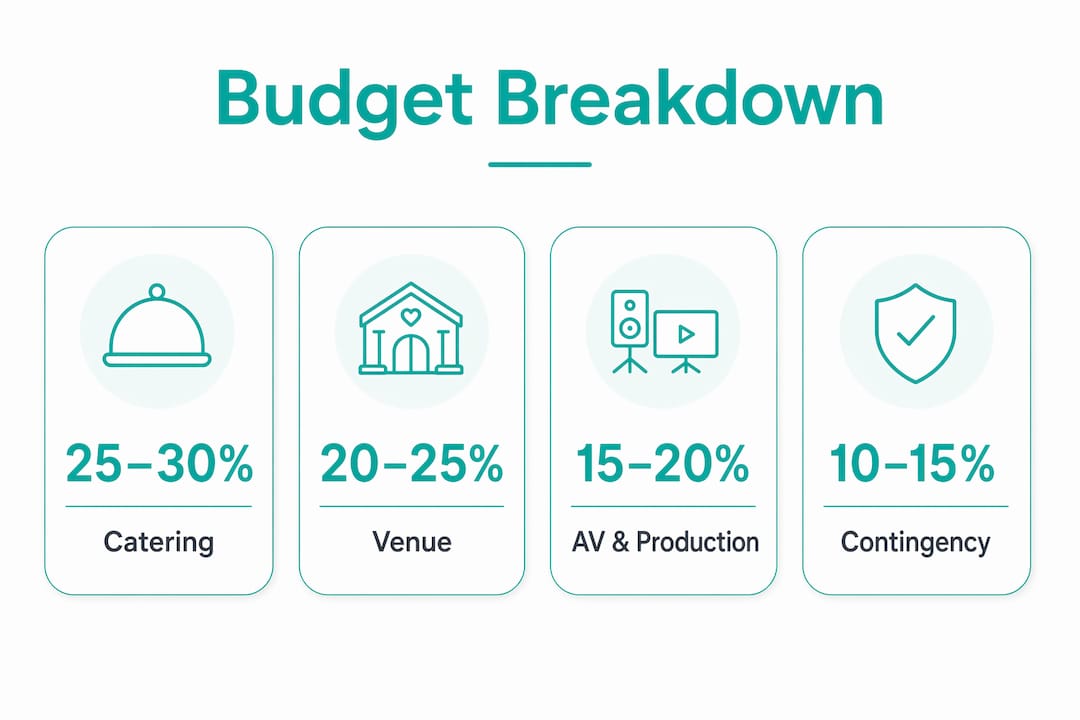
Typical mid-size event budgets allocate spending across these categories:
| Category | Typical share of total budget |
|---|---|
| Venue | 20–25% |
| Catering | 25–30% |
| AV and production | 15–20% |
| Marketing and communications | 5–10% |
| Speaker fees | 5–10% |
| Decor and branding | 5–8% |
| Contingency reserve | 10–15% |
On a $50,000 budget, catering alone runs $12,500 to $15,000. That number surprises most first-time planners. Build the contingency reserve into the original budget, not as an afterthought, because unexpected costs are not exceptional. They are standard.
Headcount accuracy directly controls budget precision because most cost categories scale with attendance. A 20% error in your attendance forecast can blow your catering and AV budgets simultaneously. Treat RSVP tracking as a core budget function, not an administrative task you hand off at the end.
Pro Tip: Lock your headcount estimate 6 weeks before the event and build a formal change-request process for any additions after that date. Late additions are the most common source of budget overruns.
What does an effective event timeline look like?
Lead time determines your options. Start planning large conferences 6–12 months in advance; events requiring custom production or major venues may need 12–18 months. Smaller team gatherings can move faster, but even a 50-person offsite benefits from 8–10 weeks of runway.
A practical timeline for a mid-size corporate event (100–300 attendees) looks like this:
- Months 6–5 before the event: Define objectives, set budget, confirm internal stakeholders, and begin venue search. Sign venue contract by the end of this phase.
- Months 4–3 before the event: Confirm AV vendor, catering partner, and any keynote speakers. Assign flexible team roles for day-of coordination. Open registration.
- Months 2–1 before the event: Finalize agenda, confirm headcount with vendors, review contracts for attrition clauses, and send attendee communications. Lock the run-of-show document.
- Weeks 2–1 before the event: Conduct a full vendor walkthrough, confirm logistics with all suppliers, and brief the day-of team. Send final attendee reminders.
- Day of the event: Execute against the run-of-show. Assign one person to own vendor communication and one person to own attendee experience. Do not let these roles overlap.
- Week after the event: Collect feedback immediately, reconcile the budget, and document lessons learned before memory fades.
Vendor evaluation follows a simple filter: references from comparable events, clear contract terms on attrition and cancellation, and a single point of contact. Vendors who cannot name a contact for day-of emergencies are a risk.
How do you design an event that people actually engage with?
Experience architecture is the practice of designing an event around emotional flow and audience journey, not just a timed agenda. Modern event frameworks prioritize this approach because attendees remember how an event made them feel far longer than they remember the content of any single session.
Practical ways to build engagement into your event design:
- Open with energy, not housekeeping. The first 10 minutes set the emotional tone. Use a speaker, a short video, or a group activity to create momentum before you cover logistics.
- Break the passive listening cycle. Sessions longer than 45 minutes without interaction lose audience attention. Use live polls, small group discussions, or Q&A breaks to reset focus.
- Design the networking intentionally. Unstructured networking time produces uneven results. Structured formats like topic tables, speed networking, or facilitated introductions produce more connections per hour.
- Build in hybrid participation. Remote attendees need more than a video feed. Dedicated chat moderators, virtual breakout rooms, and real-time polling keep distributed teams engaged alongside in-person attendees.
- Address accessibility from the start. Digital event components must meet accessibility standards such as WCAG 2.2, with enforcement active in the EU as of june 2025. Captions, accessible registration pages, and mobility-friendly venue layouts are not optional features.
For events that include alcohol, best practices include limiting service hours, training staff on responsible service, and arranging safe transportation. This protects attendees and limits employer liability. For outdoor team building activities, the same risk management principles apply.
How do you measure event success and ROI?
Post-event measurement separates professional event management from guesswork. The distinction between leading and lagging indicators is the key concept here.
| Indicator type | Examples | When available |
|---|---|---|
| Leading (real-time) | Session attendance, poll responses, app engagement, Q&A volume | During and immediately after the event |
| Lagging (downstream) | Pipeline generated, deals closed, employee retention, NPS trend | 30–90 days post-event |
Leading indicators like real-time engagement predict downstream business outcomes better than attendance counts alone. They also give you data to act on during the event itself.
Post-event measurement should capture financial, participation, satisfaction, and brand impact data collected promptly after the event. For B2B events, use attribution windows of 90 days or more to connect event spend to business outcomes. Feedback collected two weeks after an event is significantly less accurate than feedback collected within 48 hours. Send your NPS survey the morning after.
For a deeper look at connecting event data to employee engagement outcomes, the measurement frameworks used by HR teams differ from those used by marketing, and both matter for a complete picture.
Key takeaways
Effective corporate event planning requires defining a clear business objective first, then building every element of the event around that objective.
| Point | Details |
|---|---|
| Objectives before logistics | Define your North Star goal before booking a venue or drafting an agenda. |
| Budget with contingency | Reserve 10–15% of total budget for unexpected costs; treat it as a fixed line item. |
| Headcount accuracy matters | A 20% attendance forecast error disrupts catering and AV budgets simultaneously. |
| Engagement beats attendance | Track poll responses, session rates, and NPS, not just how many people showed up. |
| Measure fast, then follow up | Send NPS surveys within 48 hours; use 90-day attribution windows for B2B outcomes. |
Why I think most corporate events fail before they start
The most common mistake I see is planners who open a venue search before they have written a single objective. They find a beautiful space, fall in love with it, and then reverse-engineer a purpose to justify the booking. The event ends up shaped by the venue's constraints rather than the company's goals.
The second mistake is treating the post-event period as cleanup. The 72 hours after an event are the highest-value window in the entire planning cycle. Attendees are still emotionally connected to the experience. Feedback is accurate. Follow-up actions are fresh. Teams that treat this window as a data collection sprint consistently produce better ROI numbers than teams that send a survey two weeks later.
The third mistake is underestimating the value of repeatable templates. The first time you plan a company-wide all-hands, it takes enormous effort. The fifth time, it should take a fraction of that effort because you have documented what worked, what failed, and what your vendors actually delivered versus what they promised. Build the template during the post-event debrief, not six months later when everyone has forgotten the details.
Balancing creativity with compliance is real work. Holiday events carry legal exposure around alcohol service and conduct. Hybrid events carry accessibility obligations. Neither concern should kill creativity, but both need a named owner on the planning team who checks the boxes before the event goes live.
— Konstantin
How Hophey supports your corporate celebrations
Planning a corporate event is one challenge. Coordinating the recognition and celebration that surrounds it is another.
Hophey is a platform built for exactly that coordination. HR teams use it to manage employee birthday and milestone celebrations, collect gift contributions transparently, and communicate in a private group chat without tipping off the person being celebrated. The platform supports multi-currency contributions in UAH, USD, and EUR, sends automated reminders via email and Telegram, and handles role-based permissions so the right people have access without the wrong people seeing the surprise. For teams looking to coordinate team celebrations without the usual chaos of group chats and manual bank transfers, Hophey removes the friction. Visit hophey.gifts to see how it works for your team.
FAQ
What is the first step in corporate event planning?
Define a single, clear business objective before touching logistics. Starting with agenda or venue before objectives consistently causes misalignment and higher costs to fix later.
How far in advance should you plan a corporate event?
Large conferences require 6–12 months of lead time, and major productions may need 12–18 months. Smaller team events can move in 8–10 weeks, but earlier planning always secures better venue options and pricing.
What KPIs should you track for a corporate event?
Track session attendance rates, poll participation, Net Promoter Score, content downloads, and financial impact metrics. Attendance alone does not reflect whether the event delivered real business value.
How much contingency should a corporate event budget include?
Reserve 10–15% of the total budget as a contingency line item. This range covers the most common unexpected costs without padding the budget unnecessarily.
When should you send a post-event NPS survey?
Send the NPS survey within 48 hours of the event closing. Feedback accuracy drops significantly after that window, and 90-day attribution windows are needed for B2B outcomes like pipeline and retention.