
TL;DR:
- Organizing a group gift swap requires clear rules, appropriate expectations, and matching the format to the group's dynamics. Different formats like White Elephant, Secret Santa, or wish-list exchanges suit varying group sizes and familiarity levels, with simplicity often leading to better experiences. In workplace settings, explicit guidelines and inclusivity are essential to prevent discomfort, while platforms like Hop Hey Eneney streamline logistics for seamless execution.
Organizing a group gift swap sounds simple until someone ends up with a gag gift they genuinely hate, two people spend wildly different amounts, and half the group forgets the deadline. These small failures add up fast, turning what should be a fun team moment into a source of stress and awkward silence. The good news is that the right exchange format, paired with clear expectations, can flip that experience completely. Whether you are coordinating a holiday party for 30 coworkers or a birthday swap for a tight-knit friend group, matching the format to your group's dynamics is the single biggest factor in whether people walk away laughing or cringing.
Table of Contents
- Set clear rules: The secret to a great gift exchange
- Top 5 group gift exchange ideas (with variations))
- Idea comparison table: Choosing the right fit for your group
- Special considerations: Workplace vs. friends and family exchanges
- Why simple, explicit rules beat complicated exchanges every time
- Streamline your next gift exchange—let us help
- Frequently asked questions
Key Takeaways
| Point | Details |
|---|---|
| Clear rules prevent issues | Setting upfront guidelines for budget, timing, and appropriateness ensures a smooth exchange. |
| Select format by group | Match exchange style (e.g., White Elephant, Secret Santa) to the group’s dynamic for better engagement. |
| Comparison aids decision | A side-by-side look at exchange types makes it simple to pick the best one for your event. |
| Workplace needs differ | Office exchanges require extra attention to policy, inclusion, and professional boundaries. |
| Simple always wins | Straightforward rules and plans create the most memorable, enjoyable exchanges. |
Set clear rules: The secret to a great gift exchange
Before diving into the gift exchange ideas themselves, it is crucial to build the foundation: clear, shared expectations. This step gets skipped constantly, and it is almost always the root cause of post-exchange drama.
Think about what happens without rules. Someone brings a $5 candle while another person brings a $60 gadget. One participant wraps a regifted item with no context, and the recipient feels shortchanged. Someone misses the draw date and throws off the whole assignment chain. None of these situations are about bad intentions. They are about missing structure.
Good rules cover four core areas:
- Budget ceiling and floor. Give people a specific range, not a vague suggestion. "Around $20" means $12 to one person and $35 to another. Say "$20 to $30" and stick to it.
- Gift appropriateness. Define what is off-limits. Gag gifts only? No alcohol? Nothing too personal? Spelling this out prevents the moment where someone opens something that makes the room go quiet.
- Deadlines. Set a firm date for draws, purchases, and the exchange itself. Build in a buffer of a few days before the event so late participants do not derail the whole thing.
- Anonymity and reveal rules. Decide upfront whether this is anonymous until the end, revealed immediately upon opening, or something in between. Changing this mid-game kills the mood.
Clear up-front guidelines should define the budget ceiling, deadlines, anonymity rules, and gift appropriateness constraints before assignments or draws happen. This is especially important in workplace settings, where holiday gift-giving policies need to address regulatory and reputational considerations that simply do not apply to casual friend groups.
Pro Tip: Write your rules in a shared document or message thread and require everyone to confirm they have read it before the draw happens. It takes two minutes and eliminates 90% of the "I didn't know" problems later. You can find a solid framework for workplace gift exchange rules that covers both HR and cultural angles.
"The group that sets rules together stays together." Clear expectations are not bureaucracy. They are respect for everyone's time, money, and comfort.
One underrated rule addition: encourage participants to submit a short wish list or a few preferences. Using gift wishlists dramatically reduces the chance of a complete miss and gives givers a starting point without removing all the surprise.
Top 5 group gift exchange ideas (with variations)
With clear rules in place, it is time to pick the right format. Let's break down the most engaging options and what makes each one work.
1. White Elephant
White Elephant is the crowd favorite for a reason. Everyone brings one wrapped gift, draws a number, and takes turns either picking from the pile or stealing an already-opened gift. The drama of the steal is what makes it electric.

Key rules to nail it: pre-agree on a steal cap of two to three steals per gift, enforce a consistent budget, and decide whether gifts must be new or can be thrifted or regifted. Without a steal cap, one coveted item can get passed around endlessly and kill the pacing. White Elephant works best with groups of 8 to 25 people and is ideal when participants do not know each other deeply.
2. Secret Santa (classic and themed)
Classic Secret Santa assigns each person one recipient to buy for, keeping the giver anonymous until the reveal. It is more personal than White Elephant because you are buying for a specific person, which means the gift can be more thoughtful and tailored.
Themed variations add a creative layer. Try "bookworm Santa" where every gift must be a book, "experience Santa" where gifts are activity vouchers, or "self-care Santa" where everything is spa or wellness related. Themes reduce decision fatigue and create a cohesive event feel. Organizing Secret Santa with a digital tool makes the draw and communication seamless, especially for remote teams.
3. Regifting party
This one is exactly what it sounds like, and it is more fun than it gets credit for. Everyone brings something from their home they no longer want or need, wrapped and ready. The key is setting expectations clearly: items should be in good condition, never regifted to the original giver, and the group should agree in advance on whether items can be lightly used or must be unwrapped. Regifting parties work brilliantly for sustainability-minded groups and can double as a decluttering event.
4. Book or specialty swap
Each participant brings a wrapped book (or another agreed-upon category like a kitchen gadget, a plant, or a local food item) and exchanges through a White Elephant or draw format. The constraint makes shopping easier and creates instant conversation. "What did you bring and why?" becomes a natural icebreaker.
5. Wish-list-based exchange
Every participant submits a short wish list in advance, and givers choose from it. This removes the guessing game entirely while keeping the element of surprise about which item the recipient will get. It works especially well for groups with wide age ranges or diverse tastes. Platforms that support group gifting roles make this format easy to coordinate without endless back-and-forth messages.
Pro Tip: For remote teams, pair any of these formats with a virtual unboxing call. Ship gifts in advance and open them together on video. The reaction moments are what people remember.
Idea comparison table: Choosing the right fit for your group
Now that you know the top choices with their specific features, let's make it easy to compare your options side by side.
| Format | Group size | Complexity | Fun level | Personalization | Best for |
|---|---|---|---|---|---|
| White Elephant | 8 to 25 | Low | Very high | Low | Coworkers, acquaintances |
| Classic Secret Santa | 4 to 30 | Medium | High | High | Close teams, friend groups |
| Themed Secret Santa | 4 to 20 | Medium | High | Medium | Creative or niche groups |
| Regifting party | 6 to 20 | Low | High | Low | Eco-conscious groups |
| Book/specialty swap | 4 to 15 | Low | Medium | Medium | Interest-based groups |
| Wish-list exchange | Any size | Medium | Medium | Very high | Diverse or large groups |
The data is pretty clear on one key distinction. White Elephant outperforms Secret Santa for entertainment value when people do not know each other well, while Secret Santa creates more meaningful connections in groups with established relationships. This is not a minor difference. Choosing the wrong format for your group's familiarity level is one of the most common reasons exchanges fall flat.
If your group's primary goal is laughter and low emotional risk, White Elephant wins. If you want people to feel genuinely seen, Secret Santa is the better bet.
For groups that want the best of both, a themed Secret Santa with a wish-list component threads the needle beautifully. You get personalization without the pressure of guessing blind. Check out ideas for meaningful group gifting that balance fun and connection across different group types.
Special considerations: Workplace vs. friends and family exchanges
While the core mechanics may be similar, context matters. Here's how gift exchanges shift between work and social settings, and why ignoring that distinction creates problems.
In the workplace, the stakes are different. An inappropriate gift between friends is awkward. The same gift between coworkers can become an HR issue. Building a ruleset for workplace-appropriate exchanges means explicitly addressing what is off-limits, not just assuming people will use good judgment. Alcohol, overly personal items, political or religious content, and anything that could be perceived as favoring one person over another all need to be addressed in advance.
Key workplace-specific considerations:
- Inclusivity. Not everyone celebrates the same holidays. Frame the exchange as a "year-end celebration" or "team appreciation" event rather than tying it to a specific religious holiday.
- Budget equity. In a team with salary disparities, a $50 minimum can feel burdensome to some and trivial to others. Keep the range modest and clearly defined.
- Participation. Make it opt-in, not mandatory. Pressuring participation defeats the purpose and can create resentment.
- Manager involvement. Decide whether managers participate in the same pool as their direct reports or run a separate exchange. Mixing levels can create uncomfortable power dynamics.
| Factor | Workplace exchange | Friends and family exchange |
|---|---|---|
| Appropriateness rules | Strict, HR-informed | Flexible, group-agreed |
| Budget range | Conservative ($15 to $30) | Flexible ($20 to $75+) |
| Participation | Opt-in encouraged | Usually assumed |
| Themes | Neutral and inclusive | Anything goes |
| Alcohol as a gift | Generally avoid | Often acceptable |
| Personal items | Avoid | Fine with close relationships |
For friends and family, the main pitfalls are different. The biggest one is assuming everyone has the same budget comfort level. A casual friend group with mixed income levels needs the same budget conversation that a workplace does, just with less formality. Also, family exchanges often carry emotional history. A regifting party that sounds fun to some might feel dismissive to a family member who takes gift-giving seriously.
The workplace wish list guide offers a practical framework for HR teams who want to make exchanges feel personal without crossing professional boundaries. For informal groups, the same principles apply with more flexibility.
Why simple, explicit rules beat complicated exchanges every time
After all these options, what really makes an exchange memorable? Here is a candid view from the trenches.
Every year, someone pitches a "more creative" exchange format. Double-blind draws, multi-round steals, point systems for gift ratings, elaborate themes with sub-rules. It sounds exciting in planning. It falls apart in execution. The reason is simple: people come to a gift exchange to have fun with each other, not to learn a new game system.
We have seen it repeatedly. A group spends the first 20 minutes of the event trying to remember the rules, someone makes a mistake, someone else corrects them, and the energy drops. The gift itself becomes secondary to the confusion. Compare that to a straightforward White Elephant or a well-run Secret Santa where everyone knows exactly what to do. The room is louder, the laughter comes faster, and people talk about it afterward.
The most memorable exchanges are not the most complicated ones. They are the ones where everyone felt comfortable, the rules were fair, and the pacing was smooth. Comfort is the prerequisite for fun. You cannot get to genuine laughter and connection if people are anxious about doing something wrong.
This is why we are firm believers that boosting team culture through events is less about the event's complexity and more about the experience of being included, understood, and appreciated. A simple exchange done well beats an elaborate one done poorly every single time.
The organizer's job is not to impress people with a clever format. It is to remove friction so the group can focus on each other. That is it.
Streamline your next gift exchange—let us help
Ready to put these ideas into practice with less hassle?
Hop Hey Eneney is built exactly for this. Whether you are running a White Elephant for your office team or coordinating a Secret Santa for a friend group spread across three cities, the platform handles the logistics so you can focus on the fun.
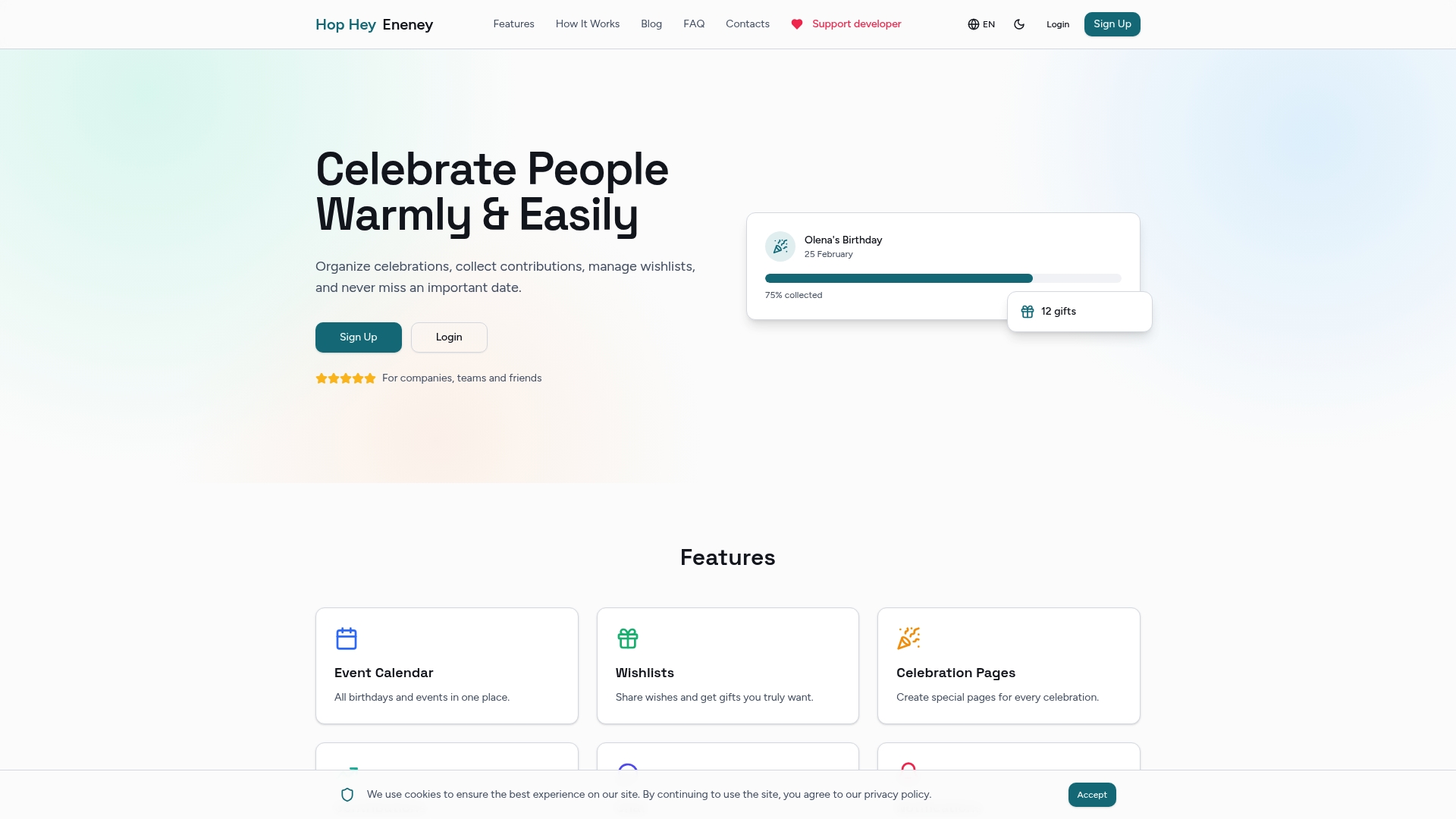
With Hop Hey Eneney, you can automate name draws, share rules and wish lists in one private space, collect gift contributions transparently, and send reminders via email or Telegram so no one misses the deadline. The platform supports multi-currency contributions in UAH, USD, and EUR, making it perfect for international teams. Role-based permissions mean the organizer controls what participants see, keeping surprises intact. Visit hophey.gifts to set up your next exchange in minutes, not hours.
Frequently asked questions
What is the most popular group gift exchange format?
White Elephant and Secret Santa are the two most widely used formats, each offering a balance of fun and manageable structure for groups of different sizes and familiarity levels.
How can we prevent awkward or unwanted gifts?
Set a clear budget range, publish appropriateness guidelines before the draw, and encourage participants to submit a short wish list. Upfront guidelines and wish lists are the most effective tools for preventing gift misfires in any group setting.
What is the best gift exchange for a team where people don't know each other well?
White Elephant is the strongest choice for loosely acquainted groups because it keeps the focus on the game rather than personal knowledge. White Elephant outperforms Secret Santa specifically for entertainment value when group members are not close.
Are regifted items acceptable in group exchanges?
Regifting is perfectly fine when the group agrees to it in advance, items are in good condition, and you never regift to the original giver. Explicit etiquette for regifting prevents the awkwardness that comes from mismatched expectations.
How do you handle gift exchanges in the workplace?
Follow your organization's gift policies, keep themes inclusive and neutral, and publish clear written rules for all participants before the exchange begins. Setting company-appropriate exchange policy is a recognized HR best practice that protects both employees and the organization.