
TL;DR:
- Structured wish lists provide clear, detailed preferences, reducing gift mismatches and enhancing team morale. Digitizing the collection process ensures consistency, saves time, and allows easy updates, streamlining event coordination. Using well-designed templates fosters inclusivity, encourages specific input, and signals that workplace celebrations are thoughtfully prioritized.
Coordinating a gift exchange for 40 people sounds simple until you're drowning in Slack messages, mismatched budgets, and someone who got three candles because nobody compared notes. A structured wish list template eliminates that chaos before it starts. It gives every participant a consistent format to share what they actually want, flags what to avoid, and gives gift-givers enough context to choose confidently. This guide walks you through exactly how to build, digitize, and manage a wish list process that makes team celebrations feel effortless rather than exhausting.
Table of Contents
- What you need: key components of an effective wish list template
- How to prepare and digitize your wish list collection
- Step-by-step guide to managing the wish list process
- Common mistakes and expert tips for wish list success
- Expected outcomes and measuring your wish list's effectiveness
- Why typical wish list methods fail and how structured templates transform celebrations
- Streamline your team celebrations with Hophey's gift coordinating tools
- Frequently asked questions
What you need: key components of an effective wish list template
To build an effective wish list, you first need to understand which components make your template thorough and user-friendly for everyone involved.
The most common mistake HR managers make is building a wish list that's too vague to be useful. A work-focused wish list template includes sections for item specifics, interests, items to avoid, size details, and online wishlist links to guide gift-givers. Without these guardrails, you end up with entries like "I like coffee" and a gift-giver standing in an aisle with no idea what roast, brand, or format someone prefers.
Here are the core components every workplace wish list template should include:
- Participant identification: Full name, team or department, and preferred contact method for follow-up questions
- Wish list items: At least three to five specific items with brand, model, color, size, and a price range for each
- Preferred categories: A fallback section listing broader interests (books, outdoor gear, kitchen gadgets) in case listed items are unavailable
- Items to avoid: Allergies, dietary restrictions, dislikes, or categories the person genuinely does not want
- Online gift wish list links: Direct links to their registry or saved items on retail sites, which removes all guesswork
- Budget range: A stated comfortable price range so nobody feels pressured to overspend
Here's a quick comparison of what a bare-bones template misses versus what a complete one provides:
| Field | Bare-bones template | Complete template |
|---|---|---|
| Item name | "A book" | "Atomic Habits by James Clear, paperback" |
| Preferences | Blank | Color, size, brand, model number |
| Avoidances | Not included | Specific items or categories to skip |
| Budget guidance | Not included | Min/max price range per item |
| External links | Not included | Links to online wishlists or retail pages |
Pro Tip: Add a short example row at the top of your wish list form showing a fully completed entry. Participants who see a concrete example fill out their own entries with far more useful detail.
For additional context on building effective workplace Secret Santa wish list tips, the structure matters as much as the content itself.
How to prepare and digitize your wish list collection
Once you know what your wish list needs to include, the next step is digitizing the collection process for smooth coordination.

Collecting wish lists via email threads or verbal check-ins creates the exact inconsistency you're trying to avoid. Digitizing wish list collection reduces paperwork and confusion by ensuring details are consistently captured in structured formats. The payoff is immediate: no chasing people down, no misread handwriting, and a single source of truth for every gift coordinator.
Follow these steps to digitize your collection process effectively:
- Pick the right tool. An online form builder or a shared spreadsheet both work. Forms work better for larger teams because they enforce structure. Spreadsheets work better when coordinators need to sort, filter, and track budgets side by side.
- Limit required fields to the essentials. Name, at least two wish list items, and one category preference. Everything else is optional. Overloading required fields tanks your completion rate.
- Write clear field instructions. Instead of labeling a field "Gift ideas," write "List at least two specific items you'd like, including brand and size." Specificity in the instructions produces specificity in the answers.
- Include a free-text notes field. Some participants have edge cases, like a gift card preference or a specific store they love. A notes field captures what your structured fields cannot.
- Test the form before sending. Fill it out yourself and check whether the instructions are clear enough that someone who just joined the company could complete it without confusion.
"Structured digital forms eliminate the back-and-forth that usually follows informal wish list requests. When every participant fills in the same fields, coordinators spend time on the fun parts, not on chasing down incomplete submissions."
One often-overlooked benefit: digitized wish lists are easy to update. When someone changes their mind or finds a better option, they can revise their entry without contacting the coordinator directly, keeping everything current without extra administrative work.
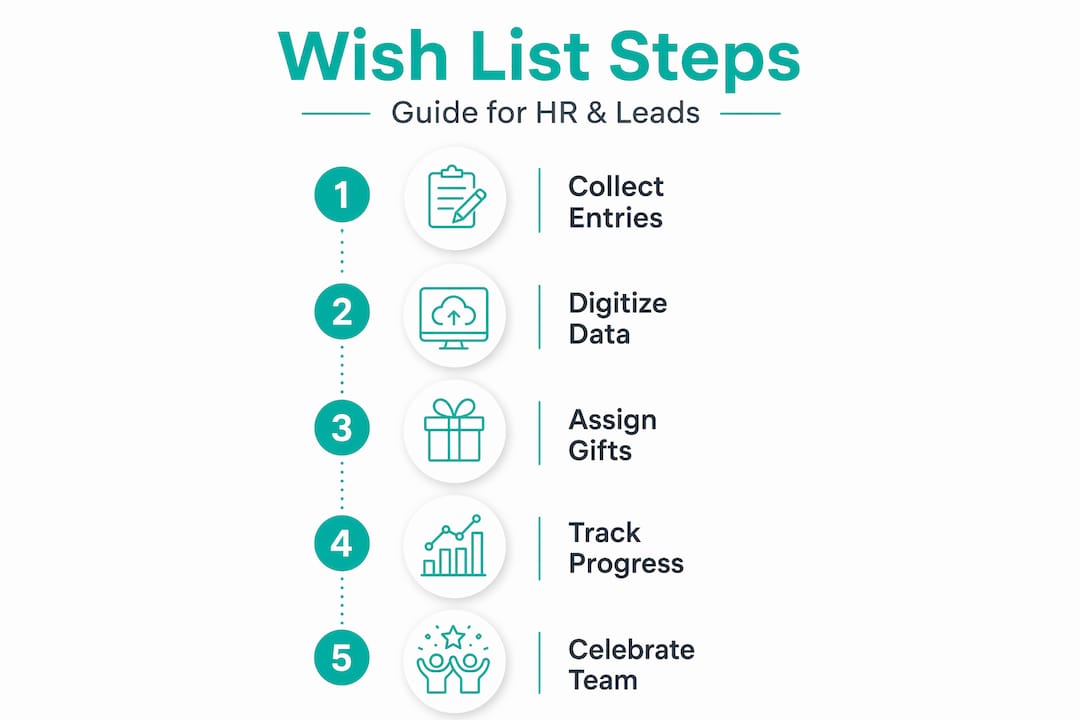
Step-by-step guide to managing the wish list process
With your digitized collection in place, let's walk through how to manage the entire process from start to finish for smooth celebrations.
The logistics of a team gift exchange break down most often between collection and execution. Here's a process that holds together across teams of any size:
- Send the invitation with context. Explain why you're using a wish list template, what the budget range is, and what deadline participants should meet. People fill forms out faster when they understand the purpose.
- Set two deadlines. One for wish list submission and one for gift purchasing. The gap between them should give coordinators at least a week to review entries and assign gift-givers.
- Review every entry before assigning. Check for vague or incomplete responses. A wish list that says "anything outdoors" needs a follow-up before you assign it to a gift-giver.
- Assign gift-givers confidentially. Never share the full wish list with the entire team. Each person should see only the wish list of the person they're buying for.
- Track the budget. Log estimated versus actual prices for every gift. Tracking both prices with purchase status helps maintain budget control and transparency across the whole exchange.
- Confirm purchases and mark status. Once someone buys a gift, mark it as purchased in your tracking sheet. This prevents two people from buying the same item and ensures nobody is missed.
Here's a simple budget tracking table you can adapt for any gift exchange:
| Participant | Gift item | Estimated price | Actual price | Purchased | Assigned to |
|---|---|---|---|---|---|
| Jordan M. | Running shoes, size 10 | $80 | $75 | Yes | Chris T. |
| Sam K. | Kindle Paperwhite | $140 | $140 | No | Dana R. |
| Riley P. | Coffee subscription | $45 | $50 | Yes | Alex W. |
For a complete walkthrough of the coordination workflow, the step-by-step gift exchange management process covers the full cycle in detail. HR teams setting up formal programs for the first time should also review workplace gift exchange guidelines to avoid common policy missteps.
Common mistakes and expert tips for wish list success
Knowing how to manage the process helps, but understanding the common traps and how to sidestep them ensures smooth results every time.
Many gift mismatches happen because participants provide vague item descriptions. Including detailed "avoid" and specificity sections reduces risk and builds confidence for gift-givers. Here's what to watch for:
- Vague entries. "A book" is not actionable. "The Thursday Murder Club by Richard Osman, hardcover" is. Coach participants on specificity before they submit.
- Missing avoidance sections. Scented products, alcohol, and certain food items can create real discomfort if given without thinking. The "items to avoid" section protects everyone.
- Too many required fields. Every field you require above the bare minimum reduces submission rates. Make almost everything optional except name and at least one wish list item.
- No estimated price range. Without price guidance, gift-givers either overspend to be safe or underspend and feel embarrassed. A listed range removes the guesswork entirely.
- Missing reminders. Even motivated teams forget. Send a reminder three days before the submission deadline and another two days before the purchasing deadline.
Pro Tip: Create a short video walkthrough (two minutes or less) showing how to fill out the wish list form. Teams that receive a short video tutorial alongside the form link submit entries that are roughly twice as specific as those who receive only a text explanation.
For teams managing complex gift-giver assignments, organizing gift-giver roles clearly from the start prevents the most common coordination breakdowns.
Expected outcomes and measuring your wish list's effectiveness
After applying all these steps and tips, you can expect these concrete improvements in your team's celebration experience.
A well-constructed wish list reduces mismatch risk and fosters positive team dynamics and morale during celebrations. That's not just a feel-good outcome: it translates into measurable changes you can track over time.
Here's what HR teams consistently report after switching to structured wish list templates:
- Higher gift satisfaction. Participants receive things they actually want because gift-givers had clear, specific guidance rather than vague hints.
- Fewer re-gifts and returns. When people list items to avoid and provide specific product details, the rate of "I already have this" or "this isn't for me" drops significantly.
- Reduced HR admin time. Coordinating a 50-person gift exchange through a structured digital template takes a fraction of the time compared to managing it through email chains and manual spreadsheets.
- Better budget adherence. Teams that track estimated versus actual prices consistently spend closer to their stated budget than those who estimate informally.
- Stronger team cohesion. Celebrations that go smoothly build positive associations around team culture. People remember the years when the gift exchange worked, and it colors how they feel about their workplace.
Stat to watch: Track your completion rate (percentage of invited participants who submit a filled-out wish list). If it falls below 70%, your form is too long or your instructions are too vague. Adjust and re-test.
For HR teams managing ongoing recognition programs, managing workplace birthday wishlists at scale requires the same structured approach applied repeatedly throughout the year, not just during the holiday season.
Why typical wish list methods fail and how structured templates transform celebrations
Understanding expected results is important, but it's equally valuable to grasp why structured templates outperform traditional approaches, because the gap is wider than most HR managers realize.
The default approach in most companies is a message in Slack or a quick email: "Hey, can everyone share their gift ideas by Friday?" What follows is a thread of one-word answers, a few people who never respond, and coordinators trying to piece together who wants what from a mix of emoji reactions and half-sentences. Informal wish list collection systematically creates the confusion and inefficiency of ad-hoc requests, which leads to gift mismatches and stress for everyone involved.
The deeper problem is psychological. When a gift-giver receives no clear guidance, they default to what they would want or to the safest, most generic option available. That's how entire teams end up with scented candles and generic gift cards. It's not bad taste. It's the predictable result of an information vacuum.
Structured wish list templates solve this by acting as guardrails for both sides. The person filling it in is prompted to think specifically. The person buying has a concrete reference rather than a guess. What looks like a minor administrative improvement is actually a fundamental shift in how clearly people communicate their preferences in a professional setting.
There's also an inclusivity angle that rarely gets discussed. Informal wish list collection tends to favor employees who are socially comfortable speaking up or who happen to catch a coordinator at the right moment. Structured templates give every employee, including introverts, newer hires, and remote team members, an equal and consistent channel to share what matters to them. That fairness compounds over time into trust: people feel genuinely seen and considered, which strengthens team bonds in ways that no corporate team-building exercise can replicate.
The impact of digitized wish lists on workplace culture goes well beyond logistics. It's a signal that the organization takes celebrations seriously enough to do them right.
Streamline your team celebrations with Hophey's gift coordinating tools
With all the know-how in place, consider how a dedicated platform can automate and simplify your gift exchange processes instead of stitching together forms, spreadsheets, and chat threads manually.
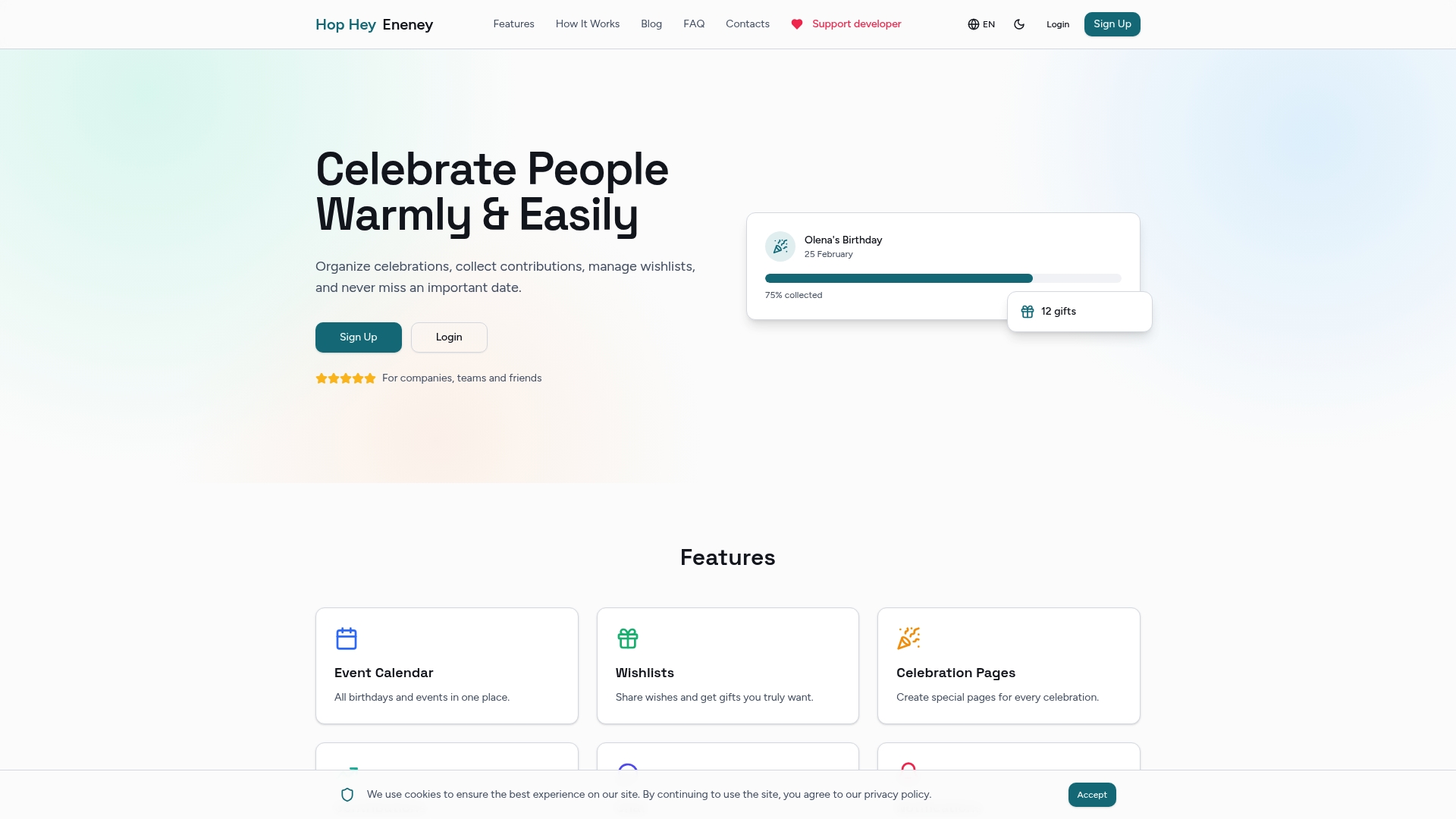
Hophey is built for exactly this use case. The platform gives HR managers and team leads a single place to create private celebration pages, collect personalized wish lists, assign gift-givers, and track contributions transparently, all without looping in the person being celebrated. Automated reminders handle deadline follow-ups so you don't have to chase anyone down. Multi-currency support covers global teams, and role-based permissions ensure the right people see the right information. If you're coordinating wish lists across multiple teams or running recurring programs like monthly birthday recognition, Hophey removes the manual overhead entirely so you can focus on making celebrations feel meaningful.
Frequently asked questions
What information should I include in a wish list template for workplace celebrations?
Include participant names, detailed gift preferences with brand, size, and color, a clear section for items to avoid, and optional links to online wishlists. Work-focused templates have sections for item specifics, interests, items to avoid, and size details, giving gift-givers everything they need to choose well.
How does digitizing wish list collection help HR teams?
Digitizing reduces paperwork, eliminates inconsistent responses, and makes collaborative management far easier across large teams. Digitizing collection reduces confusion by ensuring consistent detail capture, which saves coordinators significant time during every exchange.
What is the benefit of tracking estimated vs actual gift prices in a wish list?
It keeps the entire exchange within budget and prevents disputes when spending varies from expectations. Tracking both prices helps maintain budget control and prevents disputes by making planned versus actual spending visible to coordinators.
How can I reduce gift mismatches in workplace gift exchanges?
Require specific gift descriptions and make the "items to avoid" section prominent in your template. Specificity and "items to avoid" sections reduce gift mismatch risks by giving gift-givers clear, actionable guidance rather than vague hints.
What are common mistakes when managing wish lists for teams?
The most damaging mistakes are vague item descriptions, too many required fields that reduce submission rates, and skipping budget tracking. Vague descriptions and overloaded forms are the most common mistakes to avoid, and fixing them requires only small adjustments to your template before launch.