
TL;DR:
- Simplifying gift contributions improves participation, reduces errors, and enables more meaningful group gifts. Using clear workflows and multiple payment options ensures faster collection and higher contributor confidence. Organized, transparent processes lead to better experiences for organizers, contributors, and recipients.
Simplifying gift contributions means organizing group giving so that collecting, tracking, and spending funds is clear, fast, and fair for everyone involved. US households spend an average of $1,500 on gifts annually, yet recipients value those same gifts at roughly $1,000. That gap represents real money lost to poor coordination and mismatched choices. For teams and friend groups organizing collective gifts, a cleaner process closes that gap and makes every dollar count. The industry term for this practice is "gift contribution management," and it covers everything from setting deadlines to choosing payment methods.
Why simplify gift contributions: the core case
The strongest argument for simplifying gift contributions is financial. When a group pools money without a clear system, funds get lost, duplicated, or forgotten. The result is either a smaller gift than planned or an awkward shortfall at the last minute.
Simplified giving also raises participation rates. Donation page conversion rates sit at 11% on desktop and 8% on mobile when processes are complex. Removing friction, such as extra form fields or unclear amounts, pushes those numbers higher. The same principle applies directly to group gift collection: the easier you make it to contribute, the more people actually do.

The benefits of simplifying gifts extend beyond money. Cleaner workflows reduce the mental load on organizers, cut down on back-and-forth messages, and give contributors confidence that their money is going exactly where it should.
What are the main benefits of simplifying gift contributions?
Simplified contribution processes produce four measurable benefits for teams and groups.
- Higher participation rates. When contributing takes less than two minutes, more people follow through. Friction is the main reason people skip contributing, not unwillingness.
- Fewer administrative errors. Manual tracking through spreadsheets or group chats creates gaps. A structured process catches missing payments before they become problems.
- Less decision fatigue. Offering suggested contribution amounts with brief explanations increases average gift size and removes the paralysis of choosing a number from scratch.
- Better use of money. Focused pooling means the group buys one meaningful gift rather than several mediocre ones.
The psychological benefit is real too. Organizers who run clean processes report less stress and more enjoyment in the lead-up to a celebration. Contributors feel confident rather than confused. Recipients sense the intention behind a well-organized gift, which raises perceived value even before they open it.
Pro Tip: Offer three suggested contribution amounts (low, mid, high) with a one-line explanation for each. Groups using this approach consistently see higher average contributions than open-ended requests.
How can teams streamline gift contribution workflows?
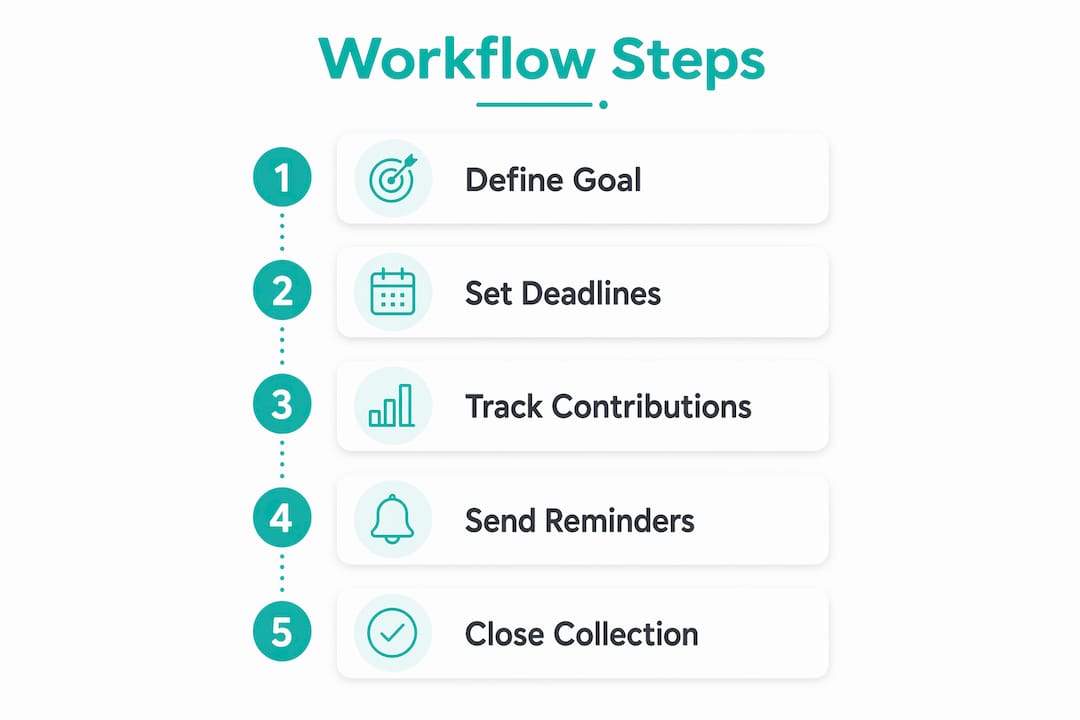
A repeatable workflow removes the chaos from group gifting. The steps below apply whether you are organizing a birthday for a colleague or a wedding gift from a large friend group.
- Define the gift goal first. Agree on the gift before collecting money. Ambiguity about what the money is for causes hesitation and drop-off.
- Set a firm closing date. A 3–5 day buffer before the celebration gives you time to handle payment delays and last-minute changes without panic.
- Batch contributions into verifiable groups. Batching contributions into small, trackable sets prevents double-counting and catches missing payments before they snowball.
- Offer multiple payment methods. Accepting Apple Pay, Google Pay, and Venmo alongside standard bank transfers reduces friction and boosts completion rates.
- Send one clear communication. A single message with the gift goal, contribution amount, deadline, and payment link outperforms a thread of reminders.
- Confirm receipt publicly. A quick group update confirming that contributions are in builds trust and encourages stragglers to act.
The table below shows how each workflow step maps to a specific problem it solves.
| Workflow step | Problem it solves |
|---|---|
| Define gift goal upfront | Prevents ambiguity and drop-off |
| Set closing date with buffer | Eliminates last-minute shortfalls |
| Batch and verify contributions | Catches errors before purchase |
| Multiple payment options | Reduces friction for contributors |
| Single clear communication | Cuts message overload for organizers |
Pro Tip: Use a shared contribution tracking tool so every contributor can see the running total. Transparency alone increases follow-through because people do not want to be the one who did not contribute.
Why do simplified group gifts feel more meaningful?
Minimalist and focused gifts consistently register as more thoughtful than large, scattered ones. The reason is psychological. When a gift is simple and clearly chosen, recipients read it as intentional. Complexity signals noise; simplicity signals care.
Joshua Becker captures this well:
"Minimalist gifts feel premium because simplicity signals that givers prioritized the recipient's experience over quantity or cost. A single well-chosen item communicates more than a pile of things assembled under time pressure."
Minimalist gifts are also easier to process visually and emotionally. Cognitive science calls this processing fluency: the easier something is to understand, the more positively people evaluate it. A gift that arrives with a clear purpose and no clutter benefits from this effect.
Simplified contributions make this possible in practice. When a group pools money cleanly, the organizer has the budget and the clarity to buy one excellent gift instead of compromising on several average ones. The gift reflects the group's collective intention rather than a rushed compromise.
- A team that pools $200 cleanly can buy a premium experience gift, such as a cooking class or a spa voucher, that a single contributor could not afford alone.
- A friend group that collects funds transparently can commission a personalized item that carries real sentimental weight.
- A company that uses a structured process can give a gift that aligns with the recipient's actual wish list, not just what the organizer guessed.
What common pitfalls complicate gift contributions?
Group gifting breaks down in predictable ways. Knowing the failure points lets you design around them.
- Manual tracking errors. Spreadsheets and chat threads miss payments, record duplicates, and create confusion about who still owes. The organizer ends up doing detective work instead of celebrating.
- Inconsistent payment methods. Asking everyone to use the same app works only if everyone already has it. Restricting options cuts participation.
- Vague deadlines. "Sometime before the party" produces a wave of last-minute contributions and at least one person who forgets entirely.
- No confirmation loop. Contributors who never receive acknowledgment assume something went wrong and sometimes pay twice.
- Late communication. Sending the contribution request less than a week before the event gives people too little time to act, especially for larger amounts.
Claire Axelrad identifies friction as the primary barrier to completing a gift contribution. Every extra step, unclear instruction, or unfamiliar payment method is a point where a potential contributor drops off. Removing those points is the single highest-leverage action an organizer can take.
Pro Tip: Close contributions 3–5 days before the event, not the day before. Use that buffer to follow up with one polite reminder to anyone who has not yet contributed. A single targeted message outperforms a broadcast reminder to the whole group.
Secure handling of collected funds also matters. Organizers who use a platform with transparent fund collection avoid the awkward position of being personally accountable for group money. Transparency protects the organizer as much as it reassures contributors.
Key Takeaways
Simplified gift contribution management raises participation, reduces errors, and produces more meaningful gifts by removing friction at every step of the process.
| Point | Details |
|---|---|
| Financial efficiency | US households lose roughly $500 per $1,500 spent due to poor gift coordination; simplification closes that gap. |
| Friction is the main barrier | Removing extra steps and offering multiple payment options directly increases contribution completion rates. |
| Batch and verify | Grouping contributions into verifiable sets prevents double-counts and missing payments before purchase. |
| Buffer your deadline | Closing contributions 3–5 days before the event gives time to resolve delays without stress. |
| Simplicity signals intention | A focused, well-organized gift reads as more thoughtful than a cluttered or rushed one. |
What I've learned from watching group gifts go wrong
Group gift organizing looks easy until you are the one doing it. I have watched well-meaning teams lose track of who paid, send three conflicting payment links, and end up buying a gift card at the last minute because the original plan fell apart. The common thread is always the same: no system.
The fix is not complicated. What works is deciding on the gift first, setting a real deadline with a buffer, and giving contributors exactly one way to pay. Every additional option or step you add is a chance for someone to hesitate and walk away.
The psychological piece matters more than most organizers realize. When contributors can see a running total and know their money is accounted for, they feel part of something. That feeling carries over to the celebration itself. The recipient senses a gift that came from a coordinated group, not a last-minute scramble.
My honest advice: treat group gifting like a small project. It has a goal, a budget, a deadline, and stakeholders. Manage it that way and the experience improves for everyone, including you.
— Konstantin
How Hophey makes group gift coordination straightforward
Organizing a group gift should not require a spreadsheet, a group chat, and three follow-up calls. Hophey brings the entire process into one place: a private celebration page, a shared contribution tracker, and a dedicated chat that keeps the surprise intact.
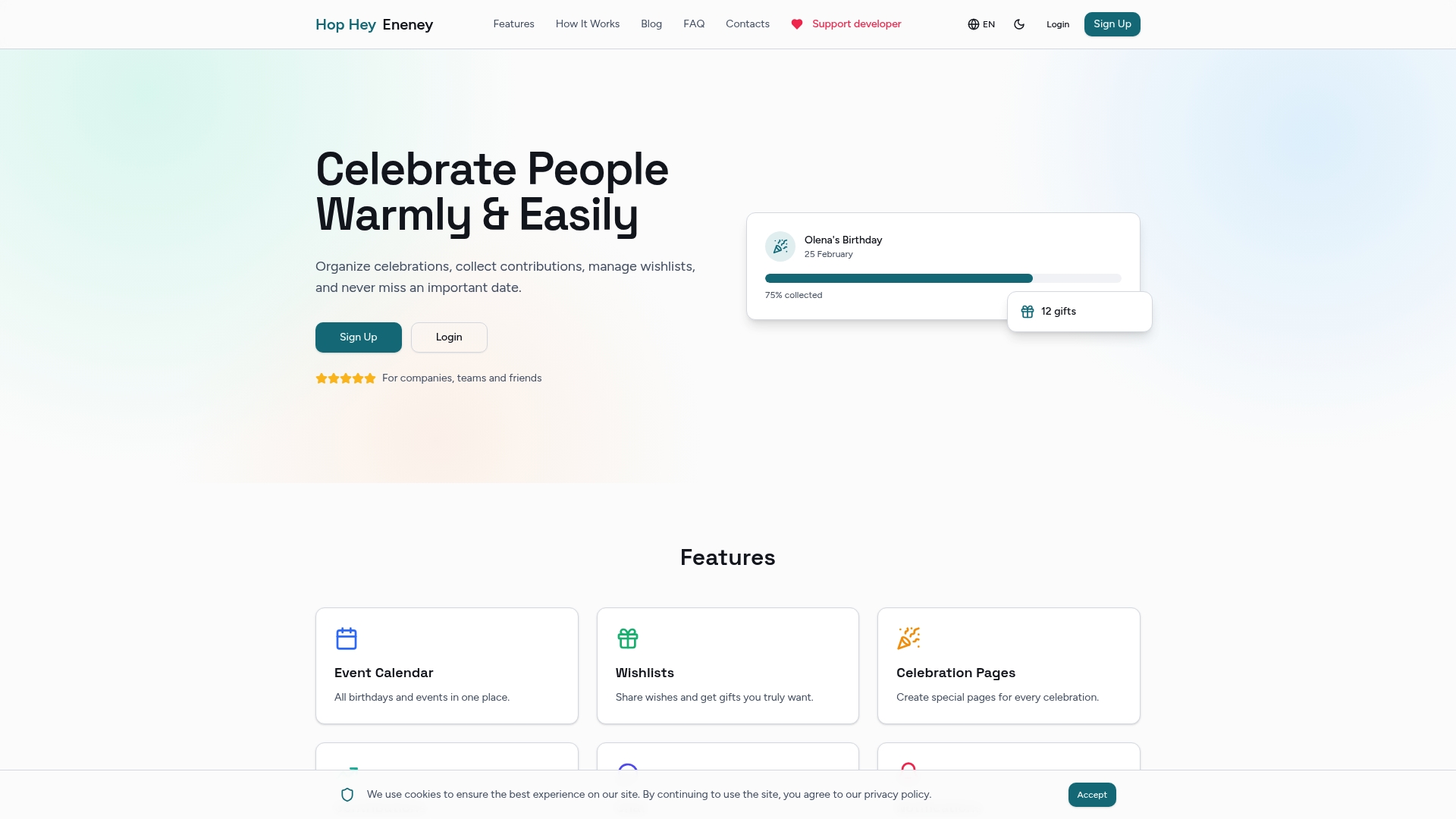
Teams using Hophey for group gifts can set contribution goals, track payments in real time, and send automated reminders without the organizer chasing anyone manually. The platform supports UAH, USD, and EUR, sends Telegram and email notifications, and works across multiple organizations. HR teams, remote groups, and friend circles all use it to run celebrations that feel personal and well-organized. If your team is ready to stop managing gifts through chat threads, Hophey is built for exactly that.
FAQ
Why simplify gift contributions for group events?
Simplified processes raise participation rates and reduce errors. When contributing is fast and clear, more people follow through and the group reaches its gift goal.
How do I collect group gift contributions without losing track?
Batch contributions into verifiable groups and use a platform with real-time tracking. A structured collection process prevents double-counts and missing payments.
What is the best deadline for closing gift contributions?
Close contributions 3–5 days before the celebration. That buffer gives you time to handle payment delays and send one targeted reminder to anyone who has not yet contributed.
Why do minimalist group gifts feel more valuable?
Simplicity signals intention. A focused gift chosen with a clear purpose reads as more thoughtful than multiple items assembled under time pressure, regardless of total cost.
Does offering multiple payment options really increase contributions?
Yes. Accepting Apple Pay, Google Pay, and Venmo alongside bank transfers removes the friction that causes contributors to drop off. Limiting payment options to one method consistently reduces completion rates.