
TL;DR:
- Shared events foster trust, collaboration, and community by activating bonding pathways like collective effervescence. These experiences improve organizational performance, loyalty, and resilience, especially when recurring and purpose-driven. Success depends on clear goals, authenticity, consistent scheduling, and measuring behavioral outcomes over time.
Shared events are structured gatherings where multiple participants pursue a common experience or goal together, and organizing them is one of the most direct ways to build trust, collaboration, and community within any organization. The question of why organize shared events has a clear answer: 97% of B2B marketers consider in-person events essential for achieving strategic business outcomes like employee engagement and team alignment. That number reflects a consensus built on real results, not preference. When teams share experiences deliberately, they create bonds that no memo, Slack channel, or performance review can replicate.
Why organize shared events: the psychological case
The most compelling reason to organize shared events is rooted in social psychology, not business strategy. Group activities activate multiple bonding pathways simultaneously, including collective effervescence, shared challenge, and in-group identity, accelerating trust far more quickly than one-on-one interactions ever could. This is not a soft claim. It is a measurable mechanism that researchers have documented across workplace teams, sports fans, and community groups alike.
Collective effervescence is the term sociologist Émile Durkheim coined to describe the heightened sense of connection people feel when participating in a shared activity. A University at Buffalo study confirmed that live shared experiences generate this effect as a strong predictor of well-being and social connection, well beyond the activity itself. The implication for organizations is direct: a well-designed team event does not just feel good in the moment. It rewires how participants perceive each other for weeks afterward.
Familiarity compounds this effect over time. People who attend recurring events together move from polite acquaintances to genuine collaborators because repeated contact lowers social barriers and builds comfort. The emotional memory of a shared moment, whether a company offsite, a team birthday celebration, or a quarterly gathering, becomes a reference point that shapes future interactions. This is why one-off events produce limited results while consistent event programs produce lasting culture change.
"The well-being benefits of live events are driven by collective effervescence, a shared sense of connection to others and something larger than oneself, which is replicable beyond music in varied shared experiences." — University at Buffalo
Pro Tip: Design your events to include at least one moment of synchronized participation, a group activity, a shared meal, or a collective decision. These synchronized moments are the specific triggers for collective effervescence and produce the strongest bonding outcomes.
How shared events impact organizational performance
The benefits of shared events extend directly into measurable business performance, and the data makes a strong case for treating event investment as a strategic priority rather than a discretionary budget line. Businesses investing in shared experiences increase employee motivation, performance, guest loyalty, and collaboration by creating emotional bonds that directly influence behavior. Emotional commitment to a team or organization does not come from reading a mission statement. It comes from shared moments that make the mission feel real.

61% of UK adults prioritize positive, meaningful brand experiences over cost, which signals that experience-driven ROI outperforms transactional approaches in both employee and customer contexts. Organizations that understand this shift their event budgets from one-time spectacles to consistent, meaningful gatherings that accumulate relational capital over time.
The contrast between organizations that invest in shared events and those that do not is stark across several dimensions:
| Outcome area | With shared events | Without shared events |
|---|---|---|
| Employee motivation | Higher, driven by emotional connection to team | Lower, reliant on individual incentives alone |
| Cross-team collaboration | Frequent, built on personal familiarity | Sporadic, limited by siloed relationships |
| Organizational alignment | Strong, reinforced through shared experiences | Weak, dependent on top-down communication |
| Staff retention | Improved through belonging and recognition | At risk due to disconnection and low engagement |
| Customer and partner loyalty | Deepened through memorable shared moments | Transactional and price-sensitive |
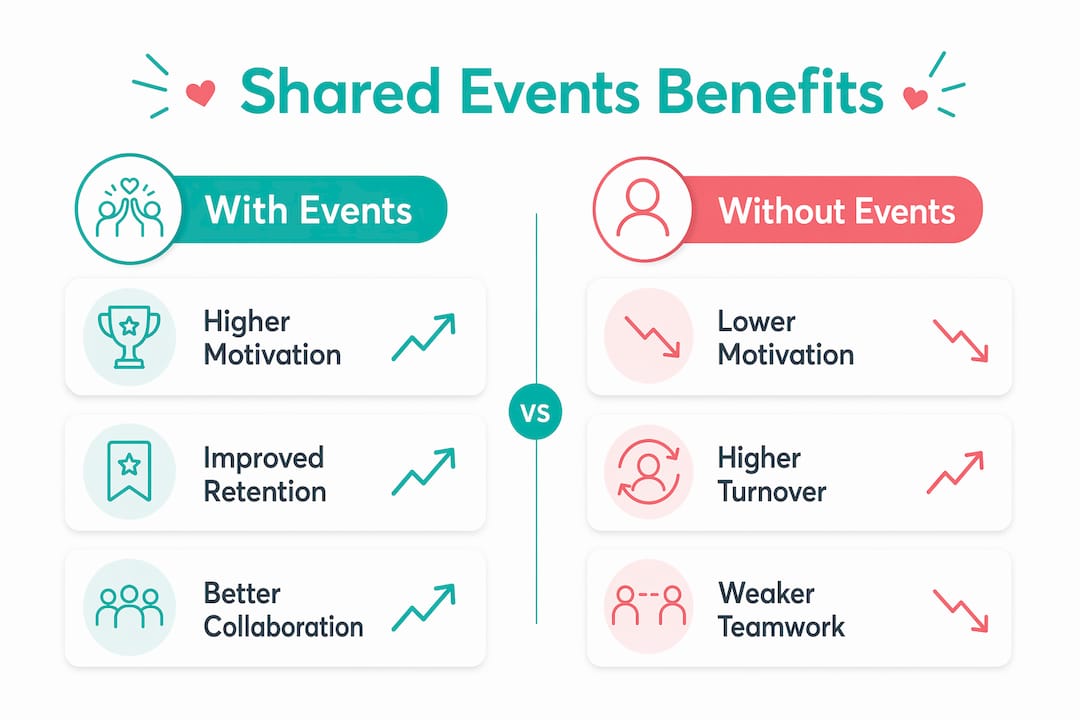
The pattern is consistent: organizations that treat shared events as infrastructure rather than entertainment see compounding returns across every performance dimension listed above.
What practical strategies exist for successful shared event planning
Knowing the benefits of shared events is only useful if you can translate them into well-executed programs. The most common mistake organizations make is jumping straight to logistics before defining purpose. Clearly defining the event's purpose first informs every subsequent decision and sets the criteria for measuring success. Ask what behavior or relationship you want to change before you book a venue or set a date.
Here are the core practices that separate effective shared event programs from forgettable ones:
- Define the "why" before the "what." Every event decision, from format to guest list to timing, should trace back to a specific goal. A team alignment event looks different from a community celebration, and conflating the two produces neither outcome well.
- Build a recurring cadence. Recurring events turn acquaintances into genuine communities by creating repeated contact and compounding familiarity. Monthly or quarterly touchpoints outperform annual mega-events for building lasting connection.
- Lock the schedule and simplify the format. Consistent timing removes the friction of re-deciding logistics every cycle. When participants know the first Friday of each month is team lunch, attendance becomes habitual rather than effortful.
- Coordinate stakeholders early. Advance planning that defines clear strategic objectives leads to better stakeholder alignment, smoother operations, and events that actually deliver on their stated purpose.
- Build in follow-up. The connection formed at an event fades without reinforcement. Schedule a debrief, share photos, or send a summary within 48 hours to extend the emotional resonance of the gathering.
- Avoid over-engineering. Authenticity matters more than production value. Teams respond to genuine effort and clear intention, not elaborate staging that feels disconnected from their actual work relationships.
Pro Tip: When launching a new recurring event, run the first three iterations at a loss of effort relative to attendance. The goal is to establish the habit and the expectation. Optimization comes after the pattern is set.
For a detailed framework on putting these principles into practice, the office events planning guide from Hophey covers team culture applications with specific formats and scheduling templates.
How shared events build social resilience and community identity
The impact of organized events extends beyond the walls of any single organization. The Legends Global Goosebumps Effect report documents how shared live experiences in sports and music contribute to social connection, optimism, and resilience across entire communities. This finding matters for organizations because the same mechanisms that build national or civic identity also operate at the team and company level.
Shared emotional moments create a collective identity that persists between gatherings. People who have experienced something meaningful together carry a sense of "us" that shapes how they communicate, collaborate, and support each other under pressure. This is why organizations that invest in event programs for social resilience report stronger performance during periods of organizational change or external stress.
| Social benefit | Event element that drives it |
|---|---|
| Optimism and forward momentum | Celebratory milestones and recognition moments |
| Resilience under pressure | Shared challenge activities and problem-solving formats |
| Inclusive community identity | Multi-generational and cross-functional participation |
| Lasting connection between events | Pre-event anticipation and post-event communication rituals |
Inclusive design amplifies these outcomes significantly. Events that deliberately bring together people across departments, seniority levels, or backgrounds generate broader identity bonds than those limited to homogeneous groups. The goal is not just to connect people who already know each other. It is to create new relational bridges that would not form through ordinary work interactions.
Lasting community identity develops between gatherings through anticipation and ongoing communication, not just the event itself. Organizations that treat the pre-event and post-event phases as part of the experience, through teasers, countdowns, follow-up stories, and shared memories, build communities that sustain themselves between formal gatherings.
How can organizations measure the success of shared events?
Measuring the impact of organized events requires both qualitative and quantitative lenses. Quantitative metrics include attendance rates, participation levels, post-event survey scores, and downstream KPIs like retention rates or cross-team project frequency. Qualitative measures capture the stories, the unsolicited feedback, and the behavioral shifts that numbers alone cannot explain.
Event and learning management systems help organizations track engagement and training outcomes in ways that connect event activity to organizational performance data. Platforms like these make it possible to correlate event participation with employee engagement scores or productivity metrics over time, turning anecdotal evidence into a defensible business case.
The most effective measurement approach sets goals before the event, not after. Define what success looks like in behavioral terms: more cross-team collaboration requests, higher scores on belonging surveys, or reduced time-to-trust for new hires. Then track those indicators at 30, 60, and 90 days post-event to capture the compounding effects that single-point measurement misses.
Pro Tip: Add one open-text question to every post-event survey: "What is one thing you learned about a colleague today that you did not know before?" The answers reveal the depth of connection formed and give you qualitative data that no rating scale can capture.
For a structured approach to connecting event programs to engagement outcomes, the employee engagement guide from Hophey provides a practical framework built around measurable milestones.
Key takeaways
Shared events build trust, drive performance, and create community identity through mechanisms that no digital substitute can replicate.
| Point | Details |
|---|---|
| Psychological bonding is the core mechanism | Group activities trigger collective effervescence and multiple bonding pathways simultaneously, accelerating trust. |
| Business outcomes are measurable and significant | Shared experiences increase motivation, collaboration, retention, and loyalty across employee and customer groups. |
| Purpose must precede logistics | Defining the event's strategic goal before planning any detail is the single most important planning decision. |
| Recurring cadence compounds the benefits | Repeated gatherings build familiarity and community identity in ways that one-off events cannot achieve. |
| Measurement requires pre-set behavioral goals | Setting specific behavioral indicators before the event produces defensible ROI data and guides future planning. |
What I have learned from years of watching teams gather
The organizations that get the most from shared events are rarely the ones with the biggest budgets. They are the ones that show up consistently. I have watched teams with modest resources build extraordinary cultures through nothing more than a monthly lunch and a genuine commitment to being present with each other. The format almost does not matter. The consistency is everything.
The mistake I see most often is treating events as a reward for good performance rather than an investment in future performance. When events only happen after a successful quarter, they become transactional. People attend because they earned it, not because they belong to something. That distinction changes everything about how the event lands emotionally.
Authenticity also matters more than most organizers realize. A handwritten note, a specific acknowledgment of someone's contribution, or a moment that reflects actual team history will outperform a catered dinner with no personal touch every time. The goal is not to impress people. It is to make them feel seen.
The compound effect of shared events is real and it is slow. Teams that have been gathering consistently for two years look fundamentally different from teams that have been gathering for six months. The trust is deeper, the communication is faster, and the resilience under pressure is noticeably stronger. That is the return on investment that no single event can deliver. Only a sustained commitment to gathering together produces it.
— Konstantin
Make every shared event count with Hophey
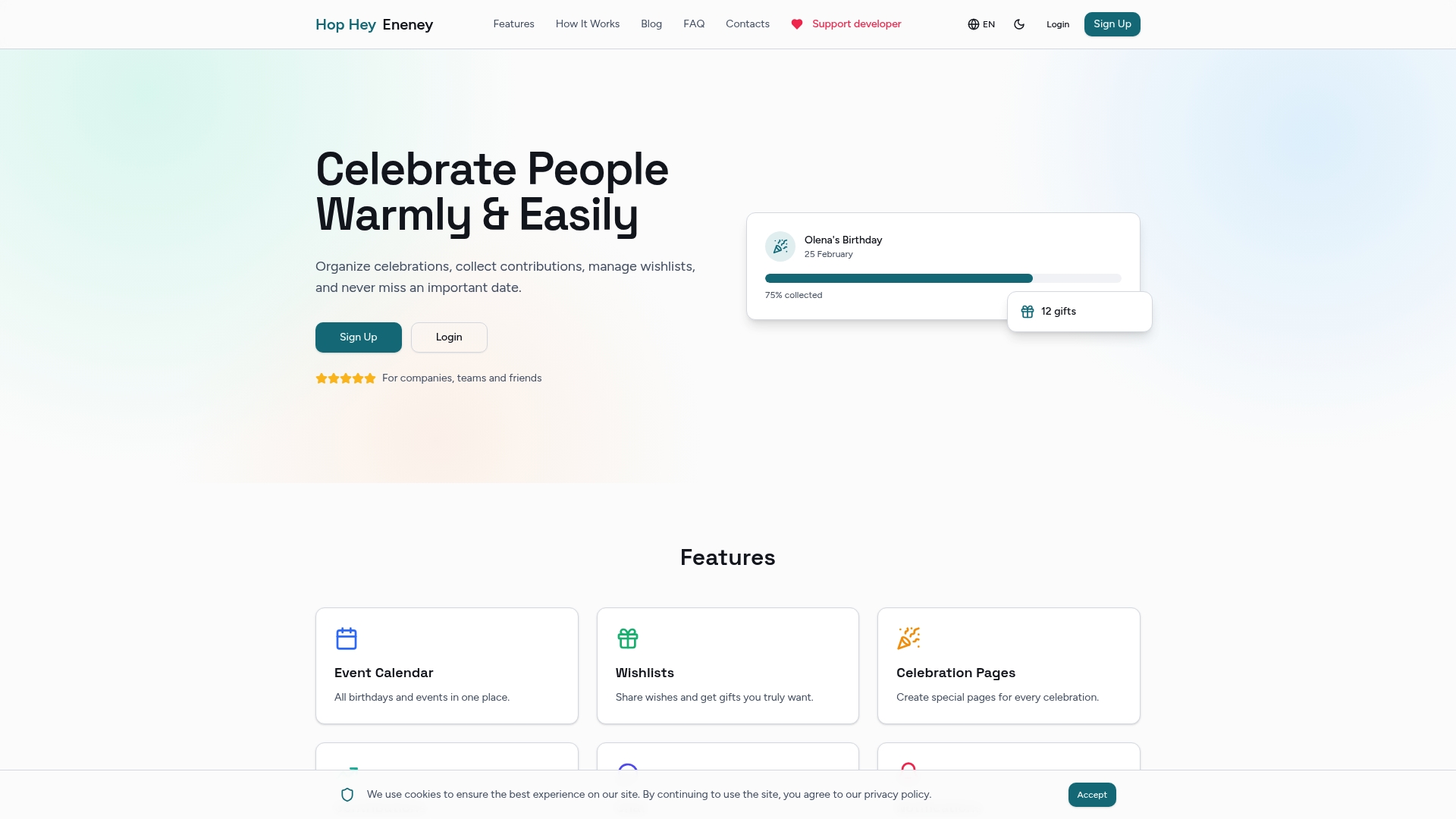
Organizing shared events is only half the equation. The other half is making sure every celebration, milestone, and team moment is handled without chaos or dropped details. Hophey is built specifically for teams, HR departments, and organizations that want to run meaningful events without the coordination overhead. From shared event calendars and private celebration pages to transparent gift fund collection and Telegram notifications, Hophey removes the friction from every step of the process. Whether you are coordinating a surprise birthday for a colleague or managing quarterly team celebrations across multiple departments, start organizing with Hophey and turn every shared moment into a lasting memory.
FAQ
Why are shared events important for team culture?
Shared events create the emotional bonds and collective identity that drive collaboration, trust, and belonging within teams. Research confirms that group bonding through shared activities accelerates trust more effectively than any other workplace intervention.
How often should organizations host shared events?
A recurring monthly or quarterly cadence produces the strongest community-building outcomes. Repeated gatherings compound familiarity and turn occasional contacts into genuine community members over time.
What is the ROI of organizing shared events?
The ROI includes higher employee motivation, improved retention, stronger cross-team collaboration, and increased customer loyalty. Organizations that invest in shared experiences see these returns compound across both employee and customer relationships.
How do you measure the success of a shared event?
Set specific behavioral goals before the event, such as cross-team collaboration frequency or belonging survey scores, then track those indicators at 30, 60, and 90 days post-event to capture the full impact.
What is the biggest mistake in shared event planning?
The most common error is prioritizing logistics over purpose. Defining clear strategic objectives first is what separates events that change team dynamics from events that are simply forgotten by the following Monday.