
TL;DR:
- A celebration checklist helps office managers organize inclusive workplace events and avoid last-minute chaos. It covers purpose, budget, roles, venue, invitations, and logistics, ensuring a memorable experience. Proper planning and role clarity prevent common failures, focusing on guest flow and meaningful recognition.
An office celebration checklist is a step-by-step planning guide that helps office managers and team leaders organize workplace events that are memorable, inclusive, and free of last-minute chaos. Without a structured checklist, even well-intentioned celebrations collapse under poor timing, unclear roles, and forgotten logistics. The most effective workplace event guide covers six core areas: purpose and budget, team roles, venue and menu, invitations, day-of coordination, and contingency planning. Get these right, and your team walks away energized rather than exhausted.
What should an office celebration checklist include?
Every solid office event checklist starts with three foundational decisions: why you're celebrating, how much you're spending, and when it happens. Skip any of these, and every decision after it becomes harder.

Define your event purpose first
The purpose of your event shapes every choice that follows. A product launch party calls for a different tone than a year-end team dinner or a birthday celebration. Write your purpose in one sentence before booking anything. That sentence becomes your filter for every vendor, venue, and activity decision.
Set a realistic budget per person
Typical corporate event costs range between $50 and $150 per person. That range is wide because team size, city, and event type all shift the number. A useful starting point is to allocate your budget across four categories:
| Category | Recommended allocation |
|---|---|
| Food and beverages | 35–40% |
| Venue | 25–30% |
| Entertainment and décor | 10–15% |
| Miscellaneous and contingency | 5–10% |
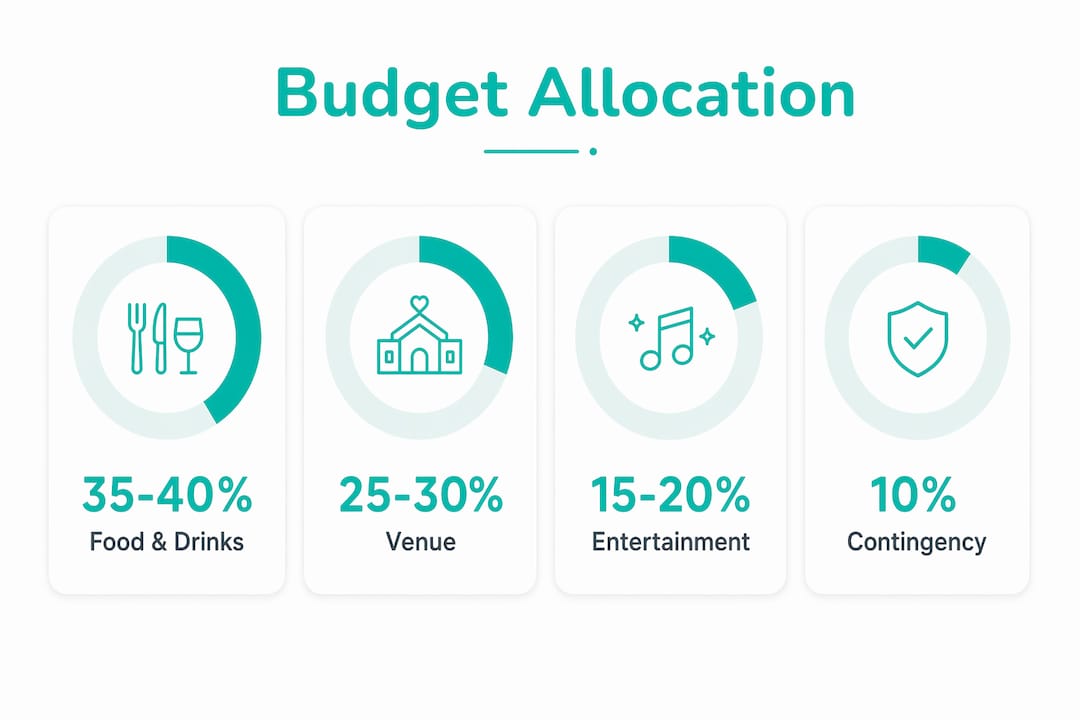
The contingency line is not optional. Unexpected costs show up at nearly every event, from a vendor cancellation to a last-minute headcount change.
Lock in your timeline early
High-demand corporate event dates require booking venues and vendors 10–14 weeks in advance in major cities. A standard planning timeline includes key milestones at 12 weeks, 8 weeks, 4–6 weeks, and a final RSVP cutoff 7 days before the event. Missing the 12-week mark often means settling for your second or third choice of venue.
Pro Tip: Set calendar reminders for each milestone the day you confirm your event date. Waiting until you "feel ready" to book vendors is how you end up with a parking lot instead of a venue.
How do you build a strong office party planning team?
Planning an office party alone is the fastest route to burnout. Assigning one small, distinct role to each team member builds shared ownership and prevents the organizer from becoming a bottleneck. A team of four to six people, each with a clear lane, outperforms one overloaded planner every time.
A well-structured planning team covers these roles:
- Event lead: Owns the master checklist, budget, and vendor contracts
- Catering coordinator: Manages the menu, dietary forms, and food delivery logistics
- Entertainment lead: Books activities, music, or speakers and manages the run-of-show
- Logistics coordinator: Handles setup, breakdown, venue contact, and parking
- Communications lead: Sends invitations, collects RSVPs, and manages reminders
Each role should have a written scope. "You handle food" is not a scope. "You collect dietary forms by November 1, confirm the caterer by November 8, and oversee setup on the day" is a scope. The difference between those two sentences is the difference between a smooth event and a chaotic one.
Pro Tip: Hold one 20-minute check-in per week in the four weeks before the event. Keep it to status updates only. Decisions happen outside the meeting.
How do you choose the right venue, menu, and entertainment?
The best venue for your team is not necessarily the most impressive one. It is the one that fits your headcount, matches your budget, and removes friction for attendees. Successful parties are built around existing team dynamics, and customization based on team size leads to better engagement. That principle applies to venue, food, and activities equally.
Venue selection criteria
When evaluating venues, check these factors before committing:
- Capacity: the space should feel comfortable, not cramped or cavernous
- Accessibility: confirm elevator access, parking, and public transit options
- Atmosphere: the room's natural feel should match your event tone
- Flexibility: ask whether you can bring outside vendors or must use in-house catering
- Backup plan: know the venue's policy for weather or technical issues
For large-scale corporate gatherings, venue logistics become significantly more complex. Dedicated conference and event venues often include built-in AV, catering coordination, and on-site staff, which reduces the load on your planning team.
Menu planning and dietary restrictions
Collect dietary requirements using a dedicated online form, not a verbal survey or email thread. Use dedicated online forms to capture detailed dietary needs at least 7–14 days before the event. Verbal collection misses people, creates privacy issues, and gives your caterer nothing concrete to work with.
Your form should ask about allergies, intolerances, religious dietary requirements, and vegetarian or vegan preferences. Share the completed form directly with your caterer, not a summary.
Entertainment and activities
Smaller teams prefer flexible, casual activities that allow organic conversation, while larger teams need more structure and a clear agenda. A team of 12 can thrive with an open bar and a trivia round. A team of 80 needs scheduled segments, clear transitions, and a host or emcee to keep energy moving.
For teams interested in outdoor team building, structured activities like competitive games or skill-based challenges work well because they give people a shared goal without requiring them to be naturally social.
How do you manage invitations, RSVPs, and day-of logistics?
Clear invitations prevent the most common office party planning failures: wrong headcount, confused guests, and vendor mismatches. Send invitations at least four weeks before the event. Each invitation should include:
- Event date, start time, and end time
- Venue name and full address
- Dress code (even "business casual" removes guesswork)
- RSVP deadline and how to respond
- Plus-one policy, if applicable
- A link to your dietary requirements form
Never accept verbal RSVPs. Verbal confirmations are forgotten, misremembered, and impossible to track. Use a digital form or a shared spreadsheet with a clear deadline. Send one reminder three days before the RSVP cutoff.
Day-of coordination steps
Day-of execution is where most events succeed or fail. Follow this sequence:
- Confirm all vendors by phone or email the morning of the event
- Arrive at the venue at least 90 minutes before guests
- Walk the full space and check every setup element against your checklist
- Assign one person as the single point of contact for vendors
- Brief your planning team on their roles for the day
- Identify the two most likely problems and have a response ready for each
Prioritizing guest flow strategy before confirming logistics improves the attendee experience significantly. Map out how guests will move from arrival to seating to food to activities. A bottleneck at the bar or a confusing room layout kills momentum faster than any catering issue.
Pro Tip: Do a full walkthrough 30 minutes before doors open. Walk the path a guest would take from the entrance to their seat. Fix anything that creates friction.
What mistakes should you avoid when planning an office celebration?
The most common mistake in corporate celebration planning is overloading the agenda. Three activities, two speeches, a raffle, and a photo booth sounds like a full event. It feels like a chore. Adopting a minimalist structure and choosing one anchor moment to build the event around reduces complexity while making the event more memorable.
Avoid these pitfalls:
- Skipping the contingency fund: Budget overruns happen. Reserve 5–10% of your total budget for surprises.
- Ignoring guest flow: A beautiful venue with poor traffic flow creates frustration. Map the room before you finalize the layout.
- Over-prescribing recognition: Authentic recognition tied to specific contributions is more effective than mandatory participation in scripted moments.
- Collecting dietary info too late: Forms sent the week of the event give caterers no time to adjust.
- Assigning tasks without deadlines: A role without a deadline is a role that gets done at the last minute.
"The biggest mistake is focusing on food or venue before guest experience. Prioritizing guest flow ensures a better event." — Event planner Aaron Dahan, Caffe Aronne
Recognition deserves special attention. Successful team celebrations pair genuine acknowledgment of specific positive impacts with meaningful tokens, not complex incentive structures. A handwritten note and a small gift tied to a real achievement lands harder than a generic award plaque.
Key Takeaways
A well-executed office celebration checklist is the difference between an event your team remembers fondly and one they endure politely.
| Point | Details |
|---|---|
| Start with purpose and budget | Define your event goal in one sentence and set a per-person budget before booking anything. |
| Book venues 10–14 weeks out | High-demand dates fill fast; missing this window limits your venue options significantly. |
| Assign clear roles with deadlines | Each planner needs a written scope and a deadline, not just a general area of responsibility. |
| Collect dietary info via online forms | Use a dedicated form at least 7–14 days before the event to give caterers actionable data. |
| Build around one anchor moment | A single memorable centerpiece beats a packed agenda that exhausts guests. |
Why I think most office parties fail before they start
The problem with most office celebrations is not the budget or the venue. It is that the organizer tries to make everyone happy at once. I have seen teams spend weeks debating themes and entertainment while the actual guest experience, how people move through the room, whether they feel recognized, whether the food works for them, gets almost no attention.
The checklist is not the goal. The goal is a room full of people who feel genuinely celebrated. The checklist is just the tool that keeps you from forgetting the things that make that possible.
What I have found works consistently is this: assign roles early, pick one moment to build the event around, and spend more time on the guest flow than on the decorations. The decorations are forgotten by the next morning. The moment when someone's contribution was called out by name in front of the team stays with them for months.
Checklists free you from holding everything in your head. That mental space is where the good ideas live. Use the structure to handle the logistics, then use the freed-up attention to make the event feel human. That is the part no checklist can do for you. For more on building team celebration strategies that go beyond logistics, the approach matters as much as the execution.
— Konstantin
How Hophey supports your office celebration planning
Planning a great celebration is one thing. Making sure the gift side of it runs without confusion is another.
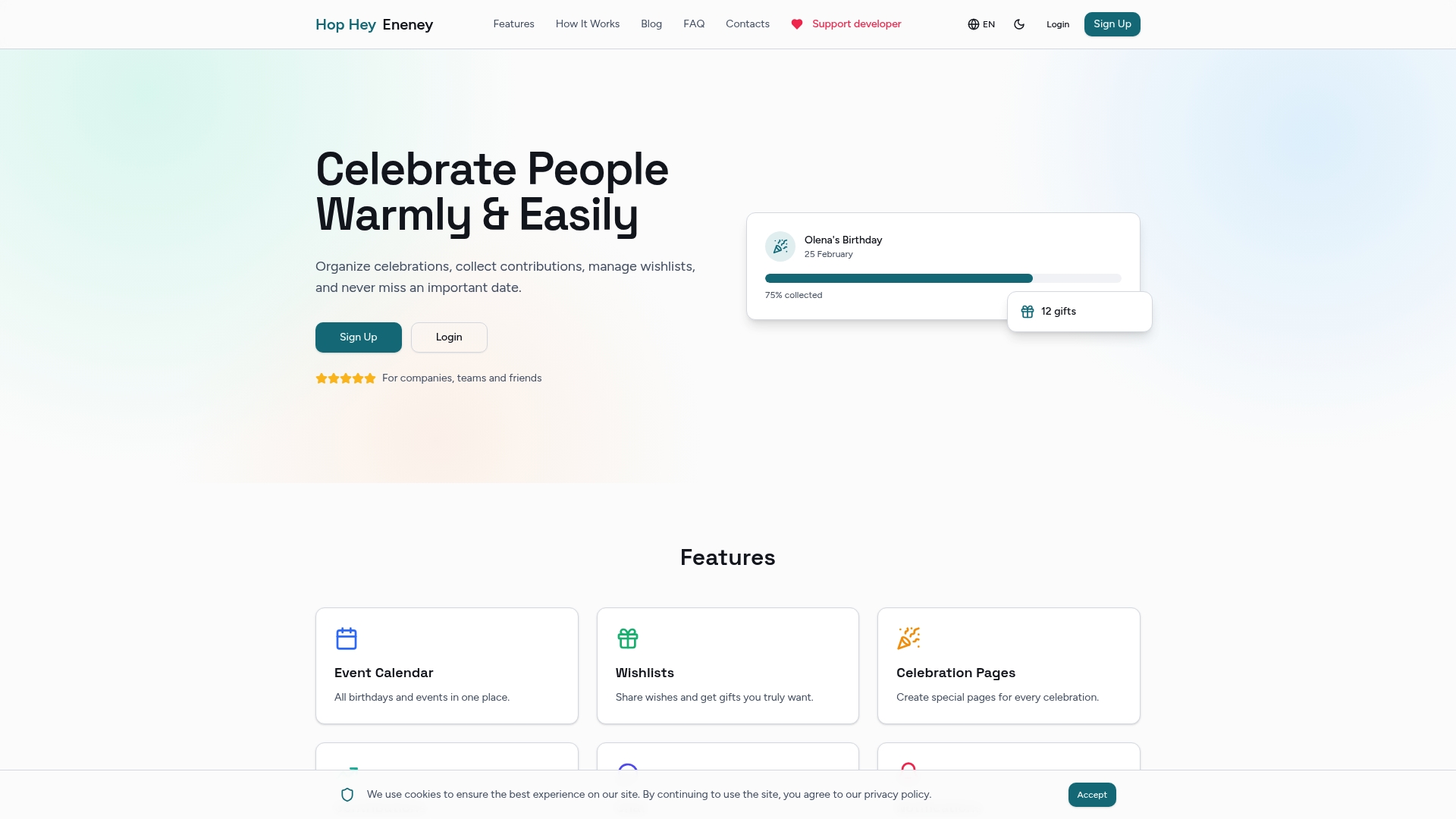
Hophey is a web platform built for exactly this situation. Teams use it to create private celebration pages, collect gift contributions transparently, and coordinate without spoiling the surprise. HR managers and team leaders can track every event in a shared calendar, send automated reminders via email or Telegram, and manage wishlists across multiple currencies. Instead of a group chat full of "who paid what," Hophey gives your team a single, clear place to handle the recognition side of any celebration. Explore team gift coordination on Hophey and add a meaningful layer to your next office event.
FAQ
What is an office celebration checklist?
An office celebration checklist is a structured planning guide covering purpose, budget, team roles, venue, menu, invitations, and day-of logistics. It keeps office managers and team leaders on track from the first planning meeting to the final cleanup.
How far in advance should you plan an office party?
Start planning at least 10–14 weeks before the event date if you are in a major city. Key milestones fall at 12 weeks, 8 weeks, and 4–6 weeks, with a final RSVP cutoff 7 days before.
How much should an office celebration cost per person?
Corporate event budgets typically run $50–$150 per person. Allocate the largest share, 35–40%, to food and beverages, and always reserve 5–10% for unexpected costs.
How do you collect dietary restrictions for an office event?
Use a dedicated online form sent at least 7–14 days before the event. Verbal collection and email threads miss people and give caterers no reliable data to work with.
What is the biggest mistake in office party planning?
Overloading the agenda is the most common error. One well-executed anchor moment creates a more memorable experience than five loosely connected activities competing for attention.