
TL;DR:
- Effective group event management relies on clear objectives, phased timelines, and centralized communication to ensure smooth execution. Planning well in advance, documenting risks, and designating ownership help prevent last-minute failures and improve attendee engagement. Using structured workflows and dedicated platforms reduces chaos, allowing teams to deliver successful, memorable gatherings.
Managing group events is the process of organizing every phase of a gathering, from objective-setting through execution and post-event evaluation, to deliver smooth coordination, on-time delivery, and attendee satisfaction. When treated as a structured project rather than an ad hoc effort, event management in 7 phases consistently keeps teams on time and within budget. The difference between a forgettable gathering and a genuinely successful one almost always comes down to process, not budget size. This guide walks you through every stage of the group event management process, with timing frameworks, coordination tips, and risk controls that apply equally to corporate conferences, community fundraisers, and social celebrations.
What does the managing group events process actually require?
The managing group events process requires three foundational elements before any logistics begin: a clear objective, a defined team with assigned roles, and a locked budget. Objectives form the strategic spine of every downstream decision, from venue selection to the tone of your invitation copy. Without a stated objective, every vendor conversation and scheduling choice becomes a guess.
Building your event team early is equally non-negotiable. Each team member needs a specific ownership area, whether that is vendor coordination, communications, or on-site logistics. Platforms like Breeze.pm, Asana, or Monday.com give teams a shared visual board where tasks, deadlines, and contracts live in one place. Centralizing task ownership on a single source of truth reduces status meetings and lets everyone review progress without waiting for a check-in call.

On the technology side, your minimum stack for group event coordination includes a project management board, a scheduling tool for conflict checks, and a communication platform for both internal team updates and external guest-facing messages. Budget preparation belongs in this same early phase. Early budget alignment is critical because high-cost items like venue, catering, and technology carry long lead times and approval chains that cannot be compressed later.
Pro Tip: Run a conflict check against local holidays, major sporting events, and competing industry conferences before you commit to a date. For large events, book 3 to 6 months out; for smaller gatherings, a minimum of 4 to 6 weeks protects your vendor options.
| Prerequisite | Why it matters |
|---|---|
| Defined event objective | Guides every tactical decision from messaging to venue layout |
| Assigned team roles | Prevents ownership gaps and duplicate effort |
| Locked preliminary budget | Reduces approval delays and feasibility surprises |
| Conflict-checked date | Protects attendance rates and vendor availability |
| Centralized project board | Replaces scattered emails with one shared reference point |
How to plan group events: the step-by-step execution roadmap
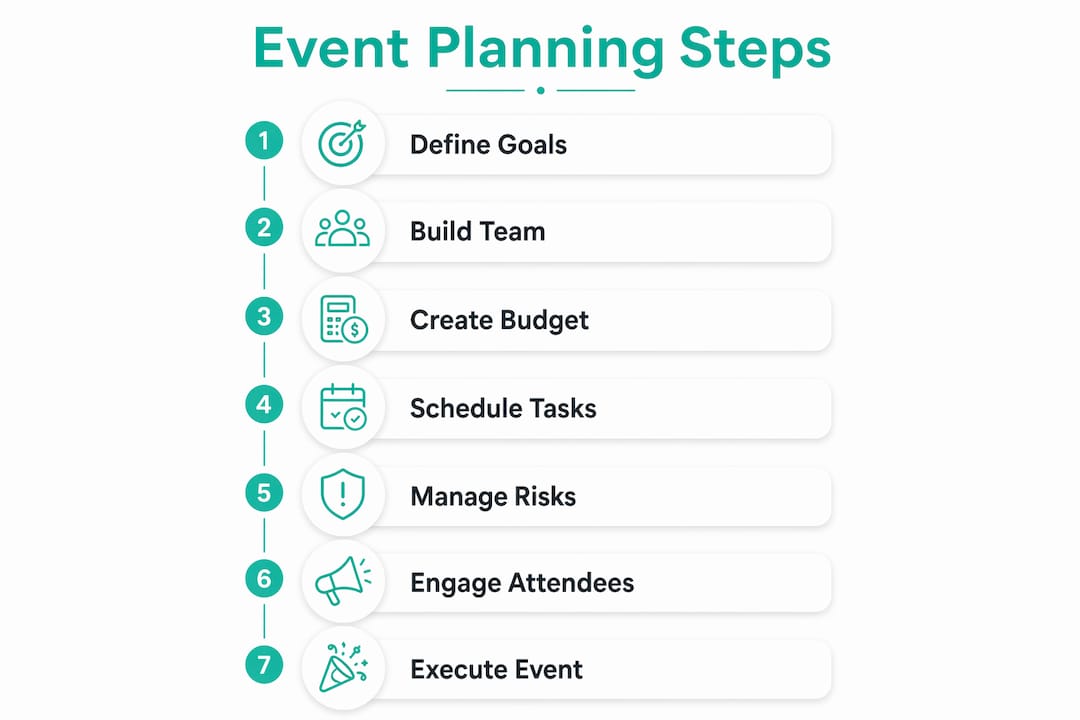
A repeatable event planning process follows a clear sequence. Skipping steps or reordering them is where most events run into trouble.
-
Define goals and audience. Write a one-sentence event objective that names the outcome you want and the audience you are serving. "Increase cross-department collaboration among 80 employees through a half-day offsite" is a goal. "Have a team event" is not.
-
Build and approve the budget. Itemize every cost category: venue, catering, A/V, staffing, transportation, printed materials, and a contingency reserve. Hold 10 to 20% of your total budget as a contingency line for overruns. Submit for stakeholder approval before signing any contracts.
-
Create a phased event timeline. Work backward from your event date. Assign hard deadlines to vendor selection, contract signing, registration opening, and communication sends. A phased run-of-show approach means drafting your detailed schedule 3 to 4 weeks out, refining it at the 2-week mark, and locking it 7 days before the event. The final 48 hours are for rehearsal and minor fixes only, not structural changes.
-
Select and contract vendors. Evaluate vendors against your objective, not just price. Confirm critical vendors in writing at the 14-day and 48-hour marks before the event. Written confirmation at both checkpoints is a risk control, not a courtesy.
-
Manage registration and communications. Open registration with enough lead time for attendees to plan travel or childcare. Segment your communication by audience type: speakers receive different information than general attendees. Approval delays and scattered info are the two most common causes of corporate event chaos, so centralize all guest-facing communications through a single channel or platform.
-
Execute on-site with a timeline manager. Assign one person the explicit role of timeline manager on event day. This person tracks the run of show in real time, communicates adjustments to vendors, and keeps the event within 5 minutes of plan. No one else makes timing calls.
-
Conduct post-event analysis. Send a feedback survey within 24 hours while impressions are fresh. Compare actual spend against budget, document what broke down, and record vendor performance notes for future use.
Pro Tip: Use a phase-based checklist with explicit deadlines for each of the 7 phases above. A checklist without dates is just a wish list.
| Planning approach | Outcome |
|---|---|
| Ad hoc, no written timeline | Missed vendor bookings, last-minute scrambles, budget overruns |
| Phased timeline with locked run-of-show | Predictable execution, clear accountability, fewer day-of surprises |
What are the best practices for risk management in group events?
Effective risk management is not just about mitigation. It requires documented contingency actions that protect the event against failure rather than assuming things will go smoothly. Every risk plan needs three components: a likelihood and impact assessment for each identified risk, a named contingency response, and a designated decision-maker who has authority to act without waiting for approval chains.
The most common risks in group event management fall into four categories:
- Vendor failure. Confirm critical vendors in writing at T-14 days and T-48 hours. Identify backup vendors for catering, A/V, and transportation before the event, not during it.
- Budget overruns. Maintain a 10 to 20% contingency reserve. Track actual spend against budget weekly in the lead-up to the event.
- Schedule delays. Your timeline manager absorbs and communicates delays in real time. Build 10-minute buffer blocks between major program segments.
- Food safety failures. For events with catering, foods must stay outside the 40°F to 140°F danger zone. Temperature logs and proper holding equipment are operational requirements, not optional extras.
"Fragmented event communication leads to inefficiency. Centralizing project info cuts down meetings and ensures everyone can review progress asynchronously."
Pro Tip: Assign a single communication channel for day-of issues. When something goes wrong on-site, the last thing you need is your team split across text messages, email, and radio. One channel, one decision-maker.
For reducing event stress before it compounds, document your risk register at least 3 weeks before the event. Waiting until the week of the event to think about contingencies means you have already lost the time needed to act on them.
How do you keep attendees engaged throughout the event lifecycle?
Attendee engagement is not a day-of concern. It starts with how you design registration and ends with whether you collect meaningful post-event feedback.
Effective engagement across the event lifecycle looks like this:
- Segmented pre-event communications. Send different messages to speakers, VIP guests, and general attendees. Each group needs different information at different times. Generic blast emails produce low open rates and confused attendees.
- Personalized agenda design. For multi-track events, let attendees select sessions during registration. This increases attendance at individual sessions and gives you accurate headcount data for room setup and catering.
- Automated reminders with RSVP tracking. Send a confirmation immediately after registration, a reminder 1 week out, and a final reminder 24 to 48 hours before the event. Track RSVP status actively and follow up with non-responders at least 5 days before your catering cutoff.
- Special needs and transportation coordination. Collect dietary restrictions, accessibility requirements, and transportation needs at registration. Addressing these proactively prevents day-of complaints and signals that the event was planned with care.
- On-site check-in technology. QR code check-in systems reduce entry queues and give you real-time attendance data. Long check-in lines are one of the most common first impressions at large events, and they set a negative tone before the program even starts.
- Post-event surveys. Send within 24 hours. Ask three to five specific questions rather than a 20-question form. Specific questions produce usable data; long surveys produce abandonment.
For boosting team engagement through events, the data consistently shows that personalization and timely communication matter more than production value. A well-communicated modest event outperforms a poorly communicated elaborate one every time.
Key takeaways
Structured group event management requires defined objectives, phased timelines, centralized communication, and documented risk controls to deliver consistent results.
| Point | Details |
|---|---|
| Start with a clear objective | Every logistics decision flows from a stated, measurable event goal. |
| Lock timelines in phases | Draft at 3 to 4 weeks, refine at 2 weeks, lock at 7 days before the event. |
| Centralize all project information | One shared board with task owners and deadlines replaces scattered emails. |
| Document risks before the event | Assign contingency responses and decision authority at least 3 weeks out. |
| Engage attendees before and after | Segmented communications and post-event surveys drive satisfaction and learning. |
Why most group events fail before they start
I have watched well-funded events collapse not because of bad vendors or bad weather, but because the organizing team never agreed on what success looked like. The objective was vague, the roles were assumed rather than assigned, and the timeline existed only in someone's head. By the time the event arrived, everyone was reacting instead of executing.
The single most underrated practice in group event coordination is treating the event as a project with a formal kickoff. That means a written brief, named owners for each workstream, and a shared project board that anyone can check without sending a message. Teams that skip this step spend the entire planning period in status meetings that exist only because no one knows where to find the current information.
The other lesson I keep relearning is that risk management gets deprioritized until it is too late. Most event planners know they should have a contingency plan. Very few write one down, assign a decision-maker, and confirm it with their vendors. The difference between a plan in your head and a plan in a document is the difference between a recoverable problem and a public failure.
Technology helps, but it does not replace clarity. Tools like Breeze.pm, Asana, or even a well-structured Google Sheet work when the team has agreed on the process. They fail when the tool becomes the substitute for the conversation about roles and ownership. Get the process right first, then pick the tool that supports it.
— Konstantin
How Hophey makes group event coordination less chaotic
Coordinating group events means managing timelines, contributions, communications, and surprises all at once. Hophey is built specifically for this. The platform gives teams a private space to plan celebrations, collect gift contributions transparently, and coordinate without involving the person being celebrated. HR teams use Hophey to automate employee recognition across multiple departments, while friend groups rely on it to organize birthdays and milestones without the usual back-and-forth. Features like automated reminders, Telegram notifications, role-based permissions, and multi-currency contribution tracking mean the coordination work happens in one place rather than across five different apps. If you are managing corporate celebrations and team events, Hophey removes the chaos so you can focus on the moment itself. Start organizing with Hophey and see how structured celebration management changes the experience for everyone involved.
FAQ
What is the managing group events process?
The managing group events process is a structured workflow covering objective-setting, team assignment, budgeting, scheduling, vendor coordination, on-site execution, and post-event analysis. Treating events as formal projects with defined phases keeps them on time and within budget.
How far in advance should you start planning a group event?
Large events require 3 to 6 months of lead time; smaller gatherings need a minimum of 4 to 6 weeks. Starting earlier protects vendor availability and gives approval processes enough time to complete without compressing logistics.
What is a run-of-show timeline?
A run-of-show timeline is a minute-by-minute schedule of every event segment, assigned to named owners. High-performing teams draft it 3 to 4 weeks out, lock it 7 days before the event, and use a dedicated timeline manager on event day to keep execution within 5 minutes of plan.
How do you handle last-minute problems at group events?
Assign a single decision-maker and a single communication channel for day-of issues before the event starts. Document contingency responses for your highest-impact risks at least 3 weeks in advance so the team is executing a plan rather than improvising under pressure.
What tools work best for group event management?
Project management boards like Breeze.pm, Asana, or Monday.com centralize task ownership and reduce status meetings. For celebration-focused group events, Hophey adds contribution tracking, private coordination, and automated reminders in one platform.