
TL;DR:
- Event budget management involves planning, tracking, and controlling all revenues and expenses to prevent overspending. It requires accurately categorizing costs, managing cash flow, negotiating contracts, and reconciling actual spending within two weeks after the event. Proper discipline helps avoid budget failures caused by outdated estimates and underfunded contingency reserves.
Event budget management is the process of planning, tracking, and controlling all revenues and expenses for an event to maintain financial control from first deposit to final invoice. Without a structured financial roadmap, even well-organized events routinely overspend, miss payment deadlines, or run short on cash at critical moments. Explaining event budget management clearly means covering six core disciplines: categorizing fixed and variable costs, building a contingency fund, managing cash flow timing, negotiating vendor contracts, tracking spending in real time, and conducting post-event reconciliation. Planners who master these disciplines consistently deliver events on budget and on brief.
What are the main components of an event budget?
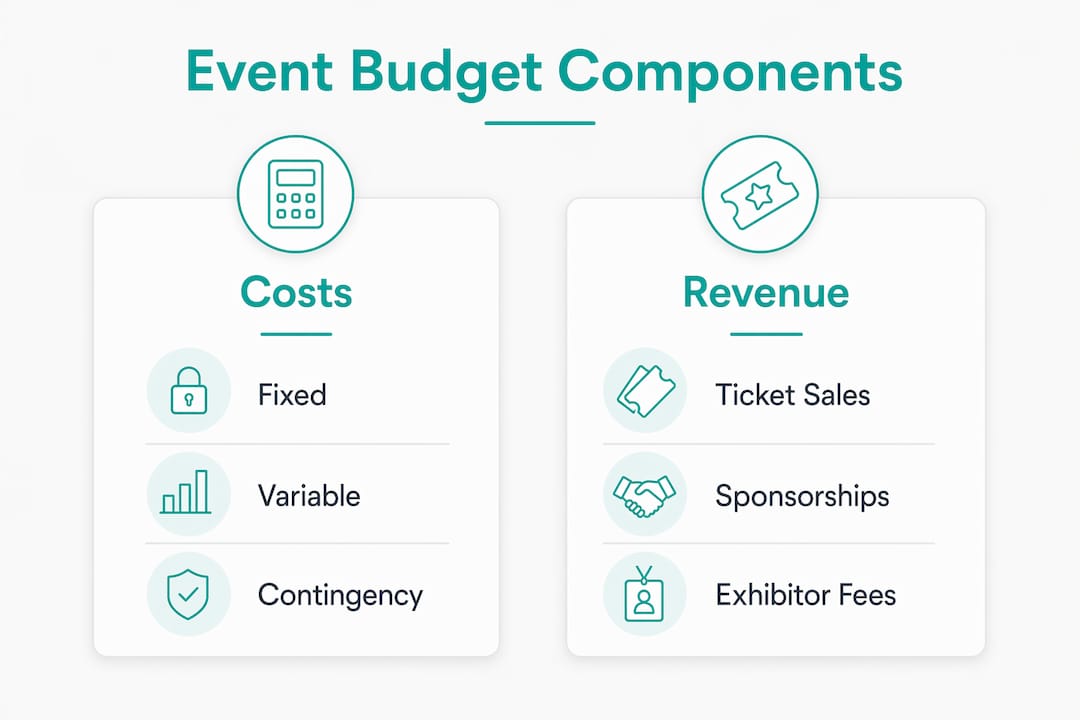
An event budget breaks into four categories: fixed costs, variable costs, revenue sources, and a contingency reserve. Understanding each category prevents the most common budgeting mistake, which is treating all line items as equally flexible.

Fixed costs stay constant regardless of attendance. Venue rental, permits, liability insurance, staging, and audio-visual infrastructure fall here. These costs are committed early and rarely negotiable once contracts are signed. That is why locking in venue and production contracts first gives you the clearest picture of your financial floor.
Variable costs scale with attendance. Catering, staffing, printed materials, and event swag all move up or down based on how many people show up. Budgeting variable costs at 80% of projected attendance initially prevents overspending and allows adjustment as registrations confirm. That 80% rule is one of the most practical techniques in event financial planning because it builds in natural breathing room without requiring a separate line item.
Revenue sources belong in every budget from day one. Ticket sales, sponsorships, and exhibitor fees offset gross expenses and change your net cost picture significantly. Planners who build budgets without revenue projections consistently underestimate how much they need to raise or spend.
The contingency fund is the category most planners underfund. Industry standards recommend reserving 10–20% of the total projected budget for unexpected costs such as weather disruptions or vendor cancellations. That range is not arbitrary. It reflects the real-world frequency of last-minute cost additions that fall outside any original scope.
| Cost type | Examples | Behavior |
|---|---|---|
| Fixed | Venue, permits, insurance, staging | Constant regardless of attendance |
| Variable | Catering, staffing, swag, printing | Scales with confirmed attendance |
| Revenue | Ticket sales, sponsorships, exhibitor fees | Offsets gross expenses |
| Contingency | Reserve fund | 10–20% of total projected budget |
Pro Tip: Never lump "miscellaneous" into one line item. Break it into subcategories like décor extras, last-minute supplies, and gratuities. Vague line items hide overspending until it is too late to correct.
One hidden cost category planners consistently ignore is service charges and gratuities. Venue contracts often add a 20–25% service charge on top of food and beverage minimums. That addition can push a catering line item well past its original estimate before a single guest arrives.
How do event planners manage cash flow and payment schedules?
Cash flow management and total budget management are two different disciplines. Confusing them causes liquidity crises even when the overall budget looks healthy on paper.
A $100,000 event budget does not mean $100,000 sits in your account on day one. Misunderstanding cash flow versus total budget causes planners to miss deposits and lose venue holds, even when the total funding is secured. The money exists, but it is not available at the right time.
Standard payment milestones follow a predictable pattern. Knowing them in advance lets you align your revenue collection with your outgoing obligations.
- Venue deposit: Due 6–12 months before the event, typically 25–50% of the total venue fee.
- Vendor deposits: 30–50% at contract signing for caterers, AV companies, and entertainment providers.
- Interim payments: Some vendors require a second installment 60–90 days out, particularly for large productions.
- Final payments: Due 14–30 days before the event for most vendors, with some requiring payment on the day of the event.
- Post-event settlements: Gratuities, overtime charges, and final headcount adjustments typically settle within 7–14 days after the event.
Map these milestones against your revenue schedule. If ticket sales open 90 days before the event but your venue deposit is due 9 months out, you need bridge funding or an early sponsor commitment to cover that gap.
Pro Tip: Set calendar reminders 30 days, 14 days, and 7 days before each payment deadline. Late payments trigger penalty clauses in most vendor contracts, and those fees eat directly into your contingency fund.
The most practical tool for cash flow tracking is a simple spreadsheet with two parallel columns: projected cash in and confirmed cash out, mapped by week. This gives you a running liquidity picture that a single budget total never provides.
What strategies help control event costs and handle unexpected expenses?
Cost control starts with prioritization, not cuts. Planners should rank budget line items by their impact on the core attendee experience before making any reductions. Cutting the keynote speaker to save money on a conference budget destroys the product. Cutting branded lanyards does not.
Negotiation is the single highest-return skill in event cost control. Many event costs are negotiable, and planners who treat first quotes as final prices consistently overpay. Specific negotiation targets include:
- Venue rental rates: Ask for a reduced rate in exchange for a multi-year commitment or off-peak date.
- Catering minimums: Negotiate the food and beverage minimum down, or request that service charges be capped.
- AV packages: Request itemized quotes and remove equipment you do not need rather than accepting bundled packages.
- Hotel room blocks: Negotiate attrition clauses to reduce your liability if room pickup falls short.
Initial vendor quotes rarely reflect final costs. Treat first estimates as baselines and allocate contingency to absorb add-ons and surprises. This mindset shift alone prevents the most common budget overrun pattern, which is assuming the first number is the real number.
Hidden fees deserve a dedicated review in every contract. Service charges, overtime labor, parking, Wi-Fi access, and equipment delivery fees regularly appear in final invoices without appearing in original quotes. Ask every vendor to provide a fully loaded estimate that includes all applicable fees before you sign.
Pro Tip: Request a "worst-case scenario" quote from your top three vendors. Ask them to include every possible add-on. That number is your true ceiling, and your contingency fund should cover the gap between the base quote and the worst-case figure.
For planners managing flexible budget roles across a team, assigning one person to own each cost category creates accountability. When everyone is responsible for the budget, no one is.
How do you track, update, and reconcile your event budget after the event?
A budget is a living document. Weekly updates are critical once vendor commitments begin, because estimates become outdated the moment a contract is signed. Planners who update budgets monthly instead of weekly routinely discover variances too late to correct them.
Post-event reconciliation is the discipline that separates planners who improve over time from those who repeat the same mistakes. The reconciliation process has a clear sequence:
- Collect all final invoices within 7 days of the event. Chase outstanding invoices immediately while vendor contacts are still responsive.
- Compare actuals to projections line by line. Document every variance, whether positive or negative, with a brief explanation.
- Calculate total variance as a percentage of the original budget. This gives you a single performance metric to track across events.
- Identify root causes for the three largest variances. Was it a scope change, a hidden fee, or a forecasting error?
- Update your budget template with the corrected figures before archiving. Future events should start from real numbers, not original estimates.
- Complete the full reconciliation within two weeks. Post-event reconciliation within 14 days is the industry standard because memories fade and vendors become harder to reach after that window.
ROI measurement belongs in this phase as well. For corporate events, calculate cost per attendee, cost per lead generated, or cost per hour of programming delivered. These metrics give stakeholders a financial story, not just a final invoice.
Building a detailed budget proposal with multiple attendance scenarios also pays dividends at reconciliation time. When you planned for 80%, 100%, and 120% attendance, you already know which cost lines should have scaled and by how much.
For planners coordinating across multiple departments or organizations, a step-by-step coordination process that includes budget checkpoints at each planning phase keeps the financial picture current without requiring a full review every week.
Key Takeaways
Effective event budget management requires categorizing costs accurately, managing cash flow separately from total budget, negotiating contracts aggressively, and reconciling actuals within two weeks of the event.
| Point | Details |
|---|---|
| Separate cash flow from total budget | A large total budget does not prevent liquidity crises if payment timing is not planned carefully. |
| Reserve 10–20% for contingency | Industry standards recommend this range to absorb weather changes, vendor cancellations, and hidden fees. |
| Budget variable costs at 80% of projected attendance | This prevents overspending and allows upward adjustment as registrations confirm. |
| Update the budget weekly once contracts begin | Static budgets cause surprises; weekly updates keep actual spend aligned with projections. |
| Reconcile within 14 days post-event | Early reconciliation captures accurate data and informs more reliable budgets for future events. |
What I have learned from years of watching event budgets fail
The most common budget failure I see has nothing to do with math. Planners build accurate spreadsheets and then stop updating them. By the time the event arrives, the budget reflects the world as it was six months ago, not as it is today.
The second pattern is underestimating the contingency fund. Planners treat 5% as reasonable and then watch a single vendor cancellation or a weather-related venue change consume it entirely. The 10–20% standard exists because real events produce real surprises at a predictable rate. A contingency fund that feels too large before the event almost always feels exactly right after it.
Negotiation skill matters more than most planners admit. The difference between a planner who accepts the first quote and one who pushes back on every contract is often 10–15% of total event cost. That gap funds your contingency reserve and then some.
Clear financial communication with stakeholders is the discipline that gets skipped most often. When budget holders understand the difference between committed spend and projected spend, they make better decisions about scope changes. When they do not understand that difference, they approve additions that blow the budget in the final weeks before the event.
Technology helps, but only if the process is sound first. A platform like Hophey that centralizes fund collection, tracks contributions in real time, and coordinates across teams removes a specific category of financial chaos from celebration events. The tool works because the underlying budget discipline is already in place.
— Konstantin
Hophey makes event financial coordination simpler
Managing an event budget gets harder when funds are collected informally, contributions are tracked in separate messages, and no one has a clear view of what has been raised versus what is owed. Hophey solves that coordination problem directly.
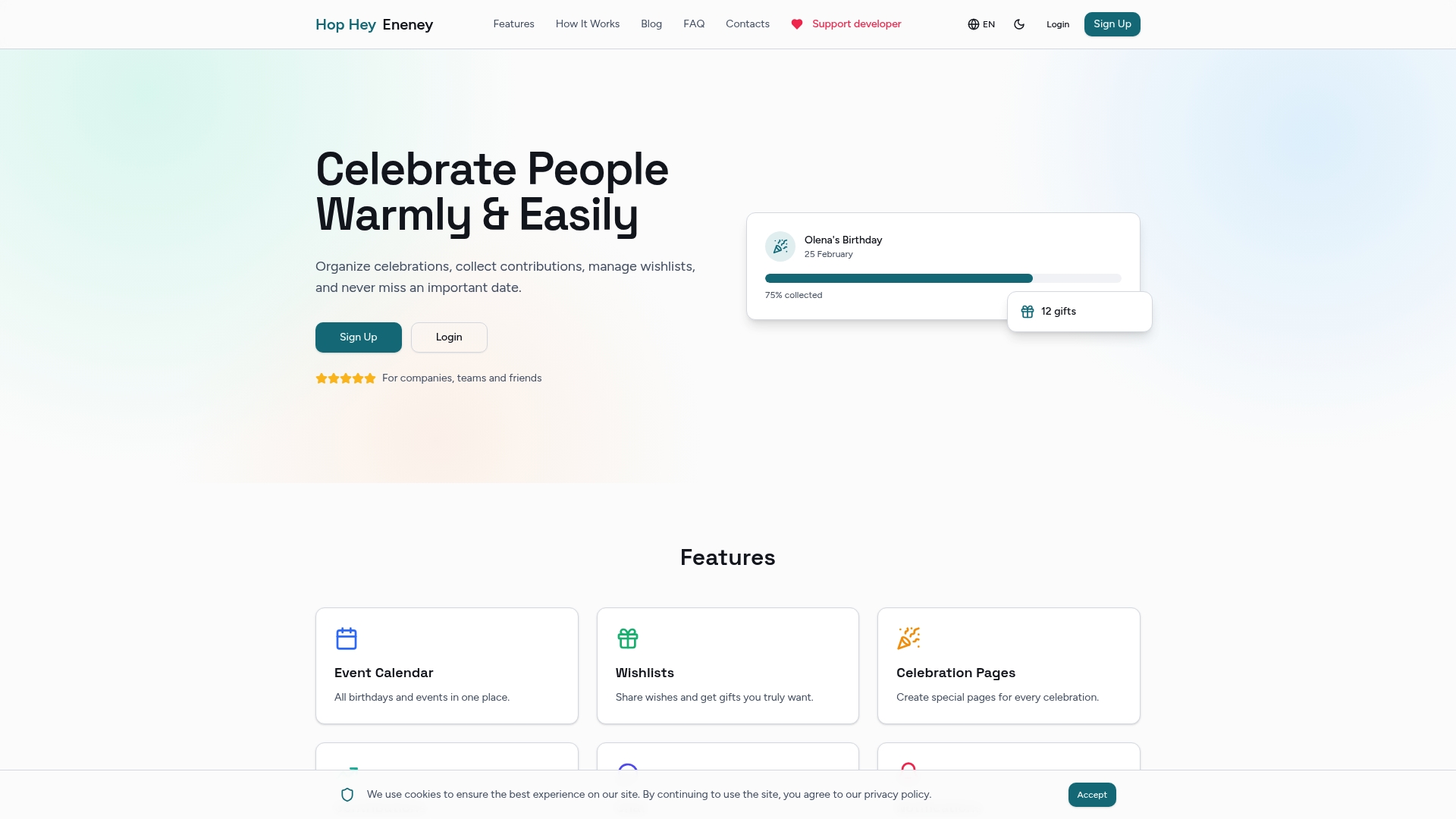
Hophey is a web platform built for teams, companies, and friend groups who want to organize celebrations without the financial chaos. The platform collects gift contributions transparently, tracks every contribution in real time, and supports multi-currency payments in UAH, USD, and EUR. Automated reminders, Telegram notifications, and role-based permissions mean the right people always know where the money stands. Whether you are coordinating a corporate milestone or a group birthday, Hophey keeps the financial side clear and the celebration a surprise.
FAQ
What is event budget management?
Event budget management is the process of planning, tracking, and controlling all revenues and expenses for an event to maintain financial control. It includes categorizing costs, managing cash flow, negotiating contracts, and reconciling actuals after the event.
How much should I set aside for a contingency fund?
Industry standards recommend reserving 10–20% of the total projected budget as a contingency fund to cover unexpected costs such as vendor cancellations or weather-related changes.
What is the difference between a total budget and cash flow?
A total budget shows all projected income and expenses for an event, while cash flow tracks when money actually moves in and out. A large total budget does not prevent a cash shortfall if payment deadlines are not aligned with revenue timing.
When should I reconcile my event budget after the event?
Complete post-event reconciliation within two weeks of the event. This window captures accurate data while invoices are fresh and vendor contacts are still responsive.
What are the most common hidden fees in event budgets?
Service charges, gratuities, overtime labor, Wi-Fi access fees, and equipment delivery charges are the most frequent hidden costs. Always request a fully loaded estimate from every vendor before signing a contract.