TL;DR:
- Building relationships through celebrations involves deliberately creating shared positive experiences that foster trust, loyalty, and belonging among teams or individuals. Recurring rituals and specific recognition deepen bonds and transition interactions from transactional to relational over time, especially when signals of appreciation are consistent and personalized. Effective celebrations are scheduled, inclusive, and designed to create lasting relational deposits, whereas sporadic or superficial events can undermine trust and engagement.
Relationship building through celebrations is the deliberate practice of using shared moments of recognition and joy to deepen trust, strengthen bonds, and create a lasting sense of belonging among individuals or teams. This is not about throwing parties. It is about designing recurring rituals that signal: you matter here. Research from Gallup confirms that employees receiving great recognition are 20 times more likely to be engaged than those who receive poor recognition. That gap is not a morale issue. It is a relationship issue, and celebrations are one of the most direct tools available to close it.
What is relationship building through celebrations?
Relationship building through celebrations is the structured use of positive shared experiences to accumulate what organizational psychologists call relational deposits. Every time a team leader acknowledges a colleague's contribution publicly, or a friend group gathers to honor a milestone, they are making a deposit into a relational account that pays dividends in trust, loyalty, and collaboration.

The psychological engine behind this process is joint savoring. A 2025 Springer Nature study of 589 couples found that shared attention to positive moments correlates directly with higher relationship quality and well-being. The effect goes beyond simply experiencing something positive. It requires mutual attention, which is exactly what a well-designed celebration creates.
Celebrations also serve as cultural signals. According to Great Place to Work, celebrating employee contributions is classified as a high-trust leadership behavior. When leaders model appreciation consistently, they normalize it across the team. That normalization is what transforms a one-time event into a relationship-strengthening system.
The distinction between a party and a relational ritual comes down to intention and repetition. A birthday cake in the break room is a gesture. A monthly team recognition session with specific, named contributions is a system. The first is forgettable. The second builds culture.
How celebrations function as catalysts for stronger relationships
Celebrations work on relationships through three overlapping mechanisms: they create shared memory, they signal value, and they reduce social distance.
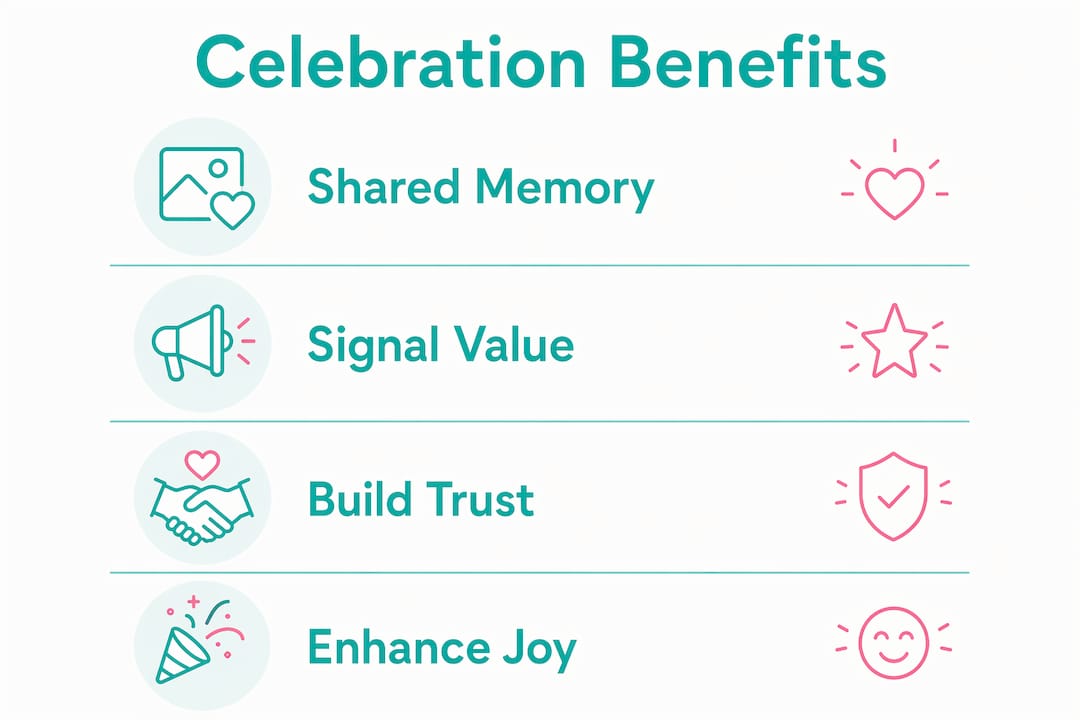
Shared memory is the foundation. When two people experience the same positive moment together, they gain a reference point that belongs only to them. This is why teams that celebrate together consistently report stronger cohesion than those that do not. The memory becomes a shorthand for trust.
Signaling value is the mechanism most leaders underestimate. Celebrations normalize appreciation and reinforce organizational culture through leadership modeling and social ritual. When a manager takes time to recognize a specific contribution, they are communicating that the person's work is seen. That signal is more powerful than any performance review.
Reducing social distance is the third mechanism, and it is especially relevant for remote or hybrid teams. Structured celebrations give people a reason to interact outside of task-focused contexts. This matters because most workplace relationships are transactional by default. Celebrations interrupt that pattern.
Effective celebration rituals that teams use today include:
- Weekly kudos channels on Slack or Microsoft Teams, where contributions are named specifically
- Monthly "wins" meetings where each team member shares one personal or professional achievement
- Quarterly milestone events tied to project completions or anniversaries
- Peer-nominated recognition programs that distribute the act of celebrating across the team
Pro Tip: Name the contribution, not just the person. "Sarah closed the Q3 deal under budget" builds more relational trust than "Great job, Sarah." Specificity is what makes recognition feel real.
For deeper reading on how this plays out in organizational settings, the engagement through celebrations guide from Hophey breaks down the mechanics in a workplace context.
What types of celebrations build the strongest relationships?
Not all celebrations produce the same relational outcomes. The format, frequency, and focus of a celebration each affect how much it contributes to relationship growth.
| Celebration type | Relational strength | Limitation |
|---|---|---|
| One-off milestone events (weddings, promotions) | High emotional impact, strong shared memory | Infrequent; hard to sustain relational momentum |
| Recurring team rituals (weekly kudos, monthly wins) | Builds belonging over time through repetition | Requires consistency; loses impact if skipped |
| Cultural and holiday celebrations | Inclusive, signals respect for identity | Risk of superficiality if not personalized |
| Peer recognition programs | Distributes appreciation, reduces hierarchy | Needs structure to avoid favoritism |
| Personal milestone acknowledgments (birthdays, work anniversaries) | High personal value, signals individual care | Requires tracking and coordination |
Recurring rituals produce the deepest relational effects over time. Mixily's research on community events shows that by the fourth or fifth event, attendees shift from feeling like visitors to feeling like members. That transition from acquaintance to community is the core goal of relationship building through celebrations. One-off events can create a spark, but recurring rituals sustain the flame.
Personal milestone acknowledgments, such as birthdays and work anniversaries, carry disproportionate relational weight. They signal that the organization or group tracks what matters to the individual, not just what matters to the team's output. This is why HR teams that automate anniversary recognition consistently report higher retention than those that do not.
How to design celebrations for maximum relationship impact
Designing celebrations that actually build relationships requires more than good intentions. It requires structure, rhythm, and a deliberate approach to social facilitation.
-
Schedule celebrations on a recurring calendar. Spontaneous celebrations feel good in the moment but do not build belonging over time. Set a fixed cadence, whether weekly, monthly, or quarterly, and protect it. Repetitive, scheduled celebrations validate achievements and reinforce interpersonal goodwill far more effectively than occasional events.
-
Build in reflection time. Joint savoring requires slow, shared attention. Add a structured moment to each celebration where participants reflect on what was achieved and why it matters. A two-minute round-table at the end of a recognition session produces more relational depth than two hours of passive celebration.
-
Reduce social activation energy. HubSpot's event research shows that structured and passive networking combined with play and free time optimizes relationship building at events. Practically, this means designing celebrations with both structured activities and unstructured time. Give people a reason to talk, then give them space to do it naturally.
-
Personalize the recognition. Generic praise ("great work, everyone") produces no relational deposit. Name the person, name the contribution, and name the impact. This specificity is what separates a meaningful celebration from a forgettable one.
-
Make participation easy and inclusive. Celebrations that require significant time, money, or social confidence create barriers. The most effective formats are low-pressure, brief, and accessible to everyone on the team regardless of role or location.
Pro Tip: Bookend your celebration events with free time. Starting 15 minutes early with informal conversation and ending 15 minutes late with open discussion produces more genuine connection than the structured program itself.
For practical frameworks on building relationships through events, the design principles above translate directly into event planning decisions.
Common pitfalls that undermine celebration-based relationship building
Even well-intentioned celebrations can fail to build relationships, or actively damage them, when they fall into predictable traps.
-
Generic or hollow praise. Telling an entire team they did "amazing work" without specifics reads as performative. People recognize the difference between genuine recognition and a checkbox exercise. Hollow praise erodes trust rather than building it.
-
Inconsistency. A celebration culture that appears and disappears based on a leader's mood or workload signals that recognition is conditional. Sporadic celebrations reduce legitimacy and teach people not to expect or value them.
-
Cultural blind spots. Not everyone experiences celebration the same way. Some team members find public recognition uncomfortable. Others come from cultural backgrounds where certain types of celebration feel inappropriate. Inclusive design means offering multiple formats and asking people what recognition means to them.
-
Celebrating only outcomes, not effort. Teams that only celebrate wins teach their members that effort without results is invisible. Recognizing process, persistence, and growth builds stronger relational trust than outcome-only recognition.
-
Neglecting follow-through. A celebration that raises expectations but produces no follow-up action undermines credibility. If a team celebration includes promises or commitments, those need to be honored. The relational outcomes of celebrations should be measured over months, not just in the immediate afterglow.
The solution to most of these pitfalls is the same: treat celebrations as a system, not an event. Assign ownership, set a schedule, and review outcomes regularly.
Key takeaways
Relationship building through celebrations works because it combines shared positive attention, consistent recognition, and social ritual into a repeatable system that accumulates trust over time.
| Point | Details |
|---|---|
| Recurring rituals outperform one-off events | By the fourth or fifth shared event, participants shift from acquaintances to community members. |
| Specificity drives relational impact | Naming the person, contribution, and impact makes recognition feel genuine and builds real trust. |
| Joint savoring deepens bonds | Shared attention to positive moments strengthens relationship quality beyond individual experience. |
| Consistency is non-negotiable | Sporadic celebrations lose legitimacy; scheduled rhythms build belonging over time. |
| Measure long-term, not just same-day | Relational outcomes from celebrations mature over months, not hours. |
Why I stopped treating celebrations as optional
I spent years watching teams invest heavily in annual retreats and holiday parties, then wonder why their culture felt flat the other 50 weeks of the year. The pattern was always the same: one big event, a brief spike in morale, then a slow return to transactional interactions.
The shift that changed my thinking was reading the research on joint savoring. The finding that shared attention to positive moments produces relationship benefits beyond individual positive experience reframed everything. The goal is not to create a good experience for each person. The goal is to create a shared experience that both people can reference, reflect on, and build from.
What I have seen work consistently is treating celebrations the way you treat any other operational system: with a schedule, an owner, and a review cycle. The teams that do this do not just feel better. They collaborate faster, resolve conflict more easily, and retain people longer. That is not a soft outcome. It is a measurable business result.
The uncomfortable truth is that most leaders know celebrations matter but treat them as optional when things get busy. That is exactly when they are most needed. A team under pressure that still takes five minutes to recognize a win is a team that trusts its leadership. That trust is built one small celebration at a time.
— Konstantin
How Hophey makes celebration-based relationship building practical
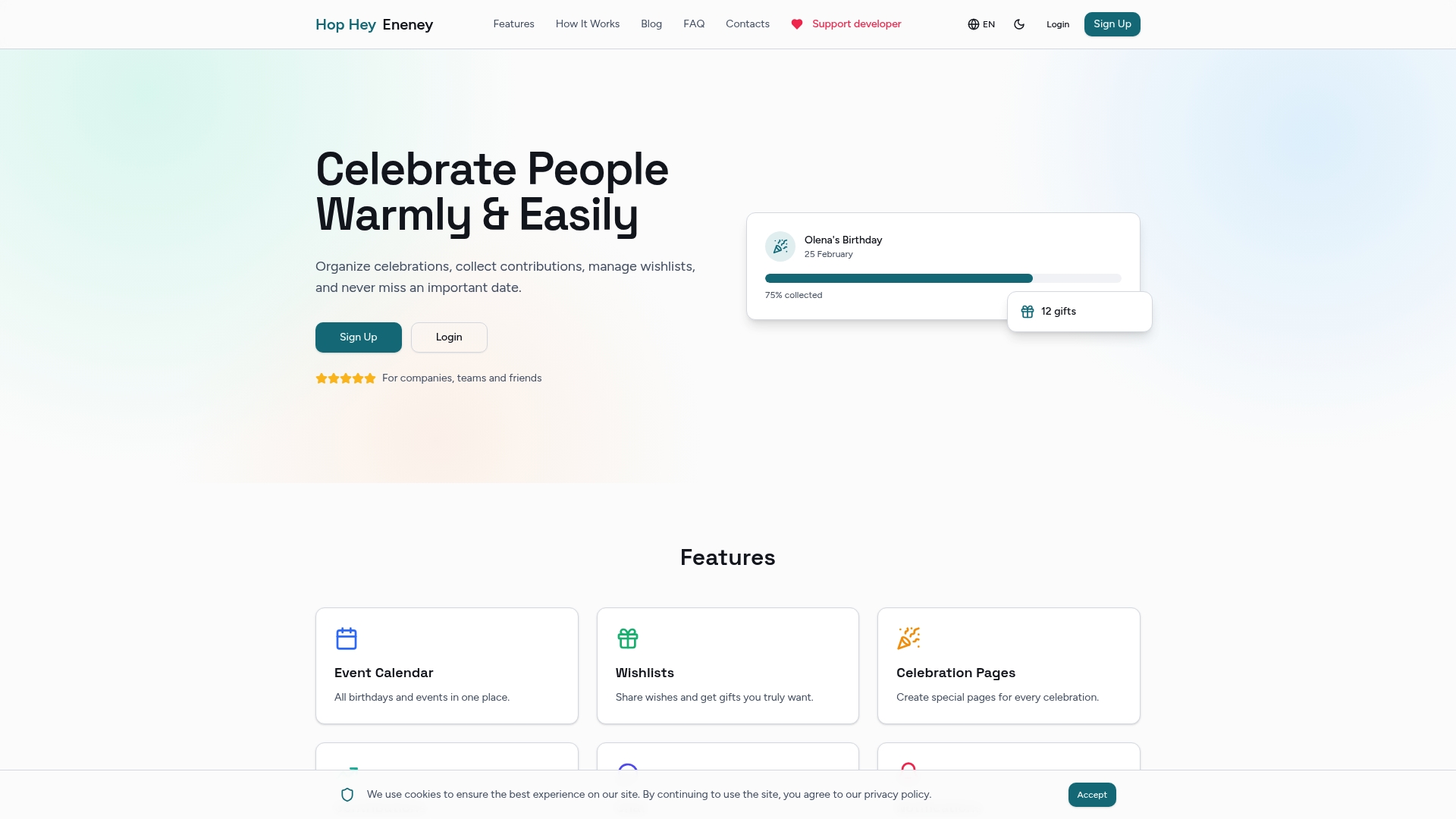
Hophey is built specifically for the challenge of turning celebration intentions into consistent practice. The platform lets teams, HR departments, and friend groups create private celebration pages, coordinate gift contributions transparently, and manage shared event calendars, all without the logistical chaos that usually derails good intentions.
For team leaders, Hophey automates the reminders, tracks contributions in real time, and keeps coordination private so surprises stay surprises. For HR teams managing recognition at scale, the multi-organization support and role-based permissions mean celebrations stay organized across departments. If you want to build a celebration culture that actually sticks, Hophey removes the friction that causes most celebration programs to fade after the first month.
FAQ
What is relationship building through celebrations?
Relationship building through celebrations is the intentional use of shared positive experiences, recognition rituals, and milestone acknowledgments to deepen trust and belonging among individuals or teams. It works through joint savoring, cultural signaling, and the accumulation of relational deposits over time.
How often should teams celebrate to build stronger relationships?
Recurring celebrations produce stronger relational outcomes than one-off events. Research on community events shows that belonging develops by the fourth or fifth shared experience, which means a monthly or weekly cadence is more effective than annual events alone.
What makes a celebration effective for relationship building?
Specificity and consistency are the two most critical factors. Named contributions, scheduled rhythms, and structured reflection time convert a generic celebration into a genuine relational investment. Generic or infrequent praise produces little to no lasting relational benefit.
Can remote teams build relationships through celebrations?
Remote teams can build strong relationships through celebrations when the format is accessible and the recognition is specific. Digital kudos channels, virtual milestone events, and coordinated gifting platforms like Hophey remove the geographic barriers that otherwise limit celebration-based connection.
How do you measure the impact of celebrations on relationships?
Relational outcomes from celebrations should be tracked over a minimum of six months, looking at indicators like collaboration frequency, trust scores, and retention rates rather than same-day sentiment. Immediate positive reactions are a starting point, not a measure of success.