
TL;DR:
- Effective event coordination involves seven phases, from goal setting to post-event review, ensuring smooth execution. Building workflows that map dependencies and assign ownership reduces gaps, while a contingency budget of 10-20% prepares teams for unexpected issues. Proper preparation, clear communication, and structured processes are key to successful events and vendor relationships.
The event coordination process is the systematic approach to managing every logistical, vendor, and team detail required to execute a smooth and memorable event. Where an event planner sets strategy and manages client relationships, an event coordinator owns operational execution. That distinction matters because confusing the two roles creates gaps that surface on event day, not during planning. This guide breaks down the full coordination workflow, from goal-setting through post-event review, so your team can move from scattered checklists to a process that actually holds together under pressure.
What are the essential steps in the event coordination process?
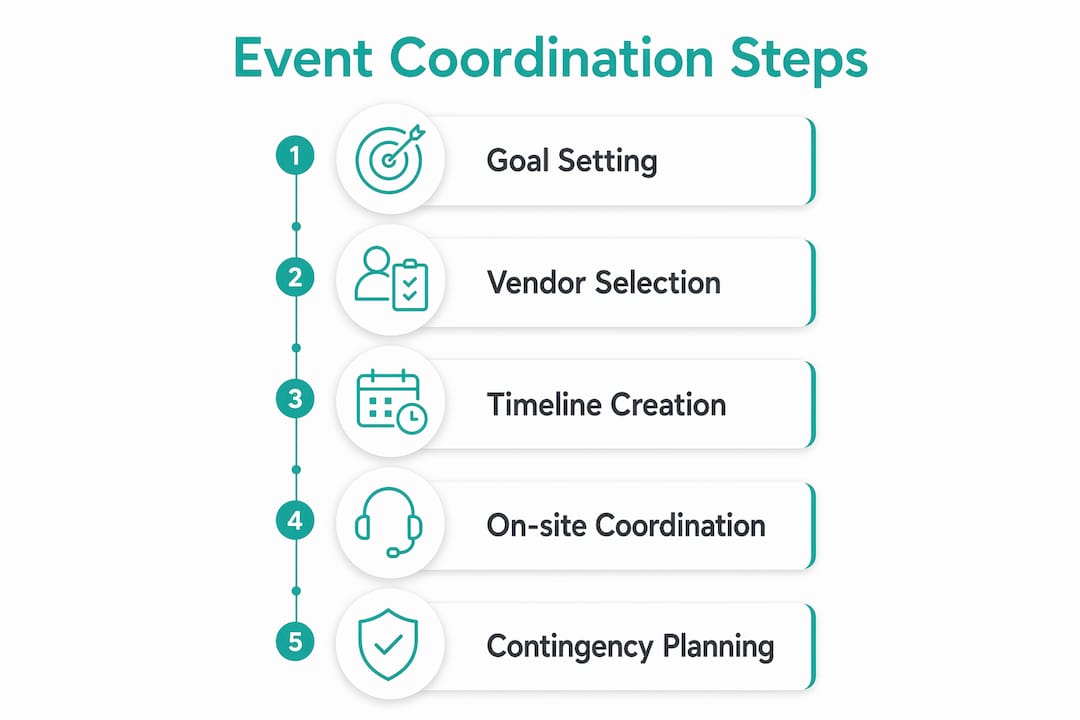
A professional event coordination workflow runs through seven distinct phases. Each phase has a clear entry point, defined outputs, and a handoff to the next stage. Skipping phases does not save time. It transfers the cost of that skipped work onto event day, when fixing problems is exponentially harder.
-
Lock goals and scope. Define the event type, expected attendance, budget ceiling, and non-negotiables before any vendor conversations begin. Scope drift is the single biggest driver of budget overruns, and it almost always starts here.
-
Select vendors and sign contracts. Identify caterers, AV teams, venues, photographers, and any other suppliers. Confirm deliverables, payment schedules, and cancellation terms in writing. Strong vendor relationships depend on clear scope and assigned contact ownership from the start.
-
Build the timeline backward from the event date. Working backward from the event date surfaces real lead times and critical dependencies that forward planning consistently misses. If the venue requires a certificate of insurance 30 days out, that deadline drives your insurance procurement date, not the other way around.
-
Assign tasks with ownership and deadlines. Every task needs one named owner and a due date. Tasks without owners fall through the gaps regardless of how detailed your list is.
-
Track budget and contingency. Maintain a live budget tracker that separates committed spend from projected spend. Reserve a contingency fund of 10 to 20% of total event cost to absorb unexpected expenses without derailing the event.
-
Execute final-week preparations. Confirm all vendors, distribute the run-of-show document, hold a team briefing, and walk the venue. Arrive on event day three to four hours early to resolve setup issues before guests arrive.
-
Run a post-event evaluation. Collect feedback from attendees, vendors, and team members within 48 hours. Document what worked, what failed, and what your contingency budget actually absorbed. This report becomes the foundation for your next event.
Pro Tip: Set a hard deadline for scope changes at least three weeks before the event. Any request after that date requires a written impact assessment covering cost, timeline, and staffing before it gets approved.
How to build an event coordination workflow beyond a basic checklist
Most teams start with a checklist and mistake it for a workflow. The difference is significant in practice.

| Feature | Checklist | Workflow |
|---|---|---|
| Task visibility | Lists what needs doing | Shows who does what and when |
| Dependencies | Not captured | Explicitly mapped |
| Ownership | Implied or absent | Assigned to a named person |
| Progress tracking | Binary (done/not done) | Tracks status across stages |
| Risk of gaps | High | Low when maintained correctly |
A checklist lists tasks; a workflow defines the when, who, and in what order. That structure reduces missed dependencies significantly, which is where most coordination failures originate. A caterer who does not know the venue loading dock closes at 5 PM is a checklist problem. A workflow that connects "venue access confirmation" to "caterer delivery scheduling" prevents it entirely.
Building a real workflow requires three additions beyond your task list:
- Dependency mapping. Identify which tasks cannot start until another is complete. Printing signage cannot happen before the final guest count is confirmed. Venue layout cannot be finalized before the AV equipment list is locked.
- Scheduled sync points. Start detailed milestone planning six to eight weeks before the event, with weekly check-ins shifting to daily check-ins in the final week. These are not status meetings for their own sake. They are the mechanism that surfaces blockers before they become crises.
- A central coordination tool. Platforms like Asana, Notion, or dedicated event management software give every team member visibility into the full picture. Automated coordination workflows can save event teams up to 62% of manual labor time per event. That number reflects the cost of manual follow-up, duplicate communication, and version-control errors that structured tools eliminate.
For teams coordinating celebrations, birthdays, or group contributions alongside logistics, tools that combine task tracking with communication and fund collection reduce the coordination overhead further. Hophey's platform, for example, integrates event calendar management, private chat, and contribution tracking in one place, which removes the need to manage three separate tools for a single celebration.
What are best practices for vendor and on-site coordination?
Day-of event success is 90% preparation and communication. The tactics below are what separate coordinators who handle surprises calmly from those who spend the event reacting.
- Send vendor confirmation packets 72 hours before the event. Include arrival time, load-in location, parking instructions, on-site contact name and phone number, and a copy of their contracted deliverables. Vendors who receive this packet arrive prepared. Vendors who do not receive it call you at the worst possible moment.
- Create a master contact sheet. List every vendor, team member, and venue contact with their role, cell number, and backup contact. Distribute it to every person with a coordination responsibility. A weak run-of-show document is a leading cause of day-of failures because it forces real-time decision-making instead of executing a pre-agreed plan.
- Conduct a venue walkthrough the day before. Check AV equipment, lighting, power access, restroom locations, and emergency exits. Identify where setup bottlenecks are likely to occur and pre-assign team members to those areas.
- Establish a single communication channel for event day. Whether that is a WhatsApp group, a Slack channel, or a radio system, every coordinator and vendor lead should be on it. Fragmented communication across text, email, and phone calls creates delays and missed updates.
- Build buffer time into the run-of-show. Every transition between program segments should have five to ten minutes of buffer. Events that run exactly on paper run late in reality.
Pro Tip: Assign one team member as the dedicated point of contact for vendors only. This person does nothing else on event day. It prevents the lead coordinator from being pulled into vendor logistics while managing the guest experience.
For group event organization, the same principle applies: one person owns vendor communication, another owns guest communication, and a third owns the timeline. Splitting those responsibilities prevents any single person from becoming a bottleneck.
How to prepare for unexpected challenges and manage contingency budgets
Risk in event coordination is not a matter of if. It is a matter of which risks materialize and how prepared your response is.
The standard contingency budget of 10 to 20% of total event cost exists for a reason. A 200-person corporate dinner with a $40,000 budget should carry $4,000 to $8,000 in reserve. That buffer covers a vendor no-show requiring a last-minute replacement, weather-related equipment rentals, or a catering overage when the final headcount exceeds the estimate.
Beyond the budget, formal risk management requires four steps:
- Identify risks during pre-planning. List every scenario that could disrupt the event: vendor cancellation, venue damage, weather, technical failure, key personnel absence. Do this as a team, not alone. Different people see different failure points.
- Assign a response owner and a response plan to each risk. "If the AV vendor cancels within 48 hours, [name] contacts [backup vendor] and authorizes up to $X from contingency." Written responses prevent paralysis when the scenario actually occurs.
- Implement a formal change control process. Require written change requests and impact assessments before approving any scope additions after the initial brief. This prevents uncontrolled scope drift that erodes both budget and team capacity.
- Communicate the contingency plan to your full team. Every coordinator should know what the backup plan is for the three most likely failure points. A team that knows the plan executes it. A team that does not know the plan improvises, and improvisation under pressure is expensive.
The most common coordination mistake is treating contingency planning as optional. Every event has surprises. The only variable is whether your team has a prepared response or an improvised one.
Key takeaways
A structured event coordination process, built on defined phases, assigned ownership, and a formal contingency plan, is the difference between an event that runs and an event that succeeds.
| Point | Details |
|---|---|
| Build timelines backward | Working from the event date reveals real lead times and prevents impossible deadlines. |
| Workflows beat checklists | Assigning ownership and mapping dependencies closes the gaps that flat task lists miss. |
| Contingency budget is non-negotiable | Reserve 10 to 20% of total event cost to absorb vendor, weather, or scope surprises. |
| Day-of success starts weeks earlier | Vendor confirmations, run-of-show distribution, and team briefings determine event-day outcomes. |
| Change control protects scope | Require written impact assessments for any additions after the initial brief is locked. |
Why I stopped trusting checklists and started building systems
I spent years watching well-prepared teams get blindsided on event day, not because they lacked effort, but because their coordination lived in a flat checklist that nobody owned end-to-end. The caterer confirmed. The AV team confirmed. But nobody had mapped the dependency between the two, and the caterer's truck blocked the AV load-in for 90 minutes. That kind of failure does not show up on a checklist. It only shows up in a workflow.
The shift that changed how I approach coordination was committing to backward planning. You cannot build a realistic timeline by starting from today and projecting forward. You start from the event date and work back. Every deadline you set becomes a function of what has to be true before that task can start. That single change eliminates the "we'll figure it out closer to the date" thinking that causes late-stage chaos.
The other lesson that took longer to internalize: vendor relationships are not transactional. The vendors who go above and beyond on event day are the ones who received clear briefs, prompt payments, and respectful communication throughout the process. Treat vendors as partners in execution, not as order-takers, and your contingency budget stays intact more often than not.
Technology matters, but only when it replaces manual coordination work rather than adding another tool to manage. Platforms that centralize communication, task tracking, and contribution management for team recognition events reduce the cognitive load on coordinators significantly. The goal is fewer tools doing more, not more tools doing less.
— Konstantin
Make your next event coordination easier with Hophey
Coordinating a celebration involves more than a timeline and a vendor list. It requires collecting contributions, managing wishlists, keeping surprises intact, and communicating across a group without losing anyone. Hophey is built specifically for that layer of coordination. Teams, HR departments, and friend groups use it to create private celebration pages, track contributions transparently, and coordinate through a dedicated chat that keeps the honoree out of the loop. If your next event involves a group gift, a team birthday, or a corporate milestone, start organizing on Hophey and remove the back-and-forth that typically consumes the most time.
FAQ
What is the event coordination process?
The event coordination process is the structured sequence of phases covering goal-setting, vendor management, timeline creation, task assignment, and day-of execution that transforms an event concept into a delivered experience. It differs from event planning in that coordination focuses on operational logistics rather than strategic design.
How far in advance should event coordination begin?
Detailed milestone planning and vendor outreach should begin six to eight weeks before the event, with weekly check-ins transitioning to daily check-ins in the final week. Complex or large-scale events require longer lead times, particularly for venue contracts and catering minimums.
What should a run-of-show document include?
A run-of-show document should list every program segment with its start time, duration, responsible team member, and required equipment or vendor action. Distribute it to all team members and vendors at least one week before the event and hold a briefing to confirm everyone understands their role.
How much contingency budget should an event have?
Standard practice sets the contingency budget at 10 to 20% of total event cost. This reserve covers vendor replacements, weather-related additions, and scope changes that occur too close to the event date to renegotiate contracts.
What is the difference between an event planner and an event coordinator?
An event planner focuses on strategy, client relationships, and creative direction. An event coordinator owns operational execution, acting as the logistical command center responsible for vendor management, timeline adherence, and day-of problem resolution.