
TL;DR:
- Maintaining a well-organized Christmas card list ensures meaningful connections and avoids holiday chaos.
- Categorizing recipients and verifying addresses annually keeps the list accurate and efficient, fostering genuine relationships.
Every December, millions of people face the same wall of chaos: a stack of cards to send, a collection of addresses scattered across phones, old emails, and scraps of paper, and a growing anxiety that someone important will be left off the list. A well-organized christmas card list is the single thing that separates a joyful holiday mailing tradition from a last-minute scramble. Whether you're sending 15 cards or 150, the system you use matters more than the cards themselves. This article walks you through exactly how to build, maintain, and use your list like a pro.
Table of Contents
- Key takeaways
- 1. Build your christmas card list from the right starting point
- 2. Organize recipients into clear groups
- 3. Decide who to add and who to remove
- 4. Verify names and addresses before you start writing
- 5. Use a printable christmas card list for tangible organization
- 6. Go digital for a flexible christmas mailing list
- 7. Compare print vs. digital methods honestly
- 8. Track who sends back and adjust over time
- 9. Add personal touches that make your cards memorable
- My honest take on christmas card lists
- Take the stress out of holiday planning with Hophey
- FAQ
Key takeaways
| Point | Details |
|---|---|
| Start with categories | Group holiday card recipients by family, friends, coworkers, and neighbors to speed up processing. |
| Prioritize accuracy | Verify names and addresses every year to avoid wasted postage and awkward mistakes. |
| Go multi-year | A persistent christmas mailing list saves time annually and helps you track who sends back. |
| Choose your format | Pick print or digital based on your card volume and comfort. Hybrid works well for most families. |
| Personalize intentionally | A short handwritten note transforms a mass-produced card into something genuinely memorable. |
1. Build your christmas card list from the right starting point
Before you write a single address, get clear on who belongs on your list. The most common mistake people make is defaulting to last year's list without thinking critically about who should be added or removed.
Your list should reflect genuine connection. Include anyone you want to reconnect with during the season, not just your closest circle. Think beyond immediate family to teachers, babysitters, neighbors, coworkers, service providers, and people who made a real difference in your year. The question is not "Who do I have to send a card to?" It's "Who would genuinely appreciate hearing from me?"
A practical starting point is pulling together contacts from three sources: your phone address book, last year's card list if you kept one, and any new people who entered your life in the past 12 months. Combine them, then trim.
2. Organize recipients into clear groups
Grouping your holiday card recipients is one of the most underappreciated time-savers in the whole process. When your christmas mailing list has everyone lumped together, you constantly have to mentally sort on the fly.
Categorize your list into groups like family, friends, work contacts, neighbors, and community connections. This does more than help you stay organized. It also shapes your card choices. You might send a photo card to close family but a more formal design to professional contacts.

Grouping also helps with workplace consistency. If you send cards to coworkers, send to every member of your immediate team, not just the ones you like most. Leaving someone out in a professional setting sends an unintended message.
Pro Tip: Create a "priority" sub-group within each category for the people who absolutely must get a card, no matter how busy you get. When time runs short, you know exactly who stays on the list.
3. Decide who to add and who to remove
Your christmas card list is yours to curate. It is not a permanent document. People move in and out of your life, relationships evolve, and some contacts simply stop making sense after a few years with no reciprocity.
A useful rule: if you have not had any meaningful contact with someone in two or more years and you genuinely cannot picture their reaction to receiving your card, it is fair to let them go. On the flip side, adding new contacts like teachers or service providers who showed up meaningfully in your year is a thoughtful gesture most people never think to make.
Review your list once a year, ideally in October before prices and shipping timelines get stressful. That 20-minute review will save you hours later.
4. Verify names and addresses before you start writing
Nothing ruins the goodwill of a holiday card faster than a misspelled name or a card returned by the post office. Address accuracy is the most practical maintenance task on your entire list.
Getting names right is non-negotiable. If you are unsure how someone prefers to be addressed, particularly with titles, preferred names, or family compositions after a move or life change, verify first. A quick text or email asking for a mailing address naturally doubles as a check-in.
Update your list every time you get a holiday card back from someone. Use those returned addresses to refresh your records. This single habit, practiced consistently, keeps your christmas mailing list accurate year after year without a major annual overhaul.
5. Use a printable christmas card list for tangible organization
There is real appeal in a physical list. You can pull it out at the kitchen table, hand it to a spouse or older kid to help address envelopes, and check names off with a pen. It is simple, satisfying, and requires no technology.
A printable christmas card list works best when it includes columns for name, address, sent status, and received status. Many free templates add a gift-tracking column as well, which is handy if you also send small gifts or gift cards with your holiday mail.
Here is what to look for in a good printable format:
- Alphabetical layout or category dividers so you can find names quickly
- A dedicated column for address updates noted by hand
- Sent and received checkboxes for each year, covering at least two to three seasons
- Enough line space to add a note about card preferences or special circumstances
You can also customize a basic template in Word or Google Docs if existing downloads do not match your style. Print a fresh copy each season and file the old one. Having past years on hand helps you spot patterns, like who has not sent back in three years running.
| Format | Best for | Limitations |
|---|---|---|
| Pre-made printable template | Beginners, small lists | Hard to update if addresses change often |
| Custom DIY printable | Design-oriented organizers | Takes time to build initially |
| Address book with tabs | Long-term record keeping | Not ideal for year-over-year status tracking |
| Binder with inserts | Large families, 50+ recipients | Bulky to store and transport |
6. Go digital for a flexible christmas mailing list
If your list has more than 30 names or you send cards every year without fail, a digital approach pays off quickly. The upfront setup takes a little time, but the long-term efficiency is significant.
A Google Sheets or Excel spreadsheet is the most flexible option for most people. Build columns for first name, last name, address, city, state, zip code, email, sent year one, received year one, and repeat the sent/received columns for each subsequent year. Tracking over multiple years saves time and creates a clear record of reciprocity.
You can also add drop-down menus in your spreadsheet for status tracking. Options like "Sent," "Not this year," and "Received" make filtering easy. Want to see everyone who sent you a card but did not get one back? One filter, five seconds.
For people who want a dedicated app rather than a spreadsheet, there are several digital tools for holiday lists worth exploring that offer built-in address books, reminder features, and shareable list access for couples managing cards together.
Pro Tip: Back up your digital list at the end of each season. Export it to PDF, save a copy to cloud storage, and email it to yourself. Losing years of carefully tracked address data is a genuinely painful experience.
Key advantages of going digital:
- Addresses update instantly without crossing out and rewriting
- Easy to sort by last name, category, or status
- Shareable with a partner or family member in real time
- Year-over-year data shows who consistently reciprocates
7. Compare print vs. digital methods honestly
Choosing between a physical and a digital system often comes down to how you personally work, not which system is objectively better.
Physical lists feel tangible and are easy to hand off. There is no login required, no file format to worry about, and no risk of a dead battery stopping you mid-addressing session. For people who send the same 20 cards to close family every year, a simple printed sheet tucked into a holiday binder is more than enough.
Digital systems shine when the list grows, changes frequently, or is managed by more than one person. A persistent multi-year list prevents re-entering data each season and makes it easy to notice when someone's address or family composition has changed.
A hybrid approach works well for many families. Keep a digital master list for data accuracy and year-over-year tracking, then print a working copy each season to use at the table while addressing envelopes.
| Factor | Physical list | Digital list |
|---|---|---|
| Setup time | Minutes | 30 to 60 minutes initially |
| Easy to update | No | Yes |
| Multi-year tracking | Possible but messy | Clean and automatic |
| Shareable | In person only | Anywhere, any device |
| Best for | Lists under 30 names | Lists of 30 or more |
8. Track who sends back and adjust over time
This is where a christmas card list becomes genuinely strategic rather than just administrative. Tracking who sends you a card back is not about keeping score. It is about investing your time and money in relationships that are actually mutual.
Using a persistent list to track sent and received status over multiple years gives you real data. If someone has not responded in four years, that is useful information. You can gracefully let them go without guilt.
Tracking reciprocity also has a positive side. When you see that a neighbor or former colleague consistently sends a card back, it is a signal that the connection matters to them too. That is worth knowing.
9. Add personal touches that make your cards memorable
Getting organized is only half the job. The other half is making your cards feel like they actually came from you.
Adding a short personal line to each card, even just one sentence specific to that person, makes a mass-produced card feel authentic. Reference something real: a shared trip, a milestone they had, a joke that still makes you laugh. It takes 30 extra seconds per card and makes a genuine difference.
For the envelope itself, small touches like decorating with stickers or adding a scent make cards stand out before they are even opened. These details are overlooked by almost everyone, which is exactly why they land so well.
For signing family cards, keep it simple and warm. Skip formal titles inside the card. List parents first, then kids. You can have everyone sign individually for close family cards and let one person sign for acquaintances.
For gift-giving context, exploring ideas around gifts for christmas card senders in your circle, especially group gifts coordinated with others, adds a meaningful extra layer to the season.
My honest take on christmas card lists
I have kept some version of a christmas card list for over a decade. What I have learned is that the method matters far less than the consistency. People who send cards every year, to roughly the same group, with at least a few personal words, build something real over time. It is not sentimental fluff. It is a lightweight but genuine maintenance of relationships that would otherwise drift.
The mistake I see people make most often is treating the list as a chore to survive rather than a tradition to shape. They copy last year's list unchanged, address the envelopes in one exhausted evening, and feel vaguely resentful by the end. The fix is simple: spend 20 minutes in October thinking about who is actually on your list and why.
I am also honest that inclusive holiday card language matters more than most people realize. If your list includes people of different backgrounds and traditions, a card that says "Happy Holidays" rather than assuming a shared celebration is not a watered-down compromise. It is just thoughtful.
The best christmas card lists are not the longest ones. They are the most intentional.
— Konstantin
Take the stress out of holiday planning with Hophey
Managing a holiday card and gift list across multiple groups, family, coworkers, and friends, gets complicated fast. Hophey is built exactly for this kind of coordination.
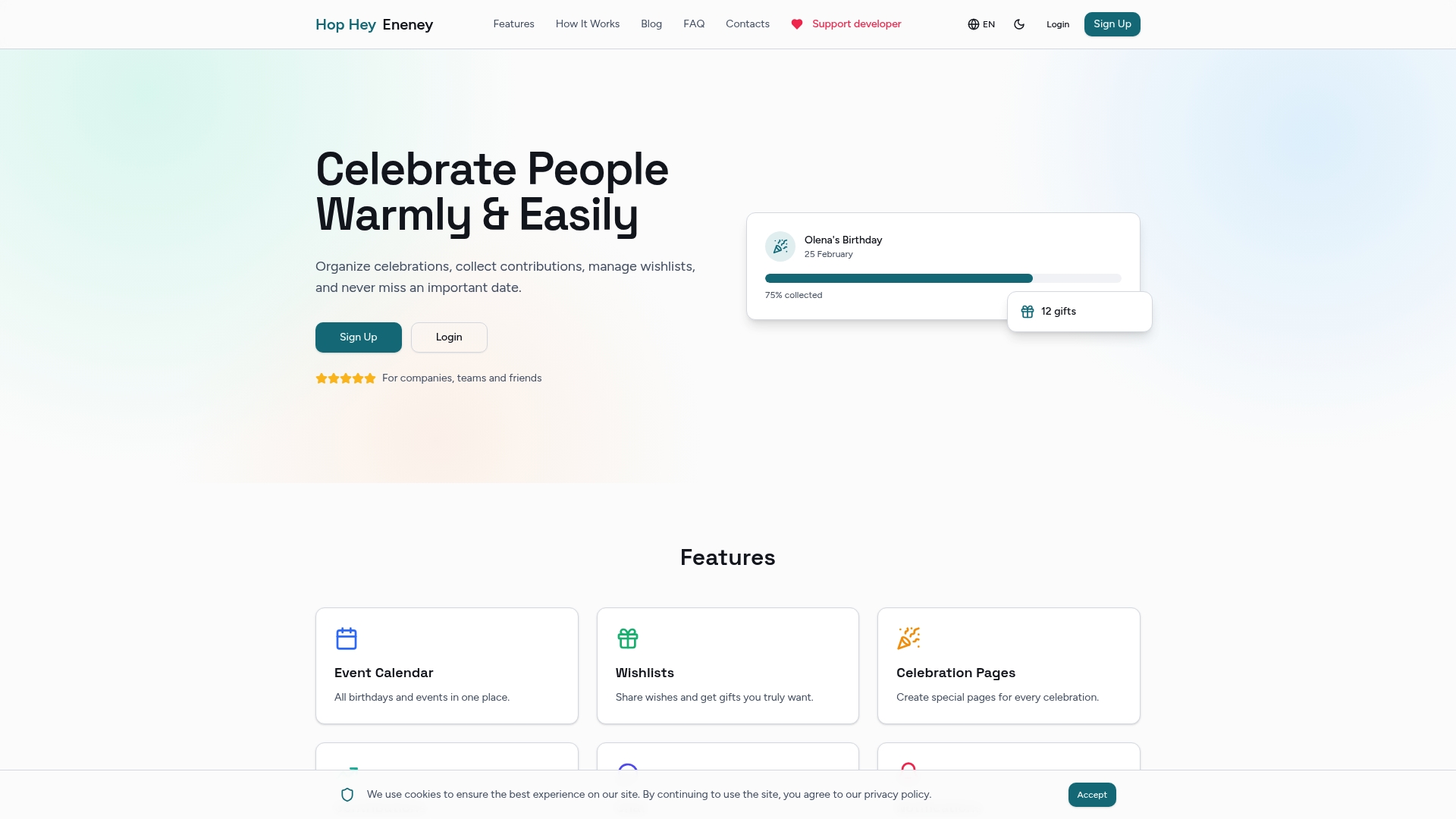
With Hophey, you can organize group celebrations and gift contributions in one place, track who has contributed, and keep everything coordinated without the chaos of group chats and forgotten follow-ups. The platform supports shared wishlists, event reminders, and multi-currency contributions, so whether you are managing holiday gifting for a team of five or a family of fifty, everything stays organized and on track. Visit Hophey to see how much simpler your holiday season can be.
FAQ
Who should be on my christmas card list?
Include family, close friends, neighbors, coworkers, and anyone you want to stay connected with. Teachers, service providers, and babysitters are often overlooked but make great additions.
How do I organize a christmas card list efficiently?
Group recipients into categories like family, friends, and work contacts, then track sent and received status each year using either a printable template or a spreadsheet.
How many cards should I send?
There is no fixed number. Send as many as you can personalize with at least a short note. Quality of connection matters more than volume.
Should I use a print or digital christmas card list?
Use print for small lists under 30 names and digital for larger or multi-year lists. A hybrid approach, digital master list plus printed working copy, works well for most families.
How do I keep my christmas mailing list accurate?
Review and update addresses once a year, ideally in October. When cards come back undelivered, update records immediately and verify current addresses with a quick message.